Artificial intelligence has moved from being an emerging technology to becoming an important part of the modern digital economy. Businesses, educational institutions, healthcare organizations, creative professionals, developers, and individuals are increasingly using AI-powered tools to solve problems, automate repetitive activities, analyze information, and create new experiences. 🌍💡
This growing ecosystem can be described as AI services: digital products and solutions that use artificial intelligence to perform, support, or enhance tasks for users and organizations.
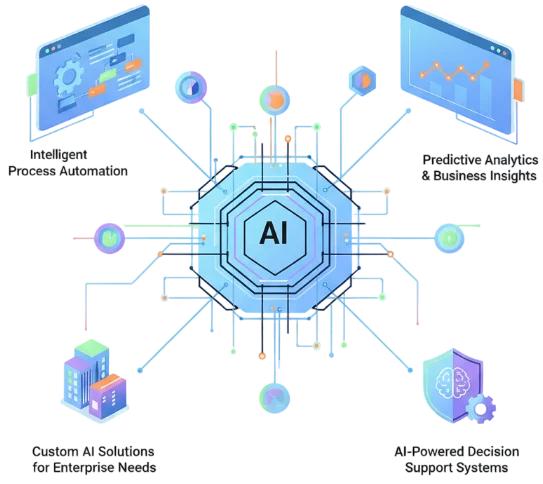
AI services can take many forms. They may include intelligent chatbots, virtual assistants, recommendation engines, predictive analytics platforms, content-generation tools, image and video systems, speech recognition applications, translation services, cybersecurity solutions, automation platforms, and AI-powered business software.
The appeal is straightforward. AI can process large amounts of information quickly, identify patterns, generate useful outputs, and assist people with tasks that would otherwise require considerable time.
However, effective AI adoption is about much more than simply choosing the newest tool. Organizations need to understand what problem they are solving, how the technology works, what information it requires, how accurate its results are, and what safeguards are necessary.
AI services are becoming increasingly accessible. In the past, developing sophisticated AI applications often required specialized research teams and expensive computing infrastructure. Today, businesses can access many AI capabilities through cloud platforms, software applications, APIs, and ready-to-use services.
This accessibility is changing the technology landscape.
Small businesses can experiment with automation. Students can use AI for learning support. Entrepreneurs can develop prototypes faster. Customer-service teams can handle routine questions more efficiently. Developers can integrate intelligent features into applications without building every model from scratch.
The future of AI services will likely involve deeper integration into everyday workflows.
Instead of opening a separate AI application, people may increasingly encounter AI capabilities directly inside the tools they already use.
This article explores the world of AI services, their major applications, benefits, challenges, and future potential. 🤖✨
Understanding What AI Services Really Are 🧠💻
AI services are technology solutions that use artificial intelligence to perform specific functions or provide intelligent assistance.
Traditional software generally follows predefined instructions. AI-powered software can often analyze data, recognize patterns, make predictions, generate content, or adapt its output based on input.
This distinction makes AI services particularly useful for complex or information-heavy tasks.
A customer-service AI system, for example, can interpret a customer’s question and provide a response based on available information. A document-analysis system can identify important details in large collections of files. A recommendation engine can analyze previous behavior and suggest potentially relevant products or content.
AI services can be divided into several broad categories.
Generative AI services create new content such as text, images, audio, video, or software code.
Predictive AI services analyze historical information to estimate future outcomes.
Conversational AI services allow users to communicate with software through natural language.
Computer vision services analyze images and video.
Speech and language services convert speech to text, translate languages, classify text, or generate spoken responses.
Automation services combine AI with workflows to reduce repetitive manual activities.
Recommendation services suggest products, content, actions, or information based on user behavior and other signals.
These categories often overlap.
A modern business platform may combine conversational AI, document analysis, predictive analytics, and workflow automation within one product.
The most important point is that AI services are not a single technology. They are a broad ecosystem of applications built around machine learning, language models, computer vision, data processing, automation, and related technologies. ⚙️
The Growth of AI as a Service ☁️🚀
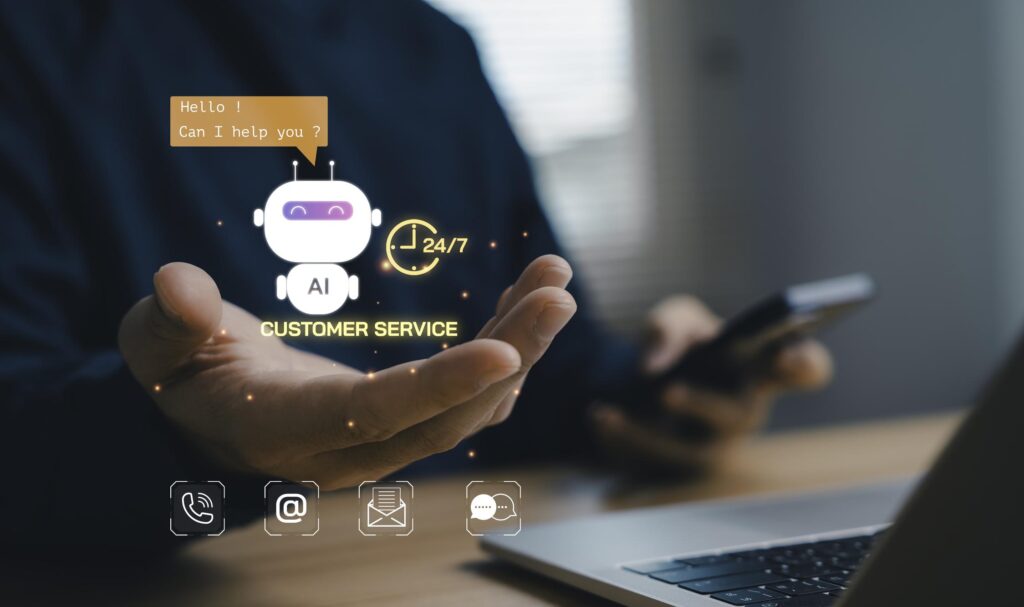
One of the biggest developments in artificial intelligence has been the rise of cloud-based AI services.
Previously, organizations interested in AI often needed to purchase specialized hardware and build substantial technical infrastructure.
Cloud computing changed that model.
Organizations can now access computing resources, machine-learning tools, model APIs, storage systems, and development platforms through internet-based services.
This has lowered the barrier to experimentation.
A startup with a small technical team can integrate AI capabilities into a product without owning a large data center.
A marketing company can experiment with generative tools without developing its own language model.
A retailer can explore predictive analytics using cloud-based infrastructure.
A software developer can connect an application to an AI API and begin testing intelligent features relatively quickly.
This model is often described as AI as a Service, or AIaaS.
AIaaS allows organizations to consume artificial intelligence capabilities as needed.
Instead of building every component internally, companies can combine external AI services with their existing software and data.
This approach can reduce development time, although it also introduces dependencies on external providers.
Organizations need to evaluate issues such as pricing, performance, data handling, availability, security, integration requirements, and long-term vendor strategy.
Even so, cloud-based AI has significantly expanded access to advanced technology.
It has helped turn AI from a specialized research capability into a practical business tool. ☁️🤖
AI Services for Customer Support 💬🤝
Customer service is one of the most visible applications of AI.
Businesses receive large numbers of questions every day. Many of these questions are repetitive, such as requests for business hours, shipping information, account instructions, product details, or basic troubleshooting.
AI-powered customer-service systems can help answer routine questions.
Conversational AI can understand natural-language requests and provide responses based on company information.
A well-designed system can operate around the clock, helping customers outside traditional working hours.
AI can also assist human support representatives.
Instead of replacing the entire customer-service process, AI can summarize conversations, recommend responses, retrieve relevant documentation, classify requests, and identify important information.
This allows employees to spend more time on complex issues requiring human judgment.
For example, a customer may contact a company with a complicated problem involving billing and technical support. An AI system could summarize the customer’s history and identify relevant policies before the case reaches a human representative.
This can improve efficiency.
However, customer-service AI should have clear escalation mechanisms.
Customers should be able to reach a human when an automated system cannot solve the problem.
Poorly designed chatbots can frustrate users if they repeatedly provide irrelevant answers or make it difficult to contact a person.
The best AI service experience combines automation with human support rather than forcing every customer into an automated pathway. 😊
AI Services for Business Automation ⚙️📈
Businesses perform many repetitive activities that require time but not necessarily complex human judgment.
AI services can help automate parts of these workflows.
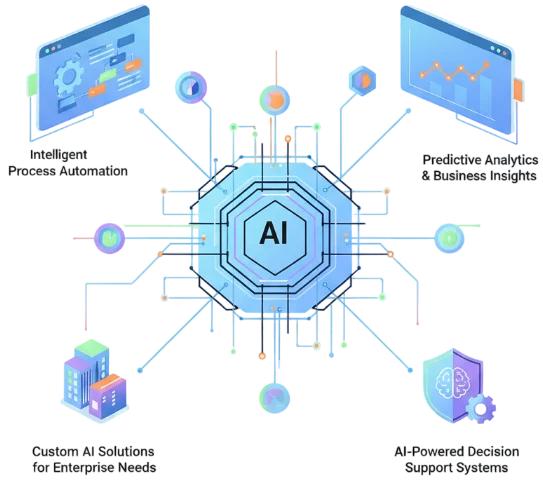
Examples include processing documents, organizing incoming emails, extracting information from invoices, categorizing customer requests, summarizing meetings, generating reports, and updating databases.
Workflow automation becomes especially powerful when AI is connected to other software systems.
Imagine an organization receiving hundreds of documents by email.
An AI service could identify the document type, extract key fields, classify the information, and send the structured data into an internal system.
Another workflow could analyze customer feedback and automatically categorize comments by topic.
Meeting recordings could be transcribed and summarized, with important action items extracted for employees.
These capabilities can reduce manual data entry and help employees focus on higher-value work.
However, automation should be designed carefully.
Not every process should be fully automated.
If an error could cause significant financial, legal, or operational consequences, human review may be appropriate.
A practical approach is to automate low-risk repetitive tasks first, measure the results, and gradually expand automation where performance is reliable.
AI automation is therefore most effective when it is connected to clearly defined business processes. 🔄💡
AI Services for Marketing and Content Creation ✍️📣
Marketing has been strongly influenced by generative AI.
AI services can help marketers brainstorm campaign ideas, draft content, analyze audience feedback, create variations of advertising copy, summarize research, and organize large amounts of information.
Content creators can use AI to explore topics, generate outlines, edit drafts, or develop creative concepts.
Visual AI tools can assist with image generation, design experimentation, and creative ideation.
Video and audio technologies can also support production workflows.
However, AI-generated content should not automatically be published without review.
AI systems can produce inaccurate information, repetitive language, or content that does not reflect a brand’s identity.
Human creativity and editorial judgment remain important.
Marketing teams should establish clear guidelines for AI-generated material.
Questions about accuracy, originality, privacy, copyright, brand voice, and disclosure may need to be addressed depending on the application.
The most productive model may be collaborative.
A marketer provides strategic direction and audience knowledge. AI generates possibilities. The marketer reviews, improves, verifies, and adapts the final result.
This can make creative processes faster without removing human responsibility.
AI therefore becomes a creative assistant rather than a complete replacement for professional expertise. 🎨🤖
AI Services for Data Analysis 📊🧠
Modern organizations generate enormous quantities of data.
Sales transactions, customer interactions, website activity, operational records, financial information, and social-media engagement can all produce useful signals.
The challenge is turning this data into actionable information.
AI services can help identify patterns, classify information, detect anomalies, and generate predictions.
For example, a retailer may analyze historical sales data to estimate future demand.
A financial organization may use machine-learning systems to identify unusual transaction patterns.
A manufacturer may analyze sensor data to identify signs of equipment problems.
A marketing team may examine customer behavior to understand which campaigns are performing best.
AI-powered analytics can process information at a scale that would be difficult to manage manually.
However, data quality is critical.
An AI system trained on incomplete, inaccurate, or biased information may produce unreliable results.
Organizations should therefore invest in data governance alongside AI adoption.
This includes understanding where data comes from, how it is stored, who can access it, and how its quality is evaluated.
AI does not magically transform poor data into perfect insights.
Strong AI services depend on strong data foundations. 📈✨
AI Services in Healthcare 🏥❤️
Healthcare organizations are increasingly exploring AI for a variety of applications.
AI services can help analyze medical information, support administrative workflows, assist research, and provide tools for patient engagement.
Medical imaging is one important area of research. AI systems can be trained to identify patterns in images that may be relevant to clinical analysis.
Natural-language processing can also help organize medical documents and extract information from large collections of text.
Administrative AI services can support scheduling, documentation, transcription, and information management.
Research organizations may use machine learning to analyze datasets and identify potential relationships.
Healthcare AI requires particularly strong safeguards because medical information is sensitive and errors can have serious consequences.
AI systems should be appropriately validated and used within suitable professional workflows.
A useful model is human-AI collaboration.
AI can highlight information or provide recommendations, while qualified healthcare professionals remain responsible for clinical decisions.
The goal is to improve efficiency and information access without removing the human expertise required for safe care.
As healthcare AI evolves, responsible development will remain essential. 🩺🔬

AI Services in Education 🎓📚
Education can benefit from AI services in many ways.
AI tutors can provide explanations and practice exercises.
Language-learning systems can support conversation practice.
Writing tools can provide feedback on grammar and structure.
Educators can use AI to develop lesson ideas, create draft quizzes, organize educational resources, and summarize materials.
Students can use AI to explore difficult concepts from different perspectives.
However, AI should support learning rather than replace it.
If students simply ask AI to complete assignments, they may miss opportunities to develop critical thinking and problem-solving skills.
Educational institutions therefore need clear policies around responsible AI use.
Students should learn how to verify information, recognize AI limitations, protect privacy, and distinguish assistance from academic misconduct.
Teachers also need professional development to understand how AI affects assessment and classroom practices.
The future classroom may involve AI as an additional educational resource alongside teachers, textbooks, laboratories, discussions, and collaborative activities.
Human educators remain essential because learning involves motivation, relationships, mentorship, creativity, and social development. 👩🏫💡
AI Services for Developers and Software Engineering 👨💻🚀
Software development has become another major area for AI services.
AI coding assistants can help developers generate code suggestions, explain unfamiliar code, identify potential problems, write tests, and produce documentation.
This can accelerate certain stages of development.
Developers can also use AI services for debugging and code analysis.
However, generated code must be reviewed carefully.
AI can produce code that appears correct but contains logical errors, security vulnerabilities, outdated approaches, or unnecessary complexity.
Professional developers therefore remain responsible for understanding and testing the software they create.
AI services can also help with application development more broadly.
Developers can integrate language models, speech recognition, image analysis, recommendation engines, or predictive models through APIs.
This allows intelligent capabilities to become components of ordinary software products.
As AI development tools improve, programming may increasingly involve describing desired behavior and reviewing generated implementations rather than manually writing every line.
This does not eliminate software engineering.
Instead, it may shift some emphasis toward architecture, testing, security, system design, product thinking, and quality assurance. 💻✨
AI Services and Cybersecurity 🛡️🔐
Cybersecurity is a complex environment in which organizations must analyze enormous quantities of information.
AI can help identify unusual patterns in network traffic, user behavior, system logs, and other data.
Security teams may use AI to prioritize alerts, classify potential threats, summarize incidents, and identify suspicious activity.
Automation can also reduce response times for certain routine security tasks.
However, AI creates both opportunities and risks.
Attackers can also use AI to improve social engineering, automate certain malicious activities, or create more convincing deceptive content.
Organizations therefore need security strategies that account for AI-related threats.
AI systems themselves must also be protected.
Access controls, data security, monitoring, testing, and appropriate governance are essential.
AI should be considered part of the cybersecurity environment rather than a universal solution to security problems.
Human security professionals remain important because interpreting threats requires context and strategic judgment. 🔒🤖
AI Services for Small Businesses 🏪💡
Large corporations are not the only organizations that can benefit from AI.
Small businesses may find AI particularly useful because they often operate with limited staff and resources.
A small company could use AI to assist with customer inquiries, marketing content, document processing, data analysis, appointment scheduling, or internal knowledge management.
An entrepreneur could use AI to research markets, brainstorm product ideas, draft business documents, or automate routine administrative work.
However, small businesses should avoid adopting too many tools at once.
A better approach is to identify one or two repetitive problems and test whether AI can provide measurable value.
For example, if employees spend several hours every week summarizing customer messages, an AI workflow might reduce that workload.
The company can then evaluate whether the system saves time without reducing quality.
This experimental approach limits risk while allowing employees to gain experience.
AI adoption does not have to begin with a massive technology transformation.
Small improvements can accumulate into meaningful productivity gains. 📈🌟
AI Services and Personal Productivity ⏰🤖
Individuals can also use AI services to improve productivity.
AI assistants can help organize information, brainstorm ideas, summarize documents, draft messages, create study materials, and support planning.
For students, AI can help explain difficult concepts and create practice questions.
For professionals, it can assist with meeting summaries, research, writing, and organization.
For creative workers, AI can provide brainstorming and ideation support.
The key is to use AI intentionally.
If a task requires personal judgment or sensitive information, users should think carefully before sharing data with an AI service.
AI-generated information should also be verified when accuracy matters.
Personal productivity is not about delegating every task to an algorithm.
It is about using technology to reduce unnecessary effort while keeping humans in control of important decisions.
The best AI assistant should make people more capable, not more dependent. 🧠✨
The Importance of Data Privacy 🔐📊
AI services often depend on data, making privacy a central issue.
Users and organizations should understand what information an AI service collects and how that information may be processed.
Sensitive personal, financial, medical, confidential business, or proprietary information should be handled carefully.
Organizations should establish policies governing which information employees can submit to external AI systems.
Access controls should also be implemented so that employees only have access to information necessary for their roles.
Data retention policies matter as well.
Companies should understand how long information is stored and what options exist for managing it.
Privacy is not merely a technical issue.
It is also a matter of trust.
Customers and employees need confidence that their information will be handled responsibly.
AI adoption that ignores privacy can create significant reputational and operational risks.
Responsible AI services therefore require privacy-conscious design from the beginning. 🛡️
Challenges of AI Services ⚠️🧩
Despite their benefits, AI services have limitations.
Accuracy is one of the biggest concerns.
AI systems can produce incorrect information, sometimes with convincing confidence.
This means users should verify important outputs.
Bias is another issue.
AI models learn from data, and data can contain biases. Poorly designed systems may therefore produce unfair results.
Cost can also become a consideration.
Although many AI services are accessible, large-scale usage can become expensive depending on computational requirements, data volume, and service pricing.
Integration can be challenging as well.
Organizations may need to connect AI systems with existing software, databases, workflows, and security infrastructure.
Employee adoption is another factor.
People may resist new technologies if they do not understand how AI affects their roles.
Training and communication can help employees understand how AI is intended to support their work.
Finally, organizations need clear accountability.
Someone must remain responsible for decisions involving AI.
Technology should not become an excuse for avoiding responsibility.
Responsible AI Adoption 🌱🤝
A responsible AI strategy begins with a clear purpose.
Organizations should identify the problem before selecting the technology.
They should evaluate whether AI is actually the appropriate solution.
Next, organizations should consider risk.
Low-risk applications such as brainstorming may require different controls from high-impact applications involving sensitive information or important decisions.
Human oversight should be included where appropriate.
Employees should understand when AI outputs need verification.
Organizations should also monitor performance after deployment.
AI systems can behave differently as data, user behavior, and business conditions change.
Regular evaluation helps identify problems before they become significant.
Transparency is valuable too.
Users should understand when they are interacting with AI and, where appropriate, what role the technology plays in a decision.
Responsible AI is ultimately about balancing innovation with accountability.
The objective is not to avoid AI.
It is to use AI in ways that create meaningful value while reducing unnecessary risk. 🌍💚
The Future of AI Services 🚀🔮
The AI services market is likely to continue evolving rapidly.
One major trend is the development of increasingly capable AI agents.
Instead of simply responding to individual prompts, future systems may be able to complete multi-step workflows, interact with software applications, retrieve information, and coordinate tasks.
Another trend is multimodal AI.
Systems may increasingly combine text, images, audio, video, and other data types.
This could make AI interactions more natural.
AI services may also become more specialized.
Rather than relying exclusively on general-purpose systems, organizations may use domain-specific models optimized for particular industries.
On-device AI is another important possibility.
As computing hardware becomes more capable, some AI functions may run directly on smartphones, computers, vehicles, industrial devices, or other hardware.
This could improve responsiveness and potentially reduce dependence on constant cloud connectivity.
AI services may also become more deeply integrated into existing software.
Instead of thinking about “using AI” as a separate activity, users may simply interact with applications that have intelligent features built into them.
The result could be a future where AI becomes an invisible layer of digital infrastructure.
How to Prepare for an AI-Powered Future 🌟📚
Individuals and organizations can take several practical steps to prepare.
First, develop AI literacy.
Understand basic concepts, capabilities, limitations, privacy considerations, and responsible-use principles.
Second, experiment.
Small, low-risk experiments can help people understand where AI is genuinely useful.
Third, strengthen human skills.
Communication, creativity, critical thinking, collaboration, leadership, and domain expertise remain valuable.
Fourth, learn verification.
Do not assume that AI-generated content is automatically accurate.
Fifth, develop clear policies when using AI professionally.
Organizations should define acceptable uses, data-handling requirements, review procedures, and accountability.
Finally, remain adaptable.
AI technology is changing quickly. Tools that are popular today may be replaced by more capable systems tomorrow.
Transferable skills and good judgment are therefore more valuable than dependence on a single platform.
The future belongs not necessarily to people who know every AI tool, but to people who understand how to use intelligent technology effectively and responsibly. 🚀
Conclusion: Building a Smarter Future With AI Services 🤖🌍✨
AI services are transforming the relationship between people, software, data, and automation.
From customer support and business operations to education, healthcare, cybersecurity, marketing, software development, and personal productivity, artificial intelligence is becoming a practical component of modern digital life.
Its greatest value comes from solving meaningful problems.
AI can reduce repetitive work, help people analyze information, accelerate creative processes, support decision-making, and enable new digital experiences.
But effective AI adoption requires more than enthusiasm.
Organizations and individuals need to consider accuracy, privacy, security, bias, cost, integration, and human oversight.
AI should support human intelligence rather than eliminate human responsibility.
The future of AI services will likely be increasingly collaborative.
People will work alongside intelligent systems, using automation for repetitive activities while applying human judgment to strategy, creativity, relationships, and important decisions.
This transformation will create both opportunities and challenges.
Businesses that learn how to integrate AI thoughtfully may improve productivity and develop new products and services.
Workers who develop AI literacy may discover new ways to enhance their skills.
Students can use AI as a learning companion while continuing to develop independent thinking.
Consumers can benefit from more personalized and responsive digital experiences.
The most successful approach is neither blind optimism nor unnecessary fear.
It is informed experimentation.
Learn what AI can do.
Understand what it cannot do.
Test it carefully.
Protect important information.
Verify critical results.
Keep humans involved where judgment matters.
And continuously adapt as the technology evolves. 🌱
AI services are still developing, and the next generation may be far more integrated, capable, personalized, and specialized than today’s systems.
The opportunity is enormous—but so is the responsibility.
The future of AI is not simply about smarter machines. It is about creating smarter ways for humans and technology to work together. 🤖🤝🧠
As organizations and individuals enter this new era, the guiding principle should be simple: