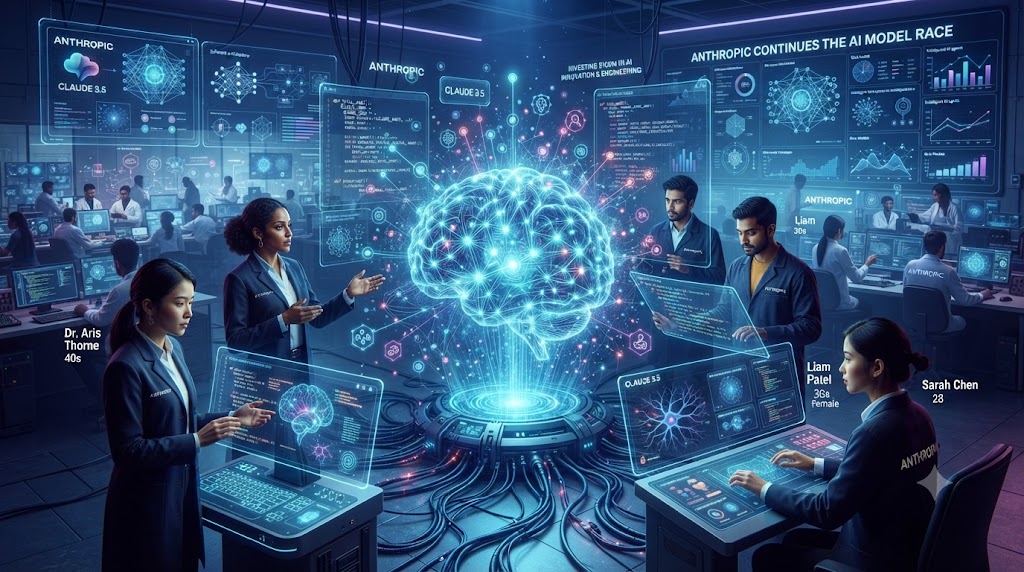
Anthropic is pushing deeper into the global artificial intelligence race with a new generation of Claude models and a major investment in AI engineering talent. In September 2026, the company introduced Claude Opus 5.5 and Claude Sonnet 5.5, while on October 2 it announced a $100 million initiative to train 10,000 engineers and address what it describes as an enterprise AI talent gap. (Anthropic)
These developments show that the AI competition is entering a new phase. The race is no longer simply about building a smarter chatbot. Companies are competing across reasoning, coding, AI agents, enterprise software, infrastructure, safety, developer ecosystems and human talent.


🚀 Anthropic’s New Strategy Is Bigger Than a Model Launch
For years, the AI industry was dominated by a relatively simple question: Which company has the most capable model?
That question is becoming much more complicated.
A modern AI system needs to do more than generate fluent text. It may need to understand large codebases, reason through complicated problems, operate computer tools, analyze documents, work with images, manage long-running tasks and interact with other software.
Anthropic’s latest strategy reflects this transformation.
With Claude Opus 5.5, the company is targeting demanding, long-running agentic coding and knowledge work. With Claude Sonnet 5.5, it is targeting a faster and lower-cost model for everyday professional tasks. Anthropic says Sonnet 5.5 is more than 30% faster than Sonnet 5 and can cost up to 30% less for most work. (Anthropic)
At the same time, the company’s $100 million engineering-training initiative demonstrates that Anthropic believes the future of AI depends not only on models but also on people capable of implementing them.
🧠 Claude Opus 5.5: Designed for Complex AI Work
Anthropic introduced Claude Opus 5.5 on September 22, 2026, describing it as the first model in its Claude 5.5 family.
The company says Opus 5.5 reaches the level of its Fable 5.1 model on most work while costing about 40% less to run than Opus 5 on typical workloads. Anthropic positions it as its strongest Opus model for long-running agents, coding and professional work. (Anthropic)
The model has a 1-million-token context window and supports outputs of up to 128,000 tokens. Anthropic’s platform documentation lists pricing at $4 per million input tokens and $20 per million output tokens. (Claude Platform)
That combination matters because AI companies are increasingly trying to move from short conversations toward extended workflows.
Imagine a software engineer giving an AI agent a large application and asking it to:
- Understand the architecture.
- Find a performance problem.
- Investigate the relevant modules.
- Modify the code.
- Run tests.
- Review the results.
- Correct failures.
- Prepare a final change for human approval.
This is dramatically different from asking a chatbot to write a 20-line function.
The AI becomes a working collaborator.
⚡ Claude Sonnet 5.5: Faster AI for Everyday Work
Anthropic introduced Claude Sonnet 5.5 on September 28, 2026, describing it as a faster and lower-cost complement to Opus 5.5. (Claude Help Center)
Sonnet is designed for tasks where organizations need a balance between intelligence, speed and cost.
Anthropic highlights several areas where Sonnet 5.5 is particularly useful:
- Software debugging 💻
- Everyday knowledge work 🧠
- Document creation 📄
- Presentation creation 📊
- Spreadsheet work 📈
- Image understanding 👁️
- Long-running tasks
- Agentic coding 🤖
The model also has a 1-million-token context window and 128,000-token maximum output. Anthropic lists API pricing at $2 per million input tokens and $10 per million output tokens. (Claude Platform)
This creates an interesting division between Anthropic’s models.
Opus 5.5 is aimed at particularly difficult, open-ended work where deeper reasoning and sustained judgment matter.
Sonnet 5.5 is positioned as the more economical choice for high-volume professional workloads.
That strategy could become important as companies move from experimenting with AI to deploying it across thousands of employees.
💻 Coding Is Becoming One of the Biggest AI Battlegrounds
Software development has emerged as one of the most important areas of competition between advanced AI models.
Anthropic says Sonnet 5.5 scored 70.6% on Terminal-Bench 4.0, compared with 10.3% for Sonnet 5 in its published comparison. It also reports strong results on other agentic coding and knowledge-work evaluations. (Anthropic)
Why does coding matter so much?
Because software engineering provides an unusually measurable environment for evaluating AI.
An AI can be asked to modify a program and then its work can be tested.
Did the code compile?
Did the tests pass?
Did the application work?
Did the AI introduce new bugs?
Can it navigate thousands or millions of lines of existing code?
These questions make software development an important laboratory for measuring increasingly autonomous AI.
🤖 The Rise of the AI Software Engineer
The traditional software-development process involved humans performing nearly every step.
A developer would read requirements, design a solution, write code, test it, debug it and deploy it.
AI agents are beginning to change that workflow.
Anthropic’s own research describes a shift in which humans increasingly make planning decisions while Claude performs more of the execution. Its research on roughly 400,000 Claude Code sessions found that people generally determine what should be done, while Claude increasingly determines how to execute the task. (Anthropic)
This distinction could become extremely important.
The future software engineer may spend less time manually typing code and more time deciding:
What should we build?
Why should we build it?
What constraints matter?
How should the system be designed?
How do we verify that the AI’s implementation is correct?
In other words, programming may increasingly become a combination of architecture, supervision, verification and AI orchestration.
🔄 From Chatbots to Autonomous AI Agents
The biggest technological shift behind the latest Claude models is arguably the transition from conversational AI to agentic AI.
A chatbot waits for a prompt and produces a response.
An AI agent can potentially take a goal and perform multiple actions to achieve it.
For example, instead of asking:
“How can I analyze this sales dataset?”
a business might tell an AI agent:
“Analyze the last three years of sales, identify unusual trends, create charts, compare regional performance and prepare a presentation for tomorrow’s meeting.”
An agent could potentially break the task into multiple stages.
📂 Find the data.
📊 Analyze it.
🔍 Identify patterns.
📈 Create visualizations.
📝 Write the report.
🎤 Prepare presentation slides.
🔎 Check the conclusions.
This is why context windows, tool use, reasoning and long-running execution are becoming so important.
🏢 Why Enterprise AI Is the Next Battlefield
Consumer AI attracts enormous attention, but enterprise AI could generate much of the industry’s long-term economic value.
Companies have thousands of repetitive workflows.
Employees spend time reading documents, answering emails, preparing reports, analyzing spreadsheets, writing software, handling customer requests and searching internal information.
AI could potentially automate or accelerate many of these tasks.
But businesses have different requirements from consumers.
They need:
🔐 Security
📋 Governance
🎯 Reliability
🧾 Auditability
👥 Access controls
💰 Predictable costs
⚙️ Integration with existing systems
Anthropic’s focus on enterprise AI therefore goes beyond simply producing impressive benchmark results.
The real question becomes:
Can companies safely deploy Claude throughout their organization?
💰 The $100 Million Investment in 10,000 Engineers
Perhaps the most interesting part of Anthropic’s recent strategy is its investment in human talent.
Anthropic announced on October 2 that it is investing $100 million to train 10,000 engineers, with the goal of addressing the enterprise AI talent gap. (Anthropic)
This announcement highlights an important reality about AI adoption.
Having access to a powerful model does not automatically mean a company knows how to use it effectively.
Organizations need people who understand how to:
- Build AI applications
- Deploy AI agents
- Connect models to business systems
- Evaluate model performance
- Protect sensitive data
- Design reliable workflows
- Monitor AI behavior
- Build security controls
- Manage AI projects
The shortage of these skills could become a major bottleneck.
👨💻 Why AI Engineers Are Becoming More Important
The AI industry sometimes creates the impression that better models will eliminate the need for technical workers.
The reality may be more complicated.
As models become more capable, organizations can potentially build more sophisticated AI systems. But someone still needs to determine what those systems should do and how they should be integrated.
Anthropic’s own research on its workplace found that AI is changing engineering roles rather than simply eliminating engineering work. The company reported that its engineers were using Claude for debugging, understanding codebases, implementing features and learning new areas of technology. (Anthropic)
Anthropic has also reported that more than 80% of the code merged into its codebase was authored by Claude as of May 2026, while engineers increasingly direct and review the resulting work. (Anthropic)
That suggests an important transition:
AI may reduce the amount of manual implementation while increasing the importance of technical judgment.
🎓 The New AI Skills Economy
The $100 million training initiative could therefore be viewed as part of a much larger trend.
The future workforce may require a new category of AI literacy.
A software engineer may need to understand AI agents.
A financial analyst may need to know how to supervise AI-generated analysis.
A marketing professional may use AI to research audiences and create campaigns.
A scientist may use AI to analyze experimental data.
A cybersecurity specialist may use AI to investigate vulnerabilities.
A healthcare organization may use AI for administrative and research workflows.
The common skill is no longer simply knowing how to use a chatbot.
It is knowing how to work with AI as a system.
🛡️ AI Safety Remains Central
The rapid increase in AI capabilities also creates significant safety questions.
More autonomous systems can potentially do more useful work—but they can also make mistakes at greater scale.
Anthropic says Opus 5.5 was externally evaluated before release, including by organizations such as Frontier Design and METR. The company also says the model includes safeguards developed for its most capable systems. (Anthropic)
This is particularly important for agentic systems.
A chatbot producing an incorrect answer is one problem.
An autonomous agent incorrectly changing production software, sending an inappropriate email, modifying financial information or accessing sensitive data could create much larger consequences.
Therefore, as AI becomes more autonomous, verification and permission systems become increasingly important.
🔐 The Human-in-the-Loop Problem
One of the biggest questions surrounding AI agents is:
How much independence should we give them?
There is no simple answer.
For low-risk tasks, an AI might be allowed to operate relatively independently.
For high-risk tasks, humans may need to approve important decisions.
This could create different levels of AI autonomy.
🟢 Low Risk
AI summarizes documents, organizes notes or drafts emails.
🟡 Medium Risk
AI modifies software, analyzes business data or creates reports.
🔴 High Risk
AI makes decisions involving money, safety, medical treatment, legal consequences or critical infrastructure.
As AI agents become stronger, organizations will need systems that determine what agents can do without approval.
This makes AI governance a core engineering challenge.
📊 Claude vs. the Broader AI Competition
Anthropic is not operating in isolation.
The company faces intense competition from major AI developers including OpenAI and Google, alongside rapidly developing open-weight models.
Google recently introduced its Gemini 4-era flagship strategy, while OpenAI continues developing frontier models and agentic capabilities. (Reuters)
The competitive landscape is therefore becoming increasingly diverse.
Different companies may win in different categories.
One model might excel at coding.
Another could be stronger in multimodal reasoning.
Another might offer lower inference costs.
Another could have better enterprise integrations.
An open model might provide organizations with more control.
This means the future may not belong to a single AI company.
⚙️ Cost Efficiency Is Becoming as Important as Intelligence
There is another major change happening in the AI model race.
Early AI competition emphasized capability.
Now companies are increasingly focused on capability per dollar.
A model that is slightly better but dramatically more expensive may not always be the best choice for businesses.
Anthropic’s positioning of Sonnet 5.5 and Opus 5.5 reflects this trend.
The company says Opus 5.5 costs around 40% less to run than Opus 5 for typical workloads, while Sonnet 5.5 is positioned as a faster, lower-cost option. (Anthropic)
For enterprise customers running millions of AI requests, small changes in token costs can become enormous financial differences.
🌐 AI Infrastructure Is Expanding
Behind every advanced AI model is a huge infrastructure ecosystem.
AI requires:
⚡ Electricity
🏢 Data centers
🖥️ GPUs and accelerators
🌐 High-speed networking
❄️ Cooling systems
💾 Storage
🔧 Specialized engineering
As models become more capable and agents run for longer periods, infrastructure requirements can grow.
The AI industry is therefore creating demand far beyond software.
It affects semiconductor manufacturing, data-center construction, networking, energy systems, cloud computing and engineering services.


🧪 AI Is Moving Into Scientific Research
Advanced AI models are also beginning to move beyond traditional office work.
Anthropic reported in September that Claude had helped discover a novel enzyme system involving CRISPR-like repeats. (Anthropic)
Such developments point toward an important possibility.
AI could eventually become a research collaborator.
Scientists could use AI to:
🔬 Search scientific literature
🧬 Analyze biological data
🧪 Generate hypotheses
💻 Write simulation code
📊 Analyze experimental results
🧠 Compare competing explanations
The long-term impact could be enormous if AI systems become capable of performing extended research workflows reliably.
🏥 Healthcare Could Become Another Major AI Market
Healthcare is another sector where advanced AI could become increasingly important.
AI systems can potentially assist with administrative tasks, medical research, literature analysis, documentation and data processing.
However, healthcare also demonstrates why human oversight matters.
An AI system operating in a medical environment must meet much higher standards of reliability than a system writing a casual social-media post.
This creates a central challenge:
How do we combine AI’s speed with human expertise and accountability?
The answer may be a collaborative model in which AI performs large amounts of analysis while qualified professionals remain responsible for important decisions.
🇮🇳 What Anthropic’s Expansion Could Mean for India
India is becoming an increasingly important market for enterprise AI.
Anthropic recently launched in-country inference for Claude through Amazon Bedrock in India, supporting local processing for organizations with data-residency and compliance requirements. Companies including Reliance, CRED, TCS and Kotak Bank have been reported among organizations exploring Claude-related applications. (Express Computer)
This is important because India has a huge technology workforce and a rapidly growing enterprise software market.
AI adoption could create demand for professionals with skills in:
- AI engineering
- Machine learning
- Cloud computing
- Data science
- Cybersecurity
- AI governance
- Automation
- Agent development
The AI talent race is therefore not limited to Silicon Valley.
It is becoming global.
👩💻 What Students Should Learn in the AI Era
The emergence of highly capable AI models does not mean students should stop learning programming or technical subjects.
Instead, the skills students develop may need to evolve.
A future-ready technology student should understand:
💻 Programming
Programming remains important because it teaches computational thinking and allows people to understand what AI-generated code is actually doing.
🧠 AI Fundamentals
Students should understand models, tokens, context windows, reasoning, embeddings, agents and evaluation.
🔐 Cybersecurity
As AI agents gain access to more systems, security becomes increasingly important.
📊 Data Analysis
AI can analyze data, but humans still need to understand whether the analysis makes sense.
🧩 Problem Solving
The ability to define a problem clearly may become more valuable as AI becomes better at implementing solutions.
🗣️ Communication
AI systems are powerful, but humans still need to explain goals, requirements and decisions.
🤯 Will AI Replace Engineers?
This is one of the most common questions surrounding the AI boom.
The answer is unlikely to be a simple yes or no.
AI can automate portions of engineering work. It can generate code, debug programs, write tests and analyze systems.
But engineering is not only code.
Engineering also involves understanding customers, constraints, risks, architecture, trade-offs and consequences.
Anthropic’s own AI-native engineering research argues that once AI handles more code generation, bottlenecks shift toward verification, code review and security. (Claude)
That is a crucial insight.
Automation may not eliminate engineering.
It may change what engineers spend their time doing.
🔮 The Future: AI Teams Working With Human Teams
The most interesting possibility is not humans versus AI.
It is humans plus AI teams.
Imagine a future software company where a small group of engineers supervises dozens of specialized AI agents.
One agent analyzes requirements.
Another writes code.
Another performs testing.
Another checks security.
Another reviews architecture.
Another prepares documentation.
Humans coordinate the overall system.
This could allow small teams to accomplish work that previously required much larger organizations.
Anthropic’s own work on AI-native engineering reflects this emerging organizational model. (Claude)
⚠️ The Risks of Moving Too Fast
The rapid pace of AI development also creates legitimate concerns.
More powerful models can potentially be misused.
More autonomous agents can make larger mistakes.
Companies may deploy systems before employees fully understand their limitations.
Workers may become overly dependent on AI.
Organizations could lose important technical expertise if humans stop understanding the systems they supervise.
And there is a broader societal question:
How quickly should advanced AI capabilities be deployed?
Anthropic itself has publicly discussed the importance of responsible development and frontier AI safeguards, showing that capability growth and safety are increasingly interconnected. (Anthropic)
🌍 The AI Race Is Becoming a Race for Ecosystems
The next stage of AI competition will probably not be determined by benchmark scores alone.
Companies need ecosystems.
That means:
Models + developers + infrastructure + applications + enterprise customers + talent + safety + distribution.
Anthropic’s latest strategy touches nearly every part of that equation.
Claude Opus 5.5 targets complex professional and agentic work.
Sonnet 5.5 targets speed and affordability.
Claude Code targets software development.
Enterprise partnerships bring AI into businesses.
And the $100 million training initiative targets the human expertise required to deploy AI effectively.
This is a much broader strategy than simply releasing another chatbot.
📈 What Comes Next for Claude?
Anthropic says Claude Haiku 5.5 is expected to join the Claude 5.5 family in the coming weeks, creating a broader model lineup spanning high-end reasoning, balanced performance and high-volume workloads. (Anthropic)
That three-tier strategy could make Claude more useful across different industries.
Businesses do not need the most expensive model for every task.
A company might use a smaller model for routine classification, Sonnet for everyday employee workflows and Opus for complex research or engineering.
This kind of model routing could help businesses control costs while still accessing powerful reasoning when necessary.
🚀 The Bigger Picture
Anthropic’s latest moves represent something bigger than a product update.
They show how quickly AI is evolving from a technology people talk to into a technology people work with.
Claude is increasingly positioned as a system that can help write software, analyze information, operate tools and perform long-running tasks.
At the same time, Anthropic’s investment in 10,000 engineers suggests that the company sees AI adoption as a human-capital challenge as much as a technological one.
The most powerful AI model in the world is not very useful to a company that does not know how to deploy it.
🧭 Conclusion: The Next AI Race Will Be About Intelligence and Execution
Anthropic’s Claude Opus 5.5 and Sonnet 5.5 demonstrate how rapidly frontier AI models are improving. Opus 5.5 is aimed at complex, long-running agentic work, while Sonnet 5.5 emphasizes the balance between intelligence, speed and cost. (Anthropic)
But the $100 million investment to train 10,000 engineers may ultimately be just as significant as the models themselves. (Anthropic)
The AI industry is entering an era where models are becoming increasingly capable of doing work rather than merely answering questions.
💻 They can write code.
🧠 They can reason through complex problems.
🤖 They can operate as agents.
📊 They can analyze professional information.
🔬 They can support scientific research.
🏢 They can become integrated into enterprise workflows.
Yet humans remain essential for defining objectives, evaluating results, managing risk and making important decisions.
The future of AI therefore may not belong simply to the company with the smartest model.
It may belong to the company that can combine advanced intelligence, affordable computing, talented engineers, reliable agents, strong safety systems and real-world adoption better than everyone else.
Anthropic’s latest Claude releases and its massive engineering-training initiative suggest that the company intends to compete on all of those fronts. And as OpenAI, Google and other AI developers continue advancing their own systems, the global AI race is likely to become even more intense. 🚀🤖
The chatbot era is evolving into the agent era—and Anthropic wants Claude to be one of the systems leading that transformation.