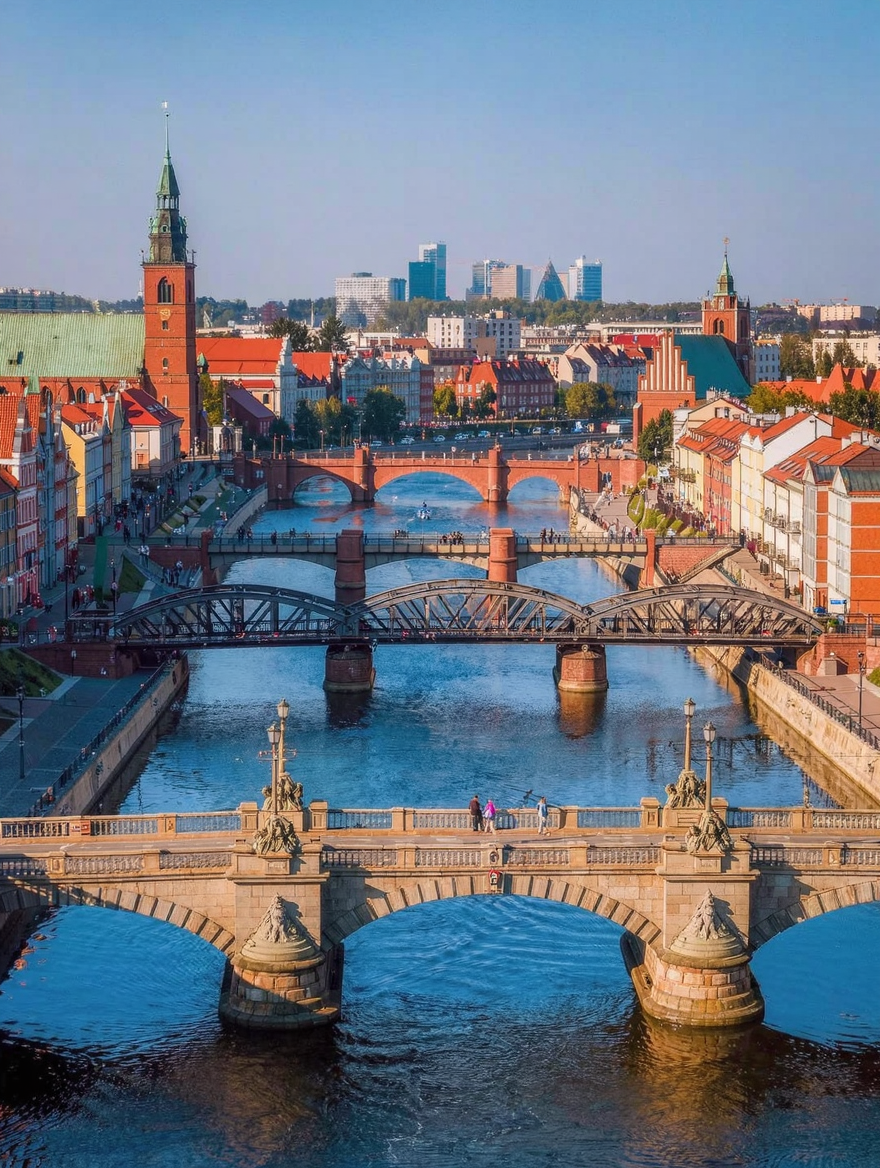
Wrocław is often lovingly referred to as the “city of a hundred bridges,” a nickname that reflects both its unique geography and its long, layered history. In reality, the city has more than 100 bridges and footbridges connecting its islands, canals, and riverbanks—making it one of the most bridge-dense cities in Europe.
A City Shaped by Water
Wrocław lies on the River Oder (Odra), which splits and branches into multiple channels as it flows through the city. Over time, this natural river system created a landscape of islands and waterways. To connect these fragmented parts of the city, bridges became essential rather than decorative.
As the city expanded, especially during the medieval period and later industrial growth, new bridges were continuously built. Today, Wrocław has over 120 bridges and footbridges, which is why the “hundred bridges” nickname stuck even though the actual number is higher.
Islands of the Oder River
One of the most fascinating aspects of Wrocław is that it is built on several river islands. Areas like Ostrów Tumski (Cathedral Island) are among the oldest parts of the city and require bridges for access. Each island adds to the need for crossings, creating a dense network of structures that shape daily life.
These islands are not just functional—they are also cultural and historical centers, filled with churches, parks, and old architecture. Bridges here are not just transport links but part of the city’s identity and charm.
Architecture and Engineering Across Centuries
The bridges of Wrocław vary widely in style, reflecting the city’s long and complex history. You’ll find Gothic stone bridges, 19th-century steel structures, and modern pedestrian walkways.
Some bridges were rebuilt after World War II, when much of the city was heavily damaged. Others were redesigned in modern times to support tourism and pedestrian-friendly movement. This mix of old and new gives Wrocław a distinctive architectural character.
More Than Just a Nickname
Calling Wrocław the “city of a hundred bridges” is not just poetic—it captures how the city functions and feels. Bridges are part of everyday life, whether you’re commuting, sightseeing, or simply walking along the riverbanks.
They also contribute to Wrocław’s romantic and scenic atmosphere, especially at night when many bridges are lit up and reflected in the water.
A Living Network of Connections
Unlike cities where bridges are occasional landmarks, Wrocław’s bridges form a continuous network that connects neighborhoods, islands, and cultural districts. This interconnected structure has shaped how the city grows and how people experience it.
In many ways, the bridges symbolize Wrocław itself: a place where different eras, cultures, and landscapes are permanently linked.