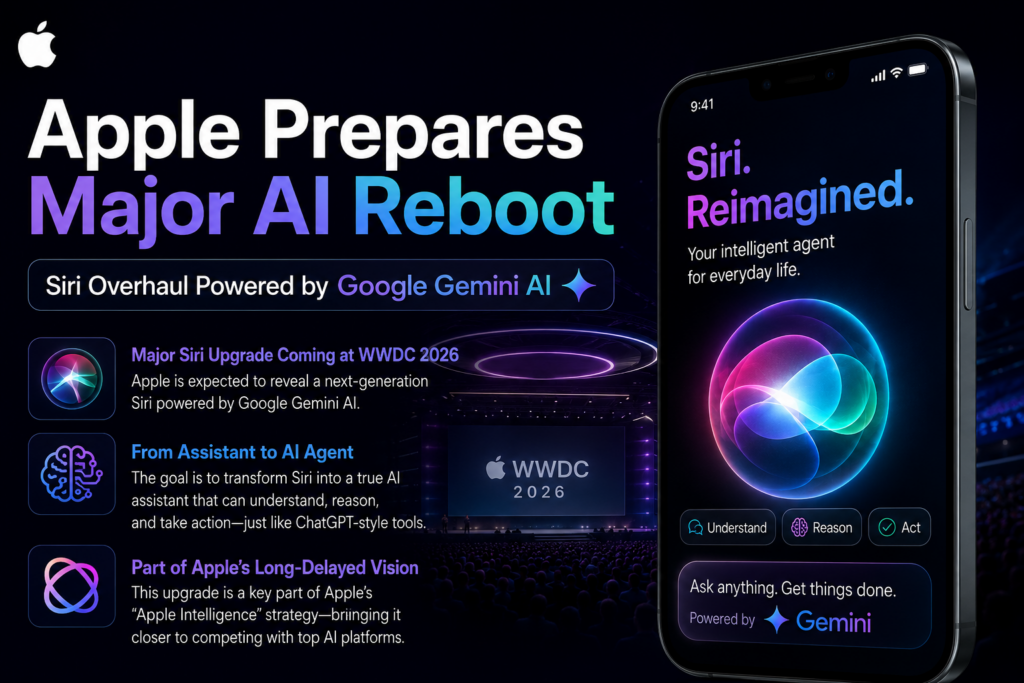
Apple appears ready to make one of its most significant artificial intelligence announcements in years. Industry reports suggest that the company is preparing a major overhaul of Siri, potentially powered by advanced AI technologies and deeper integrations with leading language models. Expected to be a centerpiece of WWDC 2026, this initiative represents a crucial step in Apple’s long-awaited AI strategy.
The move comes at a time when competitors are rapidly deploying powerful AI assistants capable of reasoning, generating content, and completing complex tasks. While Apple has traditionally prioritized privacy, device integration, and user experience, the company now faces growing pressure to deliver a truly intelligent assistant that can compete with modern AI platforms.
🤖 Why Apple Is Rebuilding Siri
For more than a decade, Siri has been one of the most recognizable voice assistants in the world. However, as AI technology evolved, competitors introduced assistants powered by large language models that offer significantly more advanced conversational abilities.
Users today expect AI systems to:
- Understand context across conversations
- Generate detailed responses
- Summarize information
- Assist with productivity tasks
- Execute multi-step actions
- Reason through complex requests
Traditional voice assistants were not designed for these capabilities. As a result, Apple is reportedly redesigning Siri from the ground up to support a more sophisticated AI architecture.
The Goal: A True AI Agent
Rather than acting as a simple voice command tool, the new Siri is expected to function as an AI agent capable of:
- Understanding natural language more accurately
- Managing workflows across applications
- Performing actions on behalf of users
- Learning contextual preferences
- Providing proactive assistance
This shift could transform Siri from a basic assistant into a digital companion capable of handling everyday tasks with far greater intelligence.
🚀 The Potential Role of Google Gemini
One of the most discussed aspects of Apple’s AI plans is the possibility of integrating Google’s Gemini AI technology.
Why Gemini Matters
Modern AI assistants require enormous computing resources and years of model development. Instead of building every capability internally, Apple may leverage external AI technologies while maintaining its own ecosystem and privacy standards.
Potential benefits include:
- More advanced reasoning capabilities
- Better conversational interactions
- Improved contextual understanding
- Faster deployment of AI features
- Access to frontier AI model performance
If implemented, this partnership could give Apple users access to cutting-edge AI functionality directly within iPhones, iPads, and Macs.
📱 Apple Intelligence Enters a New Phase
Apple introduced its broader AI vision under the “Apple Intelligence” brand. While the initial rollout focused on writing assistance, image generation, and productivity tools, many analysts viewed it as only the beginning of a much larger roadmap.
The upcoming Siri overhaul appears to represent the next major phase.
What Apple Intelligence Could Become
Future versions may include:
- Personalized AI experiences
- Cross-device contextual awareness
- Intelligent task automation
- Advanced content creation tools
- Enhanced productivity assistance
- Real-time knowledge retrieval
By embedding AI deeply into its ecosystem, Apple could create a seamless experience that competitors may struggle to replicate.
🧠 From Voice Assistant to Intelligent Agent
The biggest transformation may be Siri’s evolution into an intelligent agent.
Current Assistant Model
Traditional assistants typically:
- Respond to commands
- Set reminders
- Control smart home devices
- Provide basic information
Future Agent Model
AI agents are designed to:
- Understand goals rather than commands
- Plan multiple actions
- Complete workflows independently
- Interact across applications
- Adapt to user behavior
For example, instead of saying:
“Set a meeting reminder.”
Users may simply say:
“Schedule a meeting with Sarah next week and prepare the documents.”
A true AI agent could handle every step automatically.
🔒 Apple’s Privacy Challenge
One area where Apple hopes to differentiate itself is privacy.
As AI systems become increasingly powerful, concerns continue to grow regarding:
- Data collection
- User profiling
- Cloud processing
- Information security
Apple has built much of its brand around privacy protection, making AI implementation more complicated than it is for some competitors.
Possible Privacy Strategies
Apple may utilize:
- On-device AI processing
- Private cloud computing
- Encrypted AI requests
- User-controlled data permissions
- Hybrid local-cloud architecture
If successful, Apple could offer advanced AI features without sacrificing user trust.
💻 WWDC 2026 Could Be a Turning Point
Developers, investors, and consumers are closely watching WWDC 2026 because it may mark Apple’s biggest AI announcement since Siri’s original launch.
Expected announcements may include:
- Siri AI architecture redesign
- Expanded Apple Intelligence features
- Gemini-powered integrations
- Developer AI frameworks
- AI-enhanced productivity tools
- Smarter app interactions
A strong presentation could significantly improve Apple’s position in the AI race.
🌍 The Competitive Landscape
Apple is entering an increasingly crowded AI market.
Major technology companies are investing billions into:
- Large language models
- AI infrastructure
- Cloud computing
- AI-powered assistants
- Enterprise AI platforms
The competition is no longer just about smartphones or operating systems. It is becoming a race to build the most useful and trusted AI ecosystem.
Apple’s Advantages
Despite arriving later than some competitors, Apple possesses several strengths:
- Massive installed device base
- Strong customer loyalty
- Tight hardware-software integration
- Industry-leading silicon chips
- Global developer ecosystem
These advantages could allow Apple to scale AI features rapidly once the technology is ready.
📈 What This Means for Users
If Apple’s plans succeed, users could experience major improvements in daily interactions with their devices.
Potential benefits include:
Smarter Conversations
Siri could understand follow-up questions, context, and complex requests naturally.
Better Productivity
Users may automate tasks across apps without manual intervention.
Personalized Experiences
AI could adapt recommendations and assistance based on usage patterns.
Improved Accessibility
Advanced conversational AI may provide powerful tools for users with accessibility needs.
Unified Ecosystem
AI experiences could work seamlessly across iPhone, iPad, Mac, Apple Watch, and future devices.
🔮 The Future of Apple Intelligence
The AI industry is entering a new era where intelligent agents may become the primary way users interact with technology.
Apple’s upcoming Siri overhaul suggests the company understands this shift and intends to play a major role in shaping it.
Whether through partnerships, internal innovation, or a combination of both, Apple appears committed to transforming Siri into a truly modern AI assistant capable of competing with the most advanced systems available today.
Conclusion
Apple’s anticipated Siri overhaul could become one of the most important technology announcements of 2026. By potentially integrating advanced AI models and expanding the vision of Apple Intelligence, the company is positioning itself for a stronger role in the rapidly evolving AI landscape.
If the rumors prove accurate, WWDC 2026 may be remembered as the event where Siri evolved from a traditional voice assistant into a powerful AI agent capable of understanding, reasoning, and acting on behalf of users. For Apple, this is more than a software update—it’s a strategic reboot designed to secure its place in the future of artificial intelligence.