

Introduction
Artificial intelligence has entered a new phase in 2026. For much of the past few years, conversations about AI focused on increasingly powerful models, breakthrough research, and impressive consumer applications. Today, however, the center of gravity has shifted. The biggest story in AI is no longer just who has the smartest model—it is who has the resources to build, train, deploy, and scale AI systems globally.
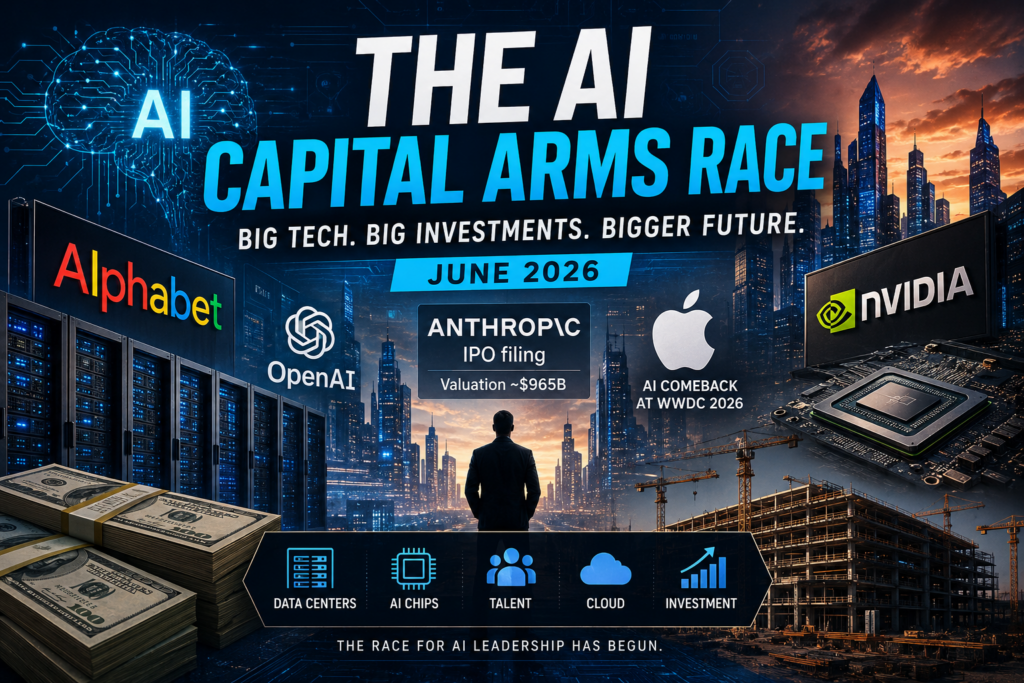
Industry analysts are increasingly describing this moment as an AI Capital Arms Race, a competition in which technology giants and well-funded startups are investing unprecedented amounts of money into infrastructure, advanced semiconductors, cloud platforms, talent acquisition, and data centers. The race is not merely about innovation; it is about securing long-term leadership in what many believe will become the most transformative technology sector of the 21st century.
The developments of June 2026 provide a clear picture of this shift. Anthropic’s move toward an IPO, Alphabet’s massive infrastructure spending plans, Apple’s renewed AI ambitions, and ongoing debates about AI’s impact on jobs all point to a common reality: artificial intelligence is now a strategic economic and geopolitical priority.
The Emergence of the AI Capital Arms Race
For years, technology companies competed primarily through software innovation. A small startup could sometimes challenge larger competitors by creating a better product or introducing a groundbreaking algorithm.
AI has changed that equation.
Modern artificial intelligence requires enormous computational resources. Training frontier AI models involves thousands of advanced processors running continuously for weeks or months. Operating these systems at global scale requires vast cloud infrastructure, sophisticated networking systems, specialized hardware, and highly skilled engineering teams.
As a result, AI leadership increasingly depends on capital investment. Companies with access to significant financial resources can build larger data centers, acquire more computing power, and attract top researchers.
The consequence is an escalating cycle of spending where major players continuously invest billions of dollars to maintain competitive advantages.
Today, the AI race resembles historical infrastructure competitions such as railroad expansion, telecommunications networks, and internet connectivity. The winners may not simply be those with the best ideas but those capable of deploying those ideas at the largest scale.
Anthropic’s IPO Signals Investor Confidence in AI


One of the most significant developments this week is Anthropic’s confidential filing for a U.S. initial public offering (IPO).
Anthropic has rapidly emerged as one of the most influential AI companies in the world. Known for developing advanced AI systems and competing directly with industry leaders, the company has attracted substantial investment and attention from both enterprises and investors.
Reports suggest that Anthropic’s valuation has approached approximately $965 billion, a figure that underscores the extraordinary optimism surrounding the AI sector. While such valuations remain subject to market conditions and future performance, the scale of investor interest reflects growing confidence that AI will continue driving economic growth and technological transformation.
The IPO filing represents more than a financial event. It symbolizes the maturation of the AI industry itself. Investors increasingly view AI companies not as speculative ventures but as foundational businesses capable of generating long-term revenue and strategic influence.
Anthropic’s move also intensifies competition with other major AI organizations. Public market participation could provide additional capital for research, infrastructure expansion, acquisitions, and talent recruitment.
The broader message to the market is clear: AI is becoming one of the most attractive investment themes globally.
Big Tech’s Infrastructure Spending Reaches Historic Levels
Perhaps the clearest evidence of the AI Capital Arms Race comes from the spending plans announced by major technology companies.
Alphabet recently revealed plans to raise approximately $80 billion focused on AI-related infrastructure investments. Such figures would have seemed extraordinary only a few years ago, but they increasingly reflect the new realities of competing in artificial intelligence.
Why are companies spending so much?
The answer lies in the infrastructure requirements of modern AI systems.
Massive Data Centers
AI models require enormous computational capacity. To meet demand, technology companies are building larger and more sophisticated data centers equipped with specialized processors and advanced cooling systems.
These facilities serve as the backbone of AI development and deployment.
High-Performance Chips
Advanced AI chips have become one of the most valuable assets in technology. Companies are competing aggressively to secure access to cutting-edge processors capable of training and running increasingly complex models.
Demand for these chips continues to outpace supply, making them a critical strategic resource.
Cloud Computing Expansion
Cloud platforms are becoming central to AI deployment. Organizations across industries increasingly rely on cloud providers to access AI services, creating incentives for technology companies to expand capacity rapidly.
Energy Requirements
AI infrastructure also requires enormous amounts of electricity. As AI workloads increase, energy availability and sustainability have become important considerations in long-term planning.
The result is a new era in which infrastructure investment plays as important a role as software innovation.
Apple’s AI Comeback Strategy


For much of the generative AI boom, Apple was often viewed as moving more cautiously than competitors.
That perception may change significantly in 2026.
At WWDC 2026, Apple is expected to introduce major AI enhancements across its ecosystem, including a significantly upgraded Siri and expanded AI capabilities integrated into iOS, iPadOS, macOS, and other platforms.
Apple’s strategy differs from many competitors in several important ways.
Privacy-Centered AI
Apple continues emphasizing privacy as a core differentiator. Rather than relying exclusively on cloud-based processing, the company is expected to expand on-device AI capabilities wherever possible.
This approach allows users to benefit from intelligent features while maintaining greater control over personal information.
Smarter Siri
Industry observers expect Siri to receive its most significant upgrade in years.
Potential improvements include:
- Better conversational understanding
- Enhanced contextual awareness
- More personalized responses
- Improved task automation
- Deeper integration across Apple services
If successful, these upgrades could help Apple close the gap with competing AI assistants.
Ecosystem Integration
Unlike standalone AI applications, Apple has the advantage of controlling both hardware and software across a broad ecosystem.
AI features integrated seamlessly across iPhones, iPads, Macs, Apple Watches, and future devices could provide a compelling user experience that competitors may struggle to replicate.
Apple’s renewed AI push demonstrates that even companies perceived as lagging in AI are now accelerating investment and development efforts.
AI Infrastructure Becomes a Strategic Asset
One of the most important shifts occurring in 2026 is the recognition that AI infrastructure itself has become a competitive advantage.
Historically, software companies could scale rapidly with relatively modest physical assets. AI changes this dynamic.
Ownership or control of infrastructure now influences:
- Model training speed
- Deployment costs
- Service reliability
- Research capabilities
- Market competitiveness
Companies that control large-scale infrastructure enjoy significant advantages.
This trend is creating new relationships between technology providers, cloud operators, semiconductor manufacturers, and governments.
As demand grows, infrastructure capacity becomes a strategic resource similar to energy, transportation networks, or telecommunications systems.
The Global Talent Competition
Infrastructure alone is not enough.
The AI Capital Arms Race also includes fierce competition for talent.
Organizations are actively recruiting:
- Machine learning researchers
- Data scientists
- AI engineers
- Infrastructure specialists
- Semiconductor experts
- Product developers
Compensation packages for elite AI professionals continue to rise as companies seek individuals capable of driving innovation and maintaining technological leadership.
Universities and research institutions are also playing increasingly important roles in preparing the next generation of AI talent.
The competition for skilled professionals has become nearly as intense as the competition for computing resources.
The Growing Debate About AI and Jobs
While investment and innovation dominate headlines, discussions surrounding AI’s impact on employment continue to intensify.
The debate has moved beyond simple automation concerns.
Many experts now believe AI could significantly reshape knowledge work, including tasks traditionally performed by:
- Analysts
- Customer support teams
- Administrative staff
- Content creators
- Software developers
- Financial professionals
Opportunities Created by AI
Supporters argue that AI will generate new industries, new roles, and greater productivity.
Potential benefits include:
- Increased efficiency
- Faster innovation
- Improved decision-making
- Enhanced creativity
- Economic growth
Historically, technological revolutions have often created more jobs than they eliminated over the long term.
Challenges and Disruption
Critics emphasize the potential for short-term disruption.
Workers may face:
- Job displacement
- Skill obsolescence
- Wage pressure
- Increased competition
Governments, educational institutions, and businesses are increasingly discussing reskilling and workforce adaptation strategies to address these challenges.
The employment implications of AI remain one of the most important policy discussions of the decade.
Why Investors Are Pouring Money Into AI
Investor enthusiasm remains remarkably strong despite concerns about valuation levels and infrastructure costs.
Several factors contribute to this optimism.
Massive Market Potential
AI applications span nearly every sector:
- Healthcare
- Finance
- Manufacturing
- Education
- Transportation
- Entertainment
- Retail
The potential market size is enormous.
Productivity Gains
AI promises substantial productivity improvements across industries, creating opportunities for businesses to reduce costs and increase output.
Platform Economics
Many leading AI providers operate platform businesses capable of generating recurring revenue through subscriptions, enterprise services, and cloud offerings.
Long-Term Transformation
Investors increasingly view AI as a foundational technology comparable to electricity, personal computing, or the internet.
This perspective supports continued capital inflows despite short-term uncertainty.
Risks Behind the AI Boom
Despite widespread optimism, the AI Capital Arms Race carries risks.
Infrastructure Costs
Building and maintaining AI infrastructure requires enormous expenditures.
Companies must generate sufficient revenue to justify these investments.
Competitive Pressure
Rapid innovation creates uncertainty regarding which organizations will ultimately dominate the market.
Regulatory Challenges
Governments worldwide are developing new frameworks governing AI development, safety, transparency, and accountability.
Market Expectations
High valuations create pressure for companies to deliver strong financial performance and sustained growth.
Investors will closely monitor whether AI revenues eventually match current expectations.
What Happens Next?
The AI industry appears poised for continued expansion throughout 2026 and beyond.
Several trends are likely to shape the next phase:
- Continued infrastructure spending
- Increased AI integration into consumer products
- More AI-focused IPOs
- Growing regulatory oversight
- Expansion of enterprise AI adoption
- Intensified competition among major technology firms
The distinction between technology companies and AI companies may gradually disappear as artificial intelligence becomes embedded across virtually every digital product and service.
Conclusion: The Real Battle Is Scale
The defining AI story of June 2026 is not merely the release of a new model or application. It is the realization that artificial intelligence has entered an era where scale matters more than ever.
Anthropic’s IPO ambitions, Alphabet’s infrastructure investments, Apple’s AI resurgence, and global discussions about jobs all reflect a common theme: AI leadership increasingly depends on capital, infrastructure, talent, and operational capacity.
The competition is no longer simply about who can build the smartest algorithm. It is about who can finance, deploy, and sustain AI systems at a global scale.
As billions of dollars continue flowing into data centers, chips, cloud computing, and research, the AI Capital Arms Race is reshaping technology, business, and society. The organizations that successfully balance innovation, infrastructure, and responsible deployment may define the next generation of economic and technological leadership.