Meta Expands AI with New Chips and Assistants: A Deep Dive into Its Next-Gen Strategy
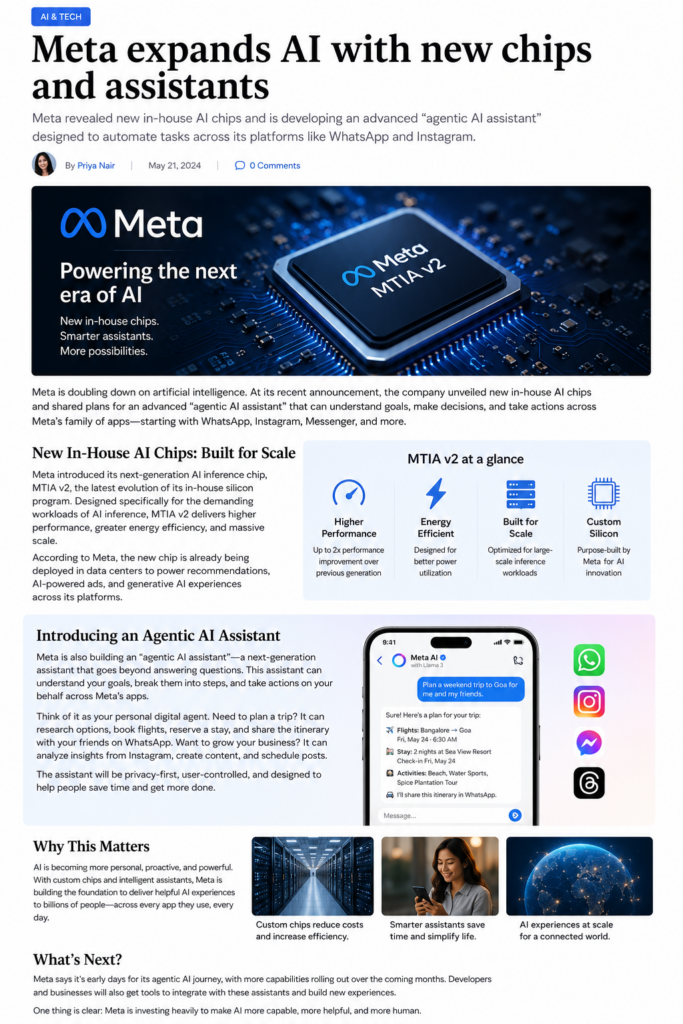
Meta has entered a new phase in its artificial intelligence journey. Instead of relying heavily on external chip suppliers and general-purpose AI assistants, the company is now building both the hardware and software backbone of its AI ecosystem in-house. Its latest announcements—custom AI chips and a next-generation “agentic AI assistant”—signal a long-term strategy to dominate AI infrastructure and user-facing intelligence across platforms like WhatsApp, Instagram, Facebook, and beyond.
This shift is not just a product update. It represents a structural transformation in how Meta envisions the future of digital interaction, automation, and social media engagement.
The Rise of Meta’s AI Infrastructure Strategy
Over the past few years, Meta has steadily increased its investment in artificial intelligence. From recommendation systems on Facebook and Instagram to content moderation and advertising optimization, AI already powers much of its ecosystem. However, the company’s newest direction goes much deeper: building dedicated AI infrastructure from the ground up.
At the core of this transformation are two major components:
- Custom-built AI chips designed in-house
- An advanced agentic AI assistant capable of autonomous task execution
These two innovations are closely connected. The chips provide the computational power needed for massive-scale AI models, while the assistant represents the user-facing application of that intelligence.
Meta’s goal is clear: reduce dependency on external AI hardware providers and create a tightly integrated ecosystem optimized for its own AI workloads.
Why Meta Is Building Its Own AI Chips
The global AI race has created a massive demand for high-performance computing hardware. Traditionally, companies like NVIDIA have dominated this space, supplying GPUs that power most modern AI systems. However, reliance on third-party hardware creates bottlenecks in cost, availability, and optimization.
Meta’s decision to develop in-house AI chips addresses several key challenges:
1. Cost Efficiency at Scale
Meta processes billions of AI-driven operations every day—content ranking, recommendation algorithms, ad targeting, and now generative AI tasks. Using external GPUs at this scale is extremely expensive.
By designing custom chips, Meta can optimize performance specifically for its workloads while significantly reducing long-term infrastructure costs.
2. Performance Optimization
General-purpose GPUs are powerful but not always optimized for specific AI tasks. Meta’s in-house chips are expected to focus on:
- Efficient inference for large language models
- Real-time recommendation systems
- Low-latency processing for messaging and social interactions
This specialization allows faster and more energy-efficient computation.
3. Strategic Independence
The AI industry is becoming increasingly competitive, and hardware supply chains are under pressure. By controlling its own chip design, Meta reduces dependency on external vendors and gains more control over its AI roadmap.
What We Know About Meta’s AI Chips
While Meta has not released full technical specifications publicly, industry expectations suggest that these chips are tailored for:
- AI inference workloads rather than general-purpose computing
- High-throughput processing for large-scale data centers
- Energy-efficient training support for future models
These chips are likely to be deployed across Meta’s global infrastructure, powering services like:
- Facebook feed ranking
- Instagram content recommendations
- WhatsApp AI features
- Meta AI assistant responses
In essence, these chips will act as the invisible engine behind Meta’s entire AI ecosystem.
The Shift Toward Agentic AI Assistants
Alongside hardware advancements, Meta is also developing a new type of AI system: an agentic AI assistant.
Unlike traditional chatbots that simply respond to prompts, agentic AI systems are designed to:
- Take initiative in completing tasks
- Perform multi-step reasoning
- Interact with apps and services autonomously
- Learn user preferences over time
This represents a major leap from reactive AI to proactive AI.
What Makes “Agentic AI” Different?
Most current AI assistants, including earlier versions of Meta AI, function in a conversational format. They wait for user input and respond accordingly.
An agentic AI assistant, however, can:
1. Execute Multi-Step Tasks
For example:
- Planning an event
- Booking services
- Sending messages across platforms
- Summarizing and acting on incoming information
2. Operate Across Apps
Meta’s ecosystem includes WhatsApp, Instagram, Facebook, Messenger, and Threads. The new assistant is designed to work across all of them seamlessly.
Imagine asking:
“Plan a birthday party for next weekend and invite my close friends.”
The assistant could:
- Create an event
- Draft invitation messages
- Send them via WhatsApp or Messenger
- Suggest venues or content ideas on Instagram
3. Personalized Decision-Making
Over time, the assistant learns user behavior:
- Communication style
- Frequently contacted people
- Content preferences
- Scheduling habits
This allows it to make increasingly relevant suggestions and decisions.
Integration Across Meta Platforms
Meta’s biggest advantage in building an AI assistant is its ecosystem scale. Unlike standalone AI tools, Meta controls some of the world’s largest social platforms.
WhatsApp Integration
WhatsApp is expected to become a key interface for agentic AI. Users may soon be able to:
- Automate replies
- Schedule reminders
- Translate messages in real time
- Summarize long chat threads
Instagram Integration
On Instagram, AI could:
- Suggest captions
- Generate post ideas
- Manage engagement
- Help creators plan content calendars
Facebook and Messenger
For Facebook, AI assistants could:
- Manage groups
- Automate event planning
- Filter notifications intelligently
- Assist businesses with customer responses
This cross-platform integration is what makes Meta’s AI strategy particularly powerful.
The Competitive Landscape
Meta is not alone in pursuing agentic AI. Tech giants across the industry are racing toward similar goals.
- Google is embedding AI deeply into its ecosystem through Gemini-based systems
- Microsoft is integrating AI agents into Windows and Office
- Apple is enhancing Siri with generative capabilities
However, Meta’s unique advantage lies in its social graph and communication platforms, which give it direct access to billions of daily interactions.
Challenges and Concerns
Despite the excitement, Meta’s AI expansion raises several important challenges.
1. Privacy Concerns
An AI assistant that operates across messaging and social platforms will need access to highly sensitive user data. This raises questions about:
- Data security
- User consent
- Information storage
2. Autonomy Risks
Agentic AI systems can take actions independently, which introduces risks such as:
- Misinterpreting user intent
- Sending unintended messages
- Making incorrect decisions on behalf of users
3. Ethical AI Deployment
As AI becomes more integrated into daily communication, ensuring fairness, transparency, and accountability becomes critical.
Meta will need to balance innovation with responsible AI governance.
Economic and Industry Impact
Meta’s move into custom chips and agentic AI could have wide-reaching effects:
1. Semiconductor Industry Disruption
If Meta successfully reduces reliance on external GPUs, it could shift demand patterns in the semiconductor market.
2. Acceleration of AI Competition
Other tech giants may accelerate their own chip development and AI assistant capabilities.
3. Transformation of Social Media
Social platforms may evolve from content-sharing networks into AI-driven personal ecosystems that manage communication, productivity, and entertainment.
The Future of Meta AI
Looking ahead, Meta’s AI strategy suggests a future where:
- AI assistants act as digital companions rather than tools
- Social media becomes partially automated and AI-managed
- Hardware and software are deeply integrated for maximum efficiency
- Communication across apps is orchestrated by intelligent agents
This vision represents a shift from passive digital platforms to active AI-driven ecosystems.
Conclusion
Meta’s expansion into custom AI chips and agentic assistants marks one of its most significant strategic shifts in recent years. By controlling both the hardware and software layers of its AI infrastructure, Meta is positioning itself to compete at the highest level of the global AI race.
The combination of powerful in-house chips and intelligent cross-platform assistants could redefine how users interact with social media, communicate with each other, and manage everyday tasks.
However, with great capability comes equally significant responsibility. Issues of privacy, autonomy, and ethical AI deployment will shape how successfully Meta can implement this vision.
What is clear is that Meta is no longer just a social media company—it is rapidly becoming a full-scale AI infrastructure and intelligence provider for the digital world.