

Introduction
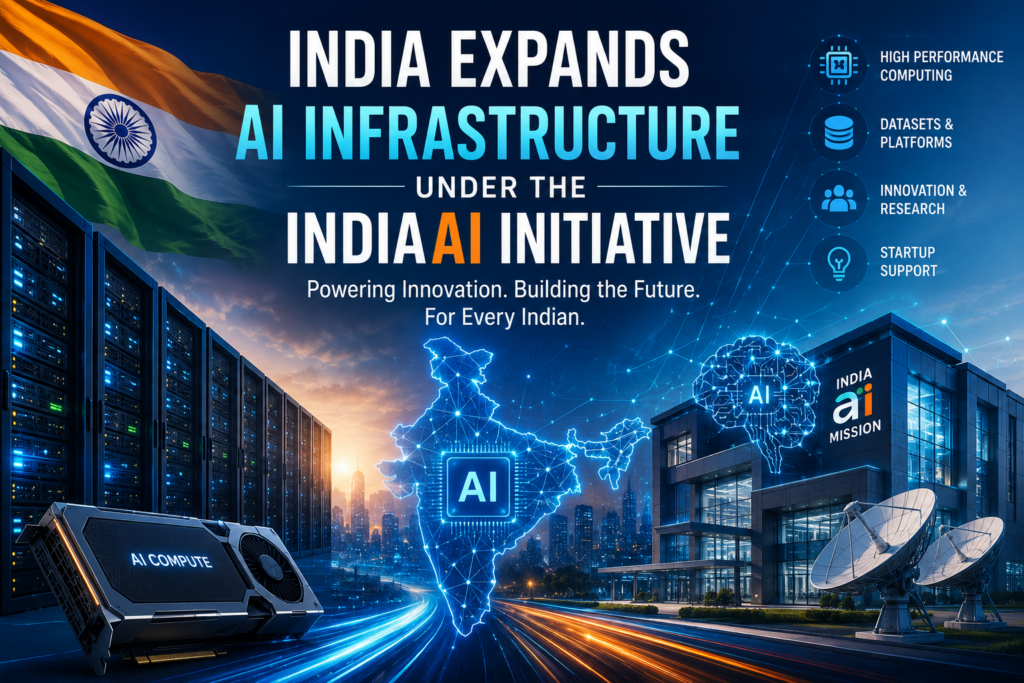
India is taking significant strides toward becoming a global leader in artificial intelligence (AI) through the ambitious IndiaAI Mission. As nations worldwide compete to establish leadership in AI research, development, and deployment, India has recognized that robust digital infrastructure is essential for fostering innovation and ensuring technological self-reliance. The IndiaAI initiative represents a comprehensive effort to democratize access to AI resources, support startups, empower researchers, and accelerate the adoption of AI across industries.
With substantial investments in computing infrastructure, GPU clusters, AI data platforms, and indigenous AI model development, India is creating an ecosystem that can support the next generation of AI-driven solutions. The initiative is not merely about technological advancement; it is also about economic growth, job creation, digital inclusion, and addressing national challenges through intelligent systems.
This article explores how India is expanding its AI infrastructure under the IndiaAI initiative, the key pillars of the mission, its impact on innovation, and what it means for the future of the country.
Understanding the IndiaAI Mission
The IndiaAI Mission was launched with a vision to establish India as a global hub for artificial intelligence innovation and deployment. The initiative seeks to provide accessible AI computing resources, quality datasets, research opportunities, and skill development programs to individuals and organizations across the nation.
The government has allocated significant funding to build an AI ecosystem that supports startups, educational institutions, researchers, and enterprises. By creating shared infrastructure and reducing barriers to entry, India aims to ensure that AI innovation is not limited to large corporations with extensive resources.
The mission focuses on several strategic objectives:
- Democratizing access to AI computing resources.
- Encouraging indigenous AI model development.
- Supporting AI startups and entrepreneurs.
- Enhancing AI education and skill development.
- Promoting responsible and ethical AI practices.
- Strengthening India’s digital sovereignty.
These goals collectively contribute to creating a sustainable and inclusive AI ecosystem.
The Importance of AI Infrastructure
Artificial intelligence depends heavily on computing power. Training modern AI models requires enormous computational resources, including high-performance Graphics Processing Units (GPUs), advanced networking systems, and large-scale data storage facilities.
Without adequate infrastructure, researchers and startups face significant challenges in developing competitive AI solutions. The high cost of acquiring GPUs and maintaining data centers often limits innovation.
India’s AI infrastructure expansion addresses these challenges by:
- Reducing the cost of AI development.
- Increasing access to advanced computing resources.
- Accelerating AI research and experimentation.
- Supporting the development of large language models.
- Enabling innovation in healthcare, agriculture, education, and manufacturing.
The availability of shared AI infrastructure creates opportunities for organizations of all sizes to participate in the AI revolution.
Massive Expansion of GPU Capacity


One of the most important components of the IndiaAI initiative is the expansion of the national GPU computing infrastructure.
Modern AI systems, especially generative AI models, require thousands of GPUs to process vast amounts of data efficiently. Recognizing this need, India has built a large AI compute platform that provides access to GPU resources for researchers, startups, and institutions.
The growing GPU infrastructure offers several benefits:
1. Affordable Access
Organizations no longer need to invest heavily in expensive hardware. Instead, they can access shared resources at subsidized rates.
2. Faster Innovation
Researchers can train models more quickly, reducing development cycles and accelerating innovation.
3. Improved Competitiveness
Indian startups gain the ability to compete globally by accessing advanced AI infrastructure comparable to international standards.
4. Support for Large-Scale Models
The infrastructure enables the development of large language models, computer vision systems, and advanced machine learning applications.
This GPU expansion forms the backbone of India’s AI ambitions.
Supporting Indigenous AI Models
One of the central goals of the IndiaAI initiative is the development of indigenous AI models that reflect India’s unique linguistic, cultural, and economic diversity.
Many existing AI systems are trained primarily on English-language data and Western contexts. As a result, they may not adequately serve India’s multilingual population.
The IndiaAI Mission encourages the creation of AI models that understand and generate content in Indian languages such as:
- Hindi
- Tamil
- Telugu
- Bengali
- Marathi
- Kannada
- Malayalam
- Gujarati
- Punjabi
- Odia
By supporting localized AI development, India aims to ensure that AI technologies are accessible to all citizens regardless of language.
These indigenous models can be applied across sectors, including customer service, education, healthcare, governance, and agriculture.
Empowering AI Startups
India already has one of the world’s most vibrant startup ecosystems. The IndiaAI initiative further strengthens this ecosystem by providing startups with access to critical resources.
Reduced Entry Barriers
Many AI startups struggle to obtain the computing resources needed to train advanced models. Shared AI infrastructure significantly lowers these barriers.
Funding Opportunities
The mission includes support mechanisms that help startups secure funding and scale their innovations.
Research Collaboration
Startups can collaborate with universities, research institutions, and government agencies to accelerate product development.
Market Expansion
Access to AI infrastructure enables startups to create innovative products capable of serving both domestic and global markets.
As a result, India is witnessing the emergence of a new generation of AI-native companies focused on solving real-world challenges.
Building World-Class Data Infrastructure
AI systems require high-quality data for training and evaluation. The IndiaAI initiative recognizes that access to reliable datasets is just as important as access to computing power.
To address this need, the government is investing in:
- Data repositories.
- Public datasets.
- Annotation platforms.
- Data governance frameworks.
- Secure data-sharing mechanisms.
These resources help researchers and developers build more accurate and reliable AI systems.
The creation of structured datasets also promotes transparency and reproducibility in AI research.
AI for Healthcare Transformation


Healthcare represents one of the most promising applications of artificial intelligence in India.
The expanded AI infrastructure can support innovations such as:
Early Disease Detection
AI systems can analyze medical images and identify diseases at early stages.
Personalized Treatment
Machine learning models can recommend treatments tailored to individual patients.
Telemedicine Enhancement
AI-powered virtual assistants can improve healthcare accessibility in rural areas.
Drug Discovery
Advanced computing resources accelerate pharmaceutical research and development.
These innovations have the potential to improve healthcare outcomes while reducing costs.
Transforming Agriculture Through AI
Agriculture remains a critical sector of the Indian economy. AI technologies supported by the IndiaAI initiative can help farmers make better decisions and improve productivity.
Potential applications include:
- Crop disease detection.
- Precision farming.
- Weather forecasting.
- Yield prediction.
- Soil health monitoring.
- Smart irrigation systems.
By combining AI with satellite imagery, sensors, and data analytics, farmers can optimize resource usage and increase agricultural output.
This contributes to food security and sustainable farming practices.
Advancing Education and Skill Development
A strong AI ecosystem requires a skilled workforce. The IndiaAI initiative places significant emphasis on education and training.
AI Curriculum Development
Educational institutions are integrating AI-related subjects into their programs.
Research Opportunities
Students gain access to advanced computing resources for AI research projects.
Industry Collaboration
Partnerships between academia and industry provide practical learning experiences.
Workforce Reskilling
Professionals can acquire AI skills to remain competitive in a rapidly evolving job market.
These efforts help prepare India’s workforce for future technological demands.
Strengthening India’s Digital Sovereignty
The rapid growth of AI has highlighted concerns regarding technological dependence on foreign infrastructure.
By investing in domestic AI capabilities, India seeks to strengthen its digital sovereignty.
Benefits include:
- Greater control over critical technologies.
- Reduced dependence on foreign cloud providers.
- Enhanced data security.
- Increased resilience against geopolitical disruptions.
- Protection of national interests.
A robust domestic AI ecosystem enables India to participate more actively in shaping global AI standards and policies.
AI Adoption Across Industries
The availability of advanced AI infrastructure encourages adoption across multiple sectors.
Manufacturing
AI improves production efficiency, predictive maintenance, and quality control.
Banking and Finance
Machine learning enhances fraud detection, risk assessment, and customer service.
Retail
AI-powered analytics help businesses understand consumer behavior and optimize operations.
Transportation
Intelligent systems improve logistics, route planning, and traffic management.
Public Services
Government agencies can use AI to enhance citizen services and improve administrative efficiency.
As infrastructure expands, AI adoption is expected to accelerate across the economy.
Challenges Ahead
Despite significant progress, several challenges remain.
Talent Shortages
Demand for AI professionals continues to exceed supply.
Data Privacy
Protecting user data while enabling innovation remains a critical concern.
Ethical AI
Ensuring fairness, transparency, and accountability in AI systems is essential.
Infrastructure Scaling
As AI demand grows, continuous investment will be required to expand computing capacity.
Energy Consumption
Large AI data centers consume significant energy, highlighting the need for sustainable infrastructure solutions.
Addressing these challenges will be crucial for long-term success.
India’s Position in the Global AI Race
Countries around the world are investing heavily in AI infrastructure and innovation.
Major economies such as the United States, China, the United Kingdom, and members of the European Union have launched large-scale AI initiatives.
India’s strategy differs in several important ways:
- Focus on democratized access.
- Emphasis on multilingual AI.
- Support for startups and research institutions.
- Large-scale public-private collaboration.
- Commitment to inclusive growth.
These strengths position India as a unique and influential player in the global AI landscape.
The Road Ahead
The IndiaAI initiative represents a foundational investment in the country’s technological future. As computing resources continue to expand and more organizations gain access to advanced AI tools, India is poised to become a major center for AI innovation.
Future developments may include:
- Larger AI supercomputing facilities.
- Advanced sovereign AI models.
- Expanded AI education programs.
- Increased international collaboration.
- Broader AI adoption across government and industry.
These advancements will further strengthen India’s position as a leading digital economy.
Conclusion
India’s expansion of AI infrastructure under the IndiaAI initiative marks a significant milestone in the country’s technological journey. By investing in GPU computing resources, data platforms, startup support, AI research, and workforce development, India is creating the foundation for a thriving AI ecosystem.
The initiative goes beyond building technology infrastructure; it seeks to democratize innovation, empower entrepreneurs, improve public services, and strengthen national competitiveness. As AI continues to reshape industries and economies worldwide, India’s strategic investments today will play a critical role in determining its future position in the global digital landscape.
With sustained commitment, collaboration, and innovation, the IndiaAI Mission has the potential to transform India into one of the world’s leading AI-powered nations, driving economic growth, technological advancement, and social progress for years to come.