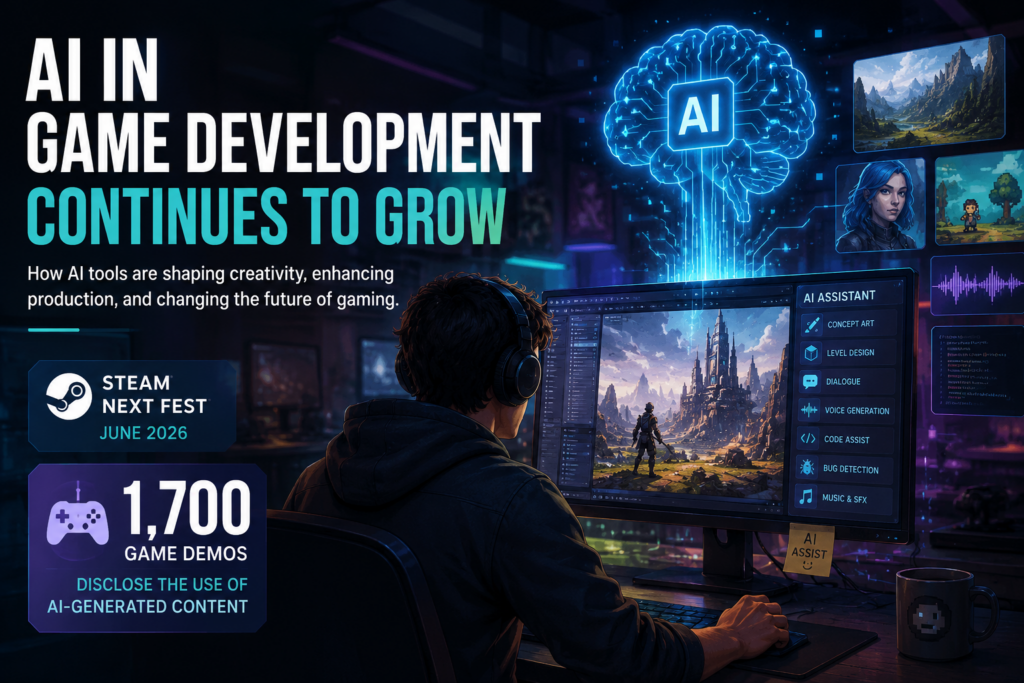


The gaming industry is experiencing a major transformation as artificial intelligence becomes a core part of the game development process. What was once considered an experimental technology is now helping developers create art, write dialogue, generate music, test games, and even assist with programming.
A clear example of this trend emerged during the June 2026 Steam Next Fest, where nearly 1,700 game demos disclosed the use of AI-generated content. The milestone demonstrates how rapidly AI tools are being integrated into game development workflows and highlights an ongoing debate about creativity, quality, and the future of independent game development.
In this article, we’ll explore how AI is reshaping the gaming landscape, the opportunities it creates, and the challenges developers and players face as AI adoption continues to grow.
The Rise of AI in Game Development
Artificial intelligence has evolved from a behind-the-scenes technology into a practical tool used throughout the development lifecycle. Game studios of all sizes are increasingly relying on AI-powered software to streamline production and reduce costs.
Several factors are driving this adoption:
- Rising game development costs
- Increasing player expectations
- Faster content creation requirements
- Shorter production timelines
- Growing accessibility of AI tools
For smaller studios and independent developers, AI offers capabilities that were previously available only to large companies with extensive resources.
Why Developers Are Embracing AI
AI can automate repetitive and time-consuming tasks, allowing teams to focus on gameplay, storytelling, and player experience.
Some common uses include:
- Creating concept art and visual assets
- Generating character dialogue
- Producing voiceovers
- Writing code suggestions
- Creating sound effects and music
- Quality assurance and bug testing
This efficiency helps developers bring projects to market more quickly while reducing production expenses.
AI-Powered Art and Asset Creation


One of the most visible applications of AI in gaming is art generation.
Developers can now create:
- Character concepts
- Environment designs
- Textures
- UI elements
- Promotional artwork
Instead of spending days creating multiple visual concepts manually, artists can generate dozens of ideas within minutes and refine the most promising options.
This approach accelerates pre-production and helps teams experiment with creative directions before committing resources to final designs.
However, many studios still rely heavily on human artists to polish, customize, and improve AI-generated outputs.
AI-Assisted Programming and Game Design
Programming is another area where AI is making a significant impact.
Modern AI coding assistants can help developers:
- Write repetitive code
- Suggest bug fixes
- Generate documentation
- Improve optimization
- Speed up debugging
For independent developers working alone or in small teams, these tools can dramatically reduce development time.
AI is also being used to assist with procedural content generation, enabling developers to create larger and more dynamic game worlds. Open-world environments, dungeon layouts, and mission structures can be generated with AI assistance while maintaining developer control over the final experience.
Voice Acting and Narrative Generation
Storytelling remains one of gaming’s most important elements.
AI tools are now capable of:
- Generating dialogue variations
- Creating temporary voiceovers
- Translating content into multiple languages
- Assisting writers with narrative ideas
These technologies can help developers prototype stories quickly and localize games for global audiences.
Despite these advantages, many players and industry professionals believe human writers and voice actors remain essential for delivering emotional depth, authenticity, and memorable performances.
The debate continues regarding where AI assistance should end and human creativity should take over.
The Growing Debate Around Creativity
As AI-generated content becomes more common, concerns about originality have intensified.
Critics argue that:
- AI-generated assets can feel generic.
- Overreliance on AI may reduce artistic expression.
- Unique creative voices could become harder to identify.
- Players may struggle to distinguish original work from machine-generated content.
Supporters counter that AI is simply another creative tool, similar to graphic design software or game engines.
According to this perspective, AI doesn’t replace creativity—it enhances productivity by handling repetitive tasks and enabling creators to focus on innovation.
The reality likely lies somewhere between these viewpoints, with successful developers finding ways to combine human imagination and AI efficiency.
Discoverability Challenges for Indie Developers


One of the biggest concerns surrounding AI-generated games is discoverability.
As AI lowers development barriers, more games can be produced and released every year.
While this creates opportunities for aspiring developers, it also increases competition on digital storefronts.
Challenges include:
Increased Market Saturation
Thousands of new titles are released annually. AI-assisted development could accelerate that growth even further.
Visibility Issues
High-quality games may struggle to gain attention among a growing number of releases.
Consumer Trust
Players may become skeptical if AI-generated content is perceived as low quality or lacking originality.
Digital platforms are increasingly introducing transparency measures that require developers to disclose AI-generated content, helping consumers make informed decisions.
How Players Are Responding
Player reactions to AI in gaming remain mixed.
Some gamers appreciate:
- Faster updates
- Larger game worlds
- More dynamic NPC interactions
- Increased accessibility
Others worry about:
- Loss of artistic authenticity
- Reduced employment opportunities for creatives
- Repetitive or low-quality content
- Ethical concerns regarding training data
The industry’s future will depend heavily on how developers address these concerns while continuing to innovate.
What the Future Holds


AI’s role in gaming is likely to expand significantly over the next decade.
Future developments may include:
- More intelligent NPCs
- Personalized game narratives
- Real-time content generation
- Advanced game testing systems
- Improved accessibility features
- Enhanced multiplayer experiences
However, successful games will continue to depend on compelling design, engaging gameplay, and strong storytelling—areas where human creativity remains essential.
Rather than replacing developers, AI appears poised to become a powerful collaborator that helps studios create more ambitious and immersive experiences.
Conclusion
The presence of nearly 1,700 AI-disclosing game demos at Steam Next Fest 2026 highlights a major shift in the gaming industry. Artificial intelligence is rapidly becoming an integral part of game development, helping creators build games faster, reduce costs, and experiment with new ideas.
At the same time, important questions remain about creativity, quality, and discoverability. As developers, players, and platforms adapt to this new reality, the most successful projects will likely be those that combine the efficiency of AI with the imagination and vision of human creators.
The future of gaming is unlikely to be purely human or purely artificial—it will be a partnership between the two.
Tags
AI Gaming, Video Game Development, Steam Next Fest, Artificial Intelligence, Indie Games, Game Design, AI Generated Content, Gaming Technology, Future of Gaming, Game Development Trends, AI Tools, Interactive Entertainment, Gaming Industry, Digital Creativity, Game Innovation