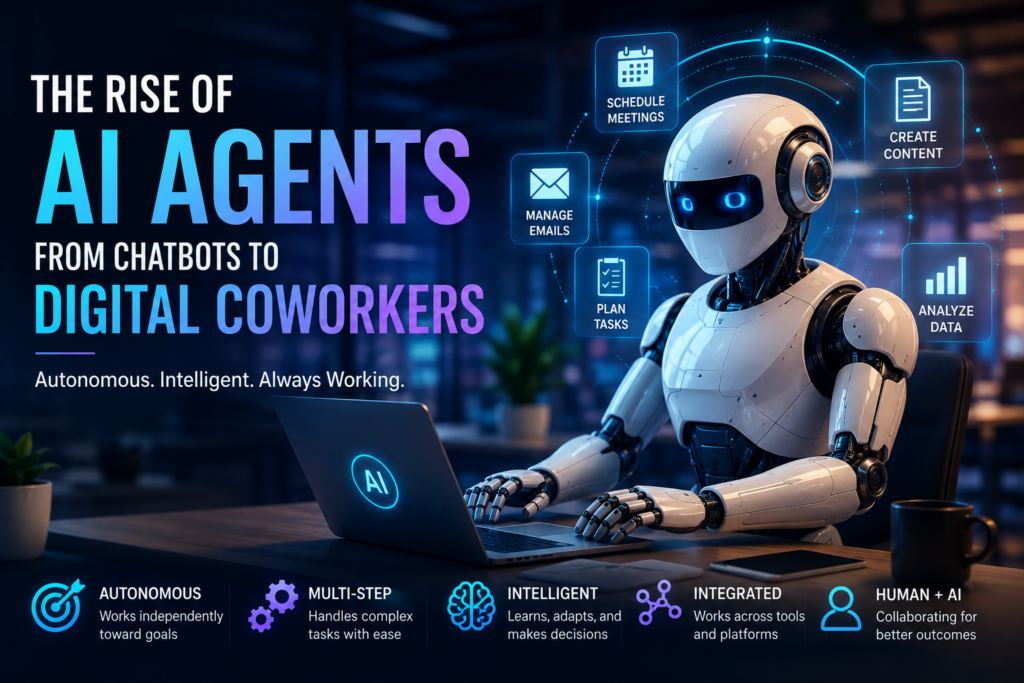
Artificial Intelligence has evolved rapidly over the past few years. What started as simple chatbots capable of answering basic questions has now transformed into intelligent AI agents that can perform complex, multi-step tasks with minimal human intervention. Businesses, developers, and consumers are increasingly embracing AI agents as digital coworkers capable of improving productivity, reducing costs, and automating repetitive work.
Unlike traditional AI assistants that simply respond to prompts, modern AI agents can plan, reason, make decisions, use external tools, remember context, and execute tasks across multiple applications. This shift represents one of the biggest technological changes since cloud computing and smartphones.
In this article, we’ll explore what AI agents are, how they differ from chatbots, why they’re becoming essential for businesses, and what the future holds for autonomous digital coworkers.
📌 What Are AI Agents?


An AI agent is an intelligent software system capable of understanding goals, planning actions, executing multiple steps, and adapting based on results.
Instead of simply answering a question, an AI agent works toward completing an objective.
For example:
Traditional Chatbot
User: “Write an email.”
The chatbot generates the email.
AI Agent
User: “Schedule a meeting with the marketing team next week.”
The AI agent can:
- Check everyone’s calendars
- Find available time slots
- Draft invitations
- Send meeting requests
- Create reminders
- Prepare the agenda
It completes the entire workflow instead of just generating text.
From Chatbots to Digital Coworkers
Earlier generations of AI focused mainly on conversation.
Examples include:
- Customer support bots
- FAQ assistants
- Website chat widgets
- Voice assistants
These systems responded when asked but rarely took initiative.
Modern AI agents can:
✅ Plan
✅ Reason
✅ Use software tools
✅ Search information
✅ Write documents
✅ Analyze data
✅ Execute workflows
✅ Learn from feedback
This makes them closer to digital employees than virtual assistants.
Key Characteristics of Autonomous AI Agents
1. Goal-Oriented Thinking 🎯
Instead of answering one question, AI agents focus on completing objectives.
Example:
“Research competitors and prepare a presentation.”
The agent may:
- Search the web
- Collect information
- Summarize findings
- Create charts
- Generate slides
2. Multi-Step Planning 🧠
AI agents divide large tasks into smaller steps.
For example:
Launch a marketing campaign.
Steps:
- Research audience
- Analyze competitors
- Write copy
- Create images
- Schedule posts
- Track performance
- Generate reports
The user provides one goal.
The AI handles dozens of actions.
3. Memory
Unlike older chatbots that forget previous interactions, AI agents often maintain working memory.
This allows them to:
- Remember preferences
- Continue long projects
- Track progress
- Maintain context
4. Tool Usage
Modern AI agents can interact with:
- Calendars
- Databases
- Web browsers
- Documents
- CRMs
- APIs
- Cloud storage
- Project management tools
Instead of simply talking, they perform actions.
5. Decision Making
Many AI agents can choose the next best action based on available information.
Example:
If an email recipient doesn’t respond:
- Wait 48 hours
- Send reminder
- Notify manager
The workflow continues automatically.
Understanding Multi-Step Task Automation


Multi-step automation means the AI doesn’t stop after one instruction.
Instead, it completes an entire sequence of connected tasks.
Example:
Employee onboarding.
Traditional automation:
- Send welcome email.
AI Agent automation:
- Create company account
- Generate passwords
- Schedule orientation
- Add employee to Slack
- Assign training
- Notify HR
- Prepare equipment checklist
- Create calendar events
Everything happens automatically.
AI Agents vs Traditional Automation
| Traditional Automation | AI Agents |
|---|---|
| Fixed rules | Flexible reasoning |
| Limited workflows | Adaptive planning |
| Cannot handle surprises | Can adjust to changes |
| One task | Multi-step objectives |
| No understanding | Understands context |
| Manual updates | Learns from feedback |
Real-World Business Applications
📧 Customer Support
AI agents can:
- Answer questions
- Process refunds
- Update orders
- Escalate issues
- Analyze customer sentiment
Support teams become faster while customers receive quicker responses.
📈 Marketing
Marketing teams use AI agents for:
- Keyword research
- Blog writing
- Social media scheduling
- Email campaigns
- Ad optimization
- Analytics reporting
One marketer can manage significantly more campaigns with AI assistance.
💼 Sales
Sales AI agents help by:
- Qualifying leads
- Writing personalized emails
- Scheduling meetings
- Updating CRM systems
- Tracking follow-ups
Sales representatives spend more time selling instead of doing administrative work.
📊 Data Analysis
Business analysts increasingly use AI agents to:
- Clean datasets
- Generate charts
- Identify trends
- Create reports
- Explain findings
Tasks that once took hours can often be completed in minutes.
🧾 Finance
Finance departments use AI agents for:
- Invoice processing
- Expense categorization
- Budget analysis
- Financial forecasting
- Fraud detection support
Human oversight remains important, especially for high-impact decisions.
👩💻 Software Development
Developers use AI agents to:
- Write code
- Review pull requests
- Detect bugs
- Generate documentation
- Run tests
- Suggest improvements
Development teams become more productive while maintaining human review.
Industries Adopting AI Agents
Many industries are integrating AI agents into everyday operations, including:
- 🏥 Healthcare
- 🏦 Banking
- 🛍️ Retail
- 🎓 Education
- 🏭 Manufacturing
- 🚚 Logistics
- 📞 Customer Service
- ⚖️ Legal Services
- 🏢 Human Resources
- 📢 Digital Marketing
The adoption rate continues to grow as AI tools become more capable and accessible.
Benefits of AI Digital Coworkers
⚡ Higher Productivity
Employees spend less time on repetitive work and more time on creative or strategic tasks.
💰 Lower Costs
Businesses reduce manual workloads and improve operational efficiency.
🌍 24/7 Availability
AI agents can operate around the clock without requiring breaks, making them useful for global operations.
📈 Better Decision Support
AI agents can analyze large amounts of information and present summaries or recommendations that help people make informed decisions.
😊 Improved Customer Experience
Customers often receive faster responses, more personalized interactions, and quicker issue resolution.
Challenges and Risks
AI agents also introduce challenges that organizations need to manage.
Data Privacy
AI systems frequently access sensitive business information, making strong security practices essential.
Accuracy
Agents can make mistakes or produce incorrect information, so important outputs should be reviewed by people.
Security
Organizations should control what systems AI agents can access and monitor their actions to reduce risks.
Human Oversight
For legal, financial, medical, or safety-critical tasks, humans remain responsible for reviewing decisions and taking final action.
The Future of AI Agents
Over the next several years, AI agents are expected to become more collaborative and specialized. Rather than replacing entire jobs, they are likely to automate routine tasks, coordinate workflows, and assist professionals across many fields.
We can expect AI agents that:
- Collaborate with other AI agents
- Coordinate across multiple business applications
- Handle increasingly complex workflows
- Personalize assistance based on user preferences
- Work alongside humans as integrated members of teams
As these capabilities mature, AI agents are likely to become a standard part of the modern workplace.
Conclusion
The evolution from chatbots to autonomous AI agents marks a significant shift in how people interact with technology. Today’s AI agents are no longer limited to answering questions—they can plan, execute, and manage multi-step workflows while working alongside humans.
For businesses, this means greater efficiency, faster execution, and the ability to automate repetitive processes. For individuals, AI agents can act as productive digital coworkers that help organize information, complete tasks, and support better decision-making. The organizations that thoughtfully combine AI capabilities with human expertise will be well positioned to benefit from this new era of intelligent automation.