

Target Length: ~3,000 words
SEO Keyword: Multimodal AI
Reading Time: 15–18 Minutes
🚀 The Rise of Multimodal AI: How Modern AI Understands Text, Images, Audio, and Video in One Model
Artificial Intelligence has entered a remarkable new era. Just a few years ago, AI tools were designed to perform one task exceptionally well. Some models specialized in writing text, others recognized images, while separate systems handled speech recognition or video analysis. Today, those boundaries are disappearing.
Welcome to the age of Multimodal AI—a revolutionary approach where a single AI model can understand and generate multiple forms of content, including text, images, audio, video, documents, and even code.
Imagine asking an AI:
“Look at this chart, summarize the report, explain it aloud, and create a presentation.”
Instead of switching between five different software applications, one AI system can perform the entire workflow.
This transformation is changing education, healthcare, business, software development, entertainment, marketing, customer service, and scientific research. In this comprehensive guide, you’ll learn how multimodal AI works, why it’s important, where it’s being used, and what the future holds.
📖 Table of Contents
- What Is Multimodal AI?
- Evolution of Artificial Intelligence
- Why AI Needed Multiple Modalities
- Understanding Different Types of Data
- How Multimodal AI Works
- AI Training Process
- Real-World Applications
- Industries Being Transformed
- Benefits of Multimodal AI
- Challenges and Risks
- Future Trends
- Best Practices
- Frequently Asked Questions
- Final Thoughts
What Is Multimodal AI?
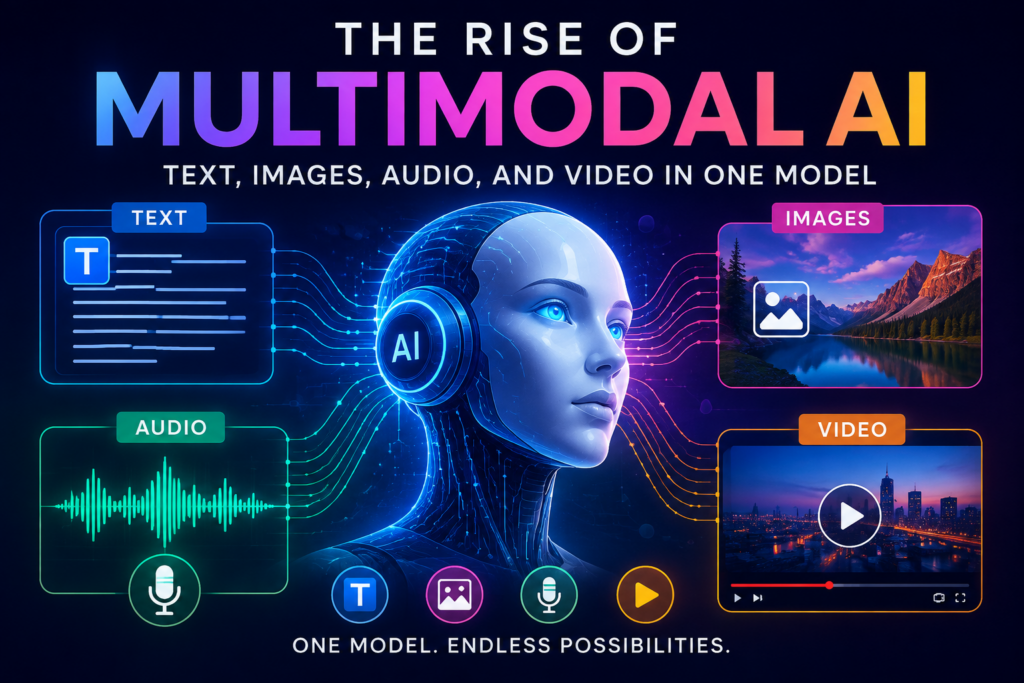
Multimodal AI refers to artificial intelligence systems capable of understanding and generating multiple types of information simultaneously.
Instead of working with only one type of input, modern AI can process:
- 📝 Text
- 🖼 Images
- 🎵 Audio
- 🎥 Video
- 📄 PDF documents
- 📊 Charts
- 📈 Graphs
- 💻 Programming code
For example, you could upload:
- A photograph of a damaged bicycle
- A voice note explaining the issue
- A repair manual in PDF format
The AI can combine all three sources of information to identify the likely problem, explain the repair steps, and even generate an illustrated guide.
From Single-Modal to Multimodal AI


First Generation: Rule-Based Systems
Early AI relied on manually programmed rules. These systems worked only within narrow domains and struggled with anything outside their predefined instructions.
Capabilities
- Simple automation
- Decision trees
- Expert systems
Second Generation: Machine Learning
Machine learning enabled AI to learn patterns from data instead of relying solely on handcrafted rules.
Applications included:
- Spam detection
- Recommendation systems
- Fraud detection
Third Generation: Deep Learning
Deep neural networks significantly improved performance in:
- Image recognition
- Language translation
- Speech recognition
However, each model generally focused on a single type of data.
Fourth Generation: Multimodal AI
Modern systems combine multiple capabilities into one model, enabling richer understanding and more natural interactions.
Why Humans Are Naturally Multimodal
Humans rarely rely on a single source of information.
When attending a lecture, you might:
- Listen to the speaker
- Read presentation slides
- Watch demonstrations
- Take notes
- Ask questions
Your brain combines all these signals to form understanding. Multimodal AI aims to emulate this process by integrating different kinds of information.
Understanding the Different Modalities
📝 Text
AI understands:
- Articles
- Emails
- Books
- Research papers
- Chat conversations
Tasks include:
- Summarization
- Translation
- Question answering
- Content creation
🖼 Images
AI can identify:
- Objects
- Faces
- Scenes
- Text within images
- Charts
- Medical scans
🎵 Audio
Audio capabilities include:
- Speech recognition
- Speaker identification
- Music analysis
- Sound classification
🎥 Video
Video understanding combines:
- Visual analysis
- Audio interpretation
- Motion tracking
- Temporal reasoning
This allows AI to summarize meetings, explain sports highlights, or identify key moments in surveillance footage.
How Multimodal AI Works


Step 1: Input Encoding
Each input type is converted into numerical representations known as embeddings.
- Text → Tokens and embeddings
- Images → Visual embeddings
- Audio → Acoustic embeddings
- Video → Frame sequences plus temporal features
Step 2: Shared Representation
The model learns relationships between different media. For instance, it associates the sentence “a child flying a kite” with many images and videos depicting that scene.
Step 3: Cross-Modal Attention
Advanced transformer architectures allow information from one modality to inform another, improving reasoning across text, images, audio, and video.
Step 4: Output Generation
Depending on the prompt, the model can produce:
- Text
- Images
- Speech
- Code
- Structured data
- Multimedia content
Practical Examples
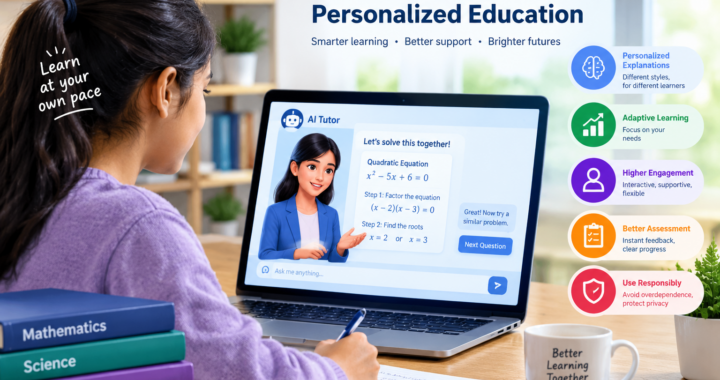
Example 1: Homework Assistant
A student uploads a math worksheet and asks, “Explain question five.”
The AI identifies the question from the image and provides a step-by-step explanation in text or speech.
Example 2: Travel Planning
Upload photos of a destination and ask for a five-day itinerary. The AI can describe landmarks, suggest activities, and generate a travel checklist.
Example 3: Product Support
A customer shares a picture of a damaged appliance and a short voice note. The AI analyzes the image, interprets the spoken description, and suggests troubleshooting steps.
Industries Being Transformed
🎓 Education
Students benefit from:
- Interactive tutoring
- Lecture summaries
- Automatic note generation
- Personalized quizzes
- Language translation
Teachers can quickly prepare lesson plans and multimedia content.
🏥 Healthcare
AI assists healthcare professionals with:
- Medical image analysis
- Clinical documentation
- Patient education
- Research support
These systems are intended to support—not replace—professional medical judgment.
💼 Business
Organizations use multimodal AI for:
- Customer support
- Knowledge management
- Document analysis
- Meeting summaries
- Workflow automation
💻 Software Development
Developers can:
- Upload UI screenshots
- Generate code
- Debug errors
- Explain stack traces
- Create documentation
🛒 E-commerce
Retailers use AI to:
- Recommend products
- Generate descriptions
- Create promotional visuals
- Improve customer search
🎬 Media and Entertainment
Creative teams use AI to:
- Draft scripts
- Generate storyboards
- Produce voiceovers
- Create subtitles
- Edit videos
Key Benefits
- Faster content creation
- Better contextual understanding
- More natural interactions
- Increased productivity
- Improved accessibility
- Reduced software switching
- Enhanced creativity
Challenges
Despite its strengths, multimodal AI has limitations:
- Hallucinations and factual errors
- Bias in training data
- Privacy concerns
- High computational costs
- Risks of deepfakes and misinformation
- Difficulty interpreting ambiguous inputs
Responsible development and careful human oversight remain essential.
Future Trends
Experts expect multimodal AI to become:
- More efficient and accessible on consumer devices
- Better at long-term reasoning
- More capable of handling complex workflows
- Better integrated with robotics and Internet of Things (IoT) devices
- Easier to personalize while preserving user privacy
Best Practices
To get the best results:
- Provide clear instructions.
- Upload high-quality media.
- Break complex requests into steps.
- Verify important outputs.
- Avoid sharing sensitive information unless you trust the service and understand its privacy practices.
Frequently Asked Questions
What makes multimodal AI different?
It processes and generates multiple forms of information instead of focusing on a single data type.
Can multimodal AI create videos?
Some AI systems can generate or edit video, while others specialize in understanding existing videos.
Is multimodal AI useful for businesses?
Yes. It can streamline customer support, content creation, document analysis, and internal workflows.
Will multimodal AI replace human creativity?
It is more likely to serve as a collaborative tool that accelerates creative work rather than replacing human judgment and originality.
Conclusion
Multimodal AI represents one of the biggest advances in artificial intelligence. By combining text, images, audio, video, documents, and code into a unified system, these models can solve more complex problems and provide more intuitive user experiences than previous generations of AI.
As adoption grows, multimodal AI is expected to become a core technology across industries—from education and healthcare to software development, marketing, research, and entertainment. Organizations and individuals who learn to use these tools effectively will be well-positioned to benefit from the next wave of AI innovation.