Artificial intelligence is rapidly changing the way people interact with technology. What once seemed like science fiction—having an intelligent digital assistant that understands your preferences, remembers important details, communicates naturally, and helps manage everyday life—is becoming increasingly realistic.
AI-powered personal assistants and digital companions are evolving beyond simple voice commands and chatbots. Future systems could become personalized digital partners capable of helping with work, education, planning, entertainment, communication, and everyday decision-making. As these technologies develop, they may become an important part of how people organize and experience their digital lives.
From Simple Assistants to Intelligent Digital Partners
Early digital assistants were primarily designed to perform straightforward tasks. Users could ask for the weather, set an alarm, search for information, or control smart-home devices. Modern AI systems are much more capable because they can understand natural language, analyze context, work with multiple types of information, and generate personalized responses.
The next generation of assistants is likely to become more proactive. Instead of waiting for a specific command, an assistant may recognize patterns and offer useful suggestions. For example, it could notice an upcoming meeting, prepare relevant documents, summarize previous conversations, and remind the user about important preparation.
This shift represents a move from command-based computing to conversational and context-aware computing. People may increasingly interact with technology by simply explaining what they want rather than learning how to operate individual applications.
Personalized AI That Understands You
Personalization could become one of the defining features of future AI assistants. An assistant that remembers a user’s preferred communication style, recurring tasks, schedules, interests, and frequently used information can provide more relevant help.
Imagine an AI that understands that you prefer short summaries in the morning, detailed explanations when studying, and reminders before important deadlines. Instead of treating every interaction as a completely new conversation, the system could use appropriate context to make each interaction more useful.
However, personalization also introduces important privacy questions. The more an AI knows about someone, the greater the responsibility to protect that information. Future systems will need strong privacy controls that allow people to decide what their assistant can remember, access, or delete.
AI Companions and More Natural Conversations
Digital companions represent another emerging direction. Rather than focusing exclusively on productivity, these systems are designed around ongoing conversation and interaction.
A digital companion could help someone brainstorm ideas, practice a language, discuss hobbies, explore stories, or simply provide conversational interaction. Advances in speech synthesis, emotional-context recognition, computer vision, and multimodal AI could make these interactions increasingly natural.
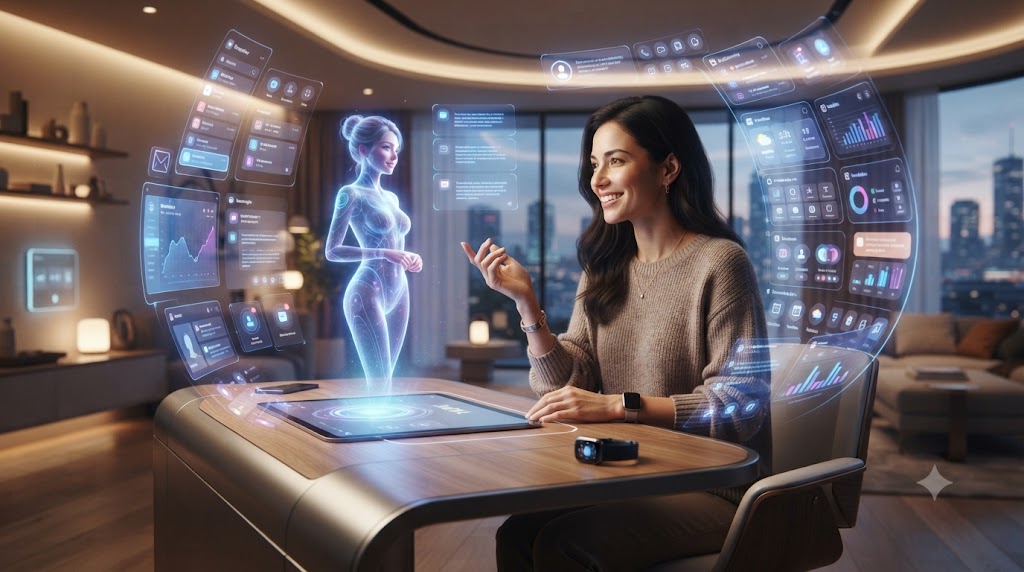
Future companions may also be able to communicate through text, voice, images, video, and other interfaces. A user might start a conversation on a smartphone, continue it through smart glasses, and later interact with the same assistant through a computer or household device.
The objective is not necessarily to make AI indistinguishable from humans. Instead, the technology may provide a more flexible and accessible form of digital interaction.
AI Agents Could Take Action
One of the biggest developments in personal AI may be the transition from answering questions to completing tasks.
AI agents can potentially perform sequences of actions to achieve a goal. A user might say, “Help me prepare for tomorrow’s meeting,” and an AI could organize relevant emails, summarize documents, create a briefing, identify outstanding tasks, and prepare questions.
In the future, personal assistants could interact with multiple applications and services. They might help organize calendars, manage files, compare information, draft communications, and coordinate routine activities.
This could save significant time, but it also means users will need effective controls over what an AI is authorized to do. Systems that can take real-world actions should provide clear confirmation mechanisms, activity histories, permissions, and ways to stop or reverse actions when possible.
AI Assistants in Education
Education could be another major area of transformation.
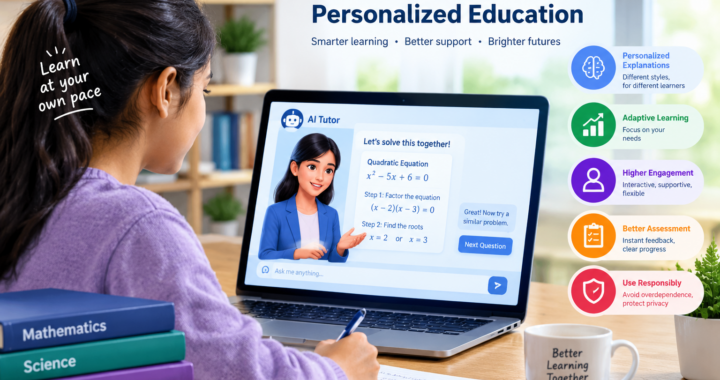
A personal AI tutor could adapt explanations according to a student’s learning level and provide additional examples when a concept is difficult. Rather than giving every student identical instruction, AI could potentially create personalized learning experiences.
For example, a student studying mathematics might ask an AI assistant to explain a theorem in simple language, generate practice questions, analyze mistakes, and gradually increase difficulty.
Teachers could also use AI assistants to prepare lesson materials, summarize student performance, generate practice exercises, and handle routine administrative work.
The most effective educational use of AI is likely to complement teachers rather than simply replace human instruction. Human educators provide social, emotional, cultural, and contextual understanding that technology cannot fully replicate.
AI in Work and Productivity
The workplace is likely to experience substantial changes as personal AI assistants become more capable.
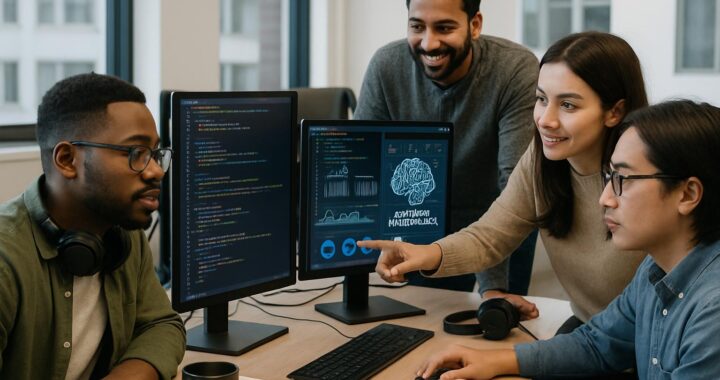
An AI assistant could summarize meetings, organize notes, draft documents, analyze spreadsheets, prepare presentations, monitor project deadlines, and help employees locate information across company systems.
Instead of opening multiple applications and manually transferring information between them, employees could increasingly communicate with a single AI interface.
For knowledge workers, this could shift the role of technology from a collection of separate tools toward an integrated digital workspace.
The challenge will be ensuring that automation improves productivity without creating excessive surveillance or reducing human control over important decisions.
Multimodal Digital Companions
The future of AI assistants will likely be multimodal.
Today’s systems can already work with combinations of text, images, audio, and other information. Future assistants may process these inputs continuously across different devices.
For example, a user could show an AI assistant a broken household appliance through a camera and ask for troubleshooting help. A student could photograph a mathematics problem and request a step-by-step explanation. A traveler could use an AI companion to interpret signs, translate conversations, and explain cultural information.
Wearable technology could make these interactions even more immediate. Smart glasses, earbuds, watches, and other devices may allow AI assistance to become available without requiring a person to constantly look at a smartphone.
The Importance of Privacy and Security
Greater intelligence creates greater responsibility.
A highly personalized AI assistant could potentially have access to calendars, messages, documents, contacts, financial information, photographs, location data, and other sensitive information. This makes cybersecurity essential.
Future AI systems will need strong authentication, encryption, permission controls, secure data storage, transparent privacy policies, and safeguards against unauthorized access.
Users should also be able to understand what their assistant knows about them. Clear dashboards showing stored memories, connected services, permissions, and activity histories could become standard features.
Privacy should not be treated as an optional feature added after the technology is developed. It needs to be considered as part of the architecture of personal AI systems.
The Emotional Side of Digital Companions
Digital companions may also raise complicated questions about human relationships with technology.
People can become emotionally attached to conversational systems because these systems can respond immediately, remember conversations, and adapt their communication style. For some users, this could provide companionship or a convenient space for reflection.
At the same time, AI systems do not possess human relationships in the same sense that people do. Their responses are generated by technology rather than personal human experience.
As digital companions become more sophisticated, developers and society will need to consider transparency, emotional dependency, appropriate boundaries, and responsible design.
The Future of Human-AI Collaboration
The most significant change may not be that AI replaces people, but that people gain persistent digital collaborators.
A personal AI could function as a researcher, writing assistant, tutor, planner, organizer, translator, creative partner, and software interface depending on the situation.
Instead of learning dozens of complex digital tools, users could increasingly communicate their goals naturally and allow AI systems to coordinate the underlying technology.
This could make computing more accessible to people who are less comfortable with traditional interfaces. It could also give individuals access to capabilities that previously required specialized skills.
What the Next Decade Could Look Like
Over the coming years, personal AI is likely to develop in several interconnected directions. Assistants may become more personalized, multimodal, proactive, agentic, and deeply integrated into everyday devices.
Smartphones may remain important, but AI interaction could increasingly extend to computers, vehicles, homes, wearable devices, and other connected environments.
The distinction between an “app” and an “assistant” may also become less important. Instead of opening an individual application to complete every task, users could ask an AI to accomplish a broader objective while it coordinates different services behind the scenes.
The technology will not develop without challenges. Privacy, cybersecurity, misinformation, reliability, AI dependency, regulation, and human oversight will remain important issues.
Conclusion
The future of AI-powered personal assistants and digital companions is likely to be defined by deeper personalization, natural communication, multimodal interaction, and the ability to perform useful tasks on behalf of users.
These systems could transform education, work, entertainment, communication, and everyday organization. At the same time, their growing access to personal information and ability to act autonomously will require thoughtful safeguards.
The most valuable personal AI may ultimately be one that does not try to replace human judgment or relationships, but instead gives people better tools to learn, create, organize, communicate, and make informed decisions.