Artificial intelligence is rapidly moving beyond chatbots and simple assistants. Modern AI agents are increasingly designed to plan tasks, use software tools, access information, write code, make decisions, and complete multi-step workflows.
This raises an important question:
Can AI agents really work without human supervision?
The short answer is: sometimes, for certain tasks—but not reliably or safely for everything.
An AI agent can operate autonomously when its environment is predictable, its permissions are limited, and the consequences of mistakes are low. But as soon as an agent is asked to make important decisions, handle sensitive information, spend money, interact with people, or operate in unpredictable situations, human oversight becomes much more valuable.
The future of AI is therefore unlikely to be about choosing between “humans” and “fully autonomous AI.” A more realistic direction is a spectrum of autonomy, where agents operate independently for routine tasks while humans remain responsible for important decisions.


🧠 What Makes an AI Agent Autonomous?
A traditional chatbot generally waits for a user prompt.
You ask:
“Write a summary of this document.”
It produces a response.
An AI agent is designed to go further. Given a goal, it may:
- Understand the objective.
- Break the objective into smaller tasks.
- Select appropriate tools.
- Execute actions.
- Observe the results.
- Adjust its plan.
- Continue until it reaches a defined outcome.
For example, a coding agent could receive:
“Find and fix the bug causing this test to fail.”
It may inspect the project, locate relevant code, modify files, run tests, analyze errors, and attempt additional fixes.
The more of these steps the system can perform without asking a person, the more autonomous it becomes.
🚀 Why Companies Want Autonomous AI Agents
The attraction is easy to understand.
Businesses contain thousands of repetitive digital processes.
Employees often spend time:
📧 Responding to routine emails
📊 Updating spreadsheets
📅 Scheduling meetings
📄 Processing documents
🔎 Searching databases
💻 Testing software
📝 Preparing reports
📋 Moving information between applications
If an AI agent can perform these tasks independently, employees could spend more time on activities requiring creativity, judgment, relationships, and strategic thinking.
The potential benefits include:
- ⚡ Faster workflows
- 💰 Lower operating costs
- 📈 Higher productivity
- 🌙 24/7 operation
- 🔄 Automated repetitive processes
- 📊 Consistent execution of standardized tasks
But these advantages only appear when agents can perform tasks reliably.
🕐 AI Agents Can Potentially Work Around the Clock
Unlike human employees, software agents don’t need traditional working hours.
A properly configured agent could potentially monitor a system continuously.
For example, an IT monitoring agent could:
🔍 Watch system logs
🚨 Detect unusual events
📊 Analyze performance
📩 Send alerts
🔧 Perform predefined recovery actions
This could be particularly valuable for routine monitoring.
But autonomy should be proportional to risk.
An agent might be allowed to restart a non-critical service automatically while requiring human approval before making changes to a production database.
🧩 Not All Tasks Require the Same Level of Supervision
One of the most important ideas in autonomous AI is that not every task needs the same level of human involvement.
Consider three categories.
🟢 Low-Risk Tasks
These can potentially be highly automated.
Examples:
- Formatting documents
- Organizing files
- Summarizing internal information
- Generating routine reports
- Sorting data
If something goes wrong, the consequences are relatively small.
🟡 Medium-Risk Tasks
These may benefit from monitoring or periodic review.
Examples:
- Drafting customer responses
- Updating business records
- Managing routine workflows
- Conducting preliminary research
🔴 High-Risk Tasks
Human approval is generally much more important.
Examples:
- Financial transactions
- Medical decisions
- Legal decisions
- Employment decisions
- Deleting important data
- Accessing highly sensitive information
This suggests that the future isn’t simply autonomous vs. supervised.
Instead, organizations can design different levels of autonomy.
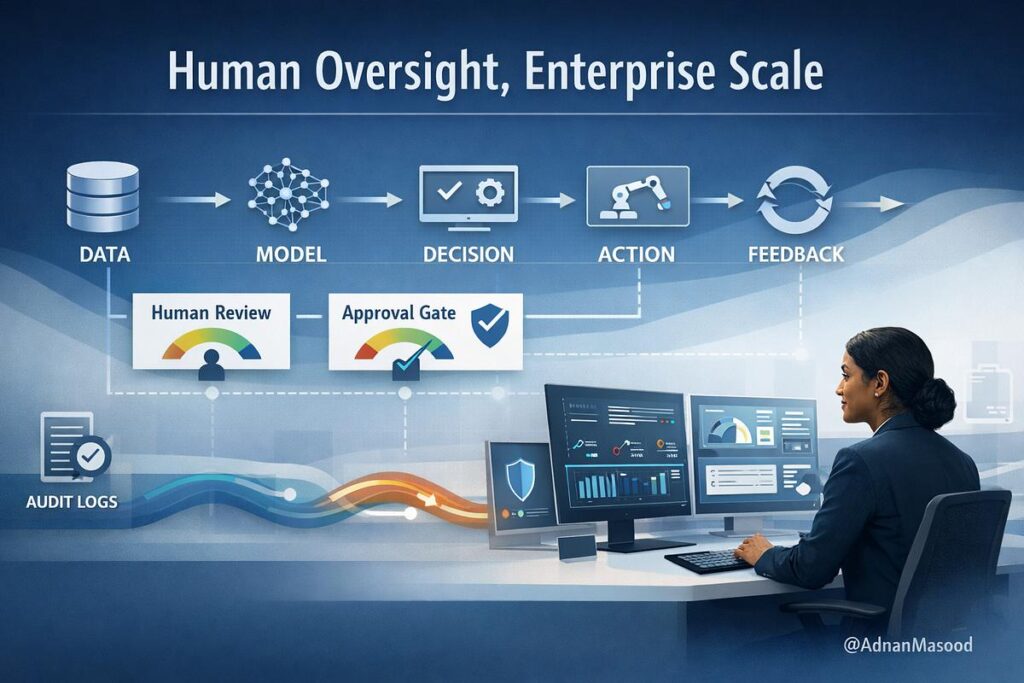
🔄 The Human-in-the-Loop Model
One popular approach is called human-in-the-loop AI.
The agent performs the work but asks a person for approval before taking important actions.
For example:
AI: “I’ve prepared this customer refund. Should I process it?”
Human: “Approve.”
AI: Executes the transaction.
This model combines automation with accountability.
The human doesn’t need to supervise every individual step.
Instead, they intervene at important decision points.
👀 Human-on-the-Loop AI
Another model is human-on-the-loop.
Here, the AI operates independently, while a person monitors the overall system.
For example:
🤖 Agent processes routine requests.
📊 Monitoring system tracks performance.
🚨 Human receives an alert if something unusual happens.
This can be more efficient than requiring approval for every action.
However, it depends on effective monitoring.
If humans receive thousands of alerts every day, they may become overwhelmed and miss important problems.
🤖 What Happens When AI Makes a Mistake?
This is the biggest problem with unsupervised AI.
Imagine an agent is instructed:
“Find the cheapest suitable flight and book it.”
The agent might misunderstand:
- The travel dates
- Airport preference
- Baggage requirements
- Refund policy
- Time constraints
A human might notice the mistake before purchasing.
An autonomous agent could potentially complete the booking before anyone notices.
This illustrates an important principle:
The more power an AI agent has to act, the more important error prevention becomes.
🧠 AI Can Be Confident and Still Be Wrong
One of the biggest misconceptions about AI agents is that better reasoning means perfect reasoning.
It doesn’t.
AI models can still:
❌ Misinterpret instructions
❌ Hallucinate information
❌ Choose inappropriate tools
❌ Make incorrect assumptions
❌ Misread documents
❌ Fail to recognize unusual situations
❌ Get stuck in loops
The problem becomes more serious when an agent is connected to external systems.
A chatbot generating an incorrect answer is one problem.
An agent acting on that incorrect answer can create a much larger problem.
🔐 The Permission Problem
Autonomous agents need access to tools.
A business agent might need:
📧 Email access
📅 Calendar access
📂 Document access
🗄️ Database access
💳 Financial systems
💻 Software development environments
But giving an AI access to everything is dangerous.
A better principle is:
Give agents the minimum permissions necessary.
For example, an agent responsible for scheduling meetings might need access to calendars but not financial accounts.
A reporting agent might need read access to a database but not permission to delete records.
This concept—limiting privileges—is an important part of designing safer autonomous systems.
🛡️ Guardrails Can Make Autonomous Agents Safer
AI agents can be surrounded by technical and organizational safeguards.
Examples include:
🔒 Permission restrictions
🚦 Approval requirements
📋 Audit logs
⏱️ Rate limits
💰 Spending limits
📂 Restricted data access
🧪 Automated testing
🚨 Anomaly detection
🛑 Emergency shutdown mechanisms
These controls don’t make agents perfect.
They reduce the potential impact of mistakes.
💰 Can AI Agents Manage Money Without Humans?
This is a good example of where autonomy becomes complicated.
An AI agent could potentially compare prices, prepare invoices, or categorize expenses.
But allowing it to independently move large amounts of money is much riskier.
A sensible system might use limits.
For example:
Under $50 → automatic
$50–$500 → notification
Above $500 → human approval
The exact limits would depend on the organization and task.
The principle is more important:
Autonomy should match the potential consequences of mistakes.
💻 AI Coding Agents: A Real-World Example
Coding is one of the areas where autonomous agents are becoming particularly useful.
An agent can potentially:
📂 Explore a codebase
💻 Write code
🧪 Run tests
🐛 Debug errors
🔍 Review changes
📦 Prepare builds
Developers can allow the system to operate independently within a controlled development environment.
But production environments are different.
An AI agent might generate a seemingly correct change that creates an unexpected security vulnerability or breaks another system.
That’s why many organizations are likely to maintain human review before important production changes.
🏢 AI Agents in Customer Service
Customer service is another promising area.
An agent can potentially answer common questions without human intervention.
For example:
Customer: “How do I reset my password?”
The AI can provide instructions.
But consider:
Customer: “I was charged twice and need a refund.”
Now the system may need to access account information and potentially issue money.
A carefully designed agent could handle routine cases automatically while escalating unusual or sensitive cases to a human.
This creates a hybrid support model.
🧑💼 AI Agents in Human Resources
HR is another field where automation must be handled carefully.
AI agents could potentially:
📄 Organize applications
📅 Schedule interviews
📝 Draft communications
📊 Prepare workforce reports
But making important decisions about people is far more sensitive.
Hiring, promotion, termination, and other employment decisions can involve complex contextual and legal considerations.
Human oversight is particularly important when AI outputs could materially affect people’s opportunities.
🏥 AI Agents in Healthcare
Healthcare provides an even clearer example of why full autonomy can be risky.
AI can potentially help:
📋 Organize information
📝 Summarize medical records
🔎 Find relevant literature
📊 Assist administrative workflows
But medical diagnosis and treatment decisions involve significant consequences.
An AI agent should not simply be given unlimited authority to make high-impact medical decisions without appropriate professional oversight and safeguards.
The more serious the consequences, the more important qualified human judgment becomes.
🌐 Autonomous AI and Cybersecurity
Cybersecurity is an interesting case because speed is extremely important.
A security agent could potentially:
🔍 Monitor network activity
🚨 Detect suspicious behavior
🧩 Investigate alerts
🔒 Isolate compromised systems
But automatically blocking legitimate users can also cause serious problems.
Imagine an agent incorrectly identifying a company’s most important server as malicious and shutting it down.
Therefore, security agents may need carefully designed escalation policies.
They could automatically handle well-understood threats while escalating ambiguous cases to security professionals.
🧪 AI Agents Need Testing Before Deployment
An agent should not simply be released into the real world because it performs well in a demonstration.
Organizations need to test:
Accuracy
Does it produce correct results?
Reliability
Does it perform consistently?
Tool Use
Does it select the right tools?
Safety
What happens when it receives unexpected instructions?
Security
Can it access information it shouldn’t?
Recovery
What happens when a tool fails?
Escalation
Does it know when to ask a human?
This final point is particularly important.
A sophisticated agent should know not only how to act, but also when not to act.
🚨 Knowing When to Stop
One of the most valuable characteristics of a reliable AI agent may be its ability to say:
“I don’t have enough information to safely continue.”
Imagine an agent processing an expense report.
If the document is unclear, the agent could either guess—or ask for clarification.
The second behavior is much safer.
Similarly, an agent could identify:
Conflicting instructions
Missing information
Unusual circumstances
Insufficient permissions
Unexpected system behavior
and escalate to a human.
True autonomy therefore doesn’t necessarily mean acting all the time.
Sometimes, stopping is the intelligent action.
📊 Measuring Autonomous AI Performance
Companies adopting AI agents need metrics.
They could measure:
- Task completion rate
- Error rate
- Human escalation rate
- Average completion time
- Cost per task
- Number of failed tool calls
- Security incidents
- Customer satisfaction
- Recovery success rate
A useful agent isn’t simply one that completes many tasks.
It needs to complete them correctly, safely, and economically.
💡 The Cost of Human Supervision
Human supervision also has a cost.
If an employee must approve every tiny action performed by an AI agent, the organization may not gain much efficiency.
Imagine an agent processing 10,000 routine requests.
If a human has to manually approve every one, automation becomes less valuable.
This is why the goal should be selective supervision.
Humans should concentrate on:
🧠 Complex decisions
⚠️ Exceptions
🔐 High-risk actions
🤝 Sensitive interactions
📈 Strategic choices
AI can handle:
🔄 Routine workflows
📊 Standardized processes
📝 Repetitive tasks
🌟 The Future May Be “Supervised Autonomy”
The most realistic future is probably not:
Humans → completely replaced
or
AI → completely controlled
Instead:
Supervised autonomy
AI agents operate independently within carefully defined boundaries.
Humans establish:
🎯 Goals
📏 Rules
🔐 Permissions
🚦 Limits
📋 Escalation procedures
The AI handles routine execution.
Humans intervene when necessary.
This could allow organizations to capture much of the efficiency of automation without giving AI unlimited authority.
🔮 Will AI Agents Eventually Become Fully Autonomous?
Possibly in some areas.
For highly predictable tasks, autonomous systems could become extremely reliable.
For example:
- Data formatting
- Routine monitoring
- Software testing
- Document classification
- Basic information retrieval
But “fully autonomous” is not a universal concept.
An AI could be fully autonomous for one task while requiring human supervision for another.
The question should therefore be:
“Autonomous for what?”
Rather than:
“Is the AI autonomous?”
🌍 A New Digital Workforce
AI agents could eventually become a form of digital workforce.
A company might operate specialized agents for:
🤖 Customer support
📊 Data analysis
💻 Software development
📧 Communication
📋 Administration
🔎 Research
🛡️ Security monitoring
Each agent could have a specific role and defined permissions.
Humans would manage the overall system.
This resembles a workplace where AI becomes a collection of specialized digital assistants rather than one universal artificial employee.
⚖️ The Ethical Question
As agents become more autonomous, society will also need to answer difficult questions.
Who is responsible if an AI agent makes a harmful decision?
Who should be accountable for an autonomous system?
How should companies explain AI decisions?
What data should agents be allowed to access?
How much autonomy is appropriate?
These aren’t purely technical questions.
They involve:
⚖️ Law
🛡️ Safety
🔐 Privacy
👥 Human rights
🏢 Corporate responsibility
As AI becomes more capable of acting independently, these questions will become increasingly important.
🏁 Conclusion: Can AI Agents Work Without Humans?
Yes—but only within appropriate boundaries.
AI agents are already capable of performing increasingly sophisticated multi-step tasks. Their ability to reason, use tools, interact with software, and operate continuously makes them powerful automation systems.
But complete independence is not the same thing as reliability.
For low-risk, predictable workflows, agents may be able to operate with minimal supervision.
For complex or high-impact tasks, human oversight remains essential.
The future will likely involve a graduated autonomy model:
🟢 Low-risk tasks: high autonomy
🟡 Medium-risk tasks: monitoring and periodic review
🔴 High-risk tasks: human approval
The most successful AI systems may therefore not be the ones that remove humans entirely.
They may be the ones that understand when to act, when to ask, and when to stop.
🤖 The future of AI isn’t necessarily human-free automation.
It is likely to be humans setting the direction while increasingly capable AI agents handle more of the journey.