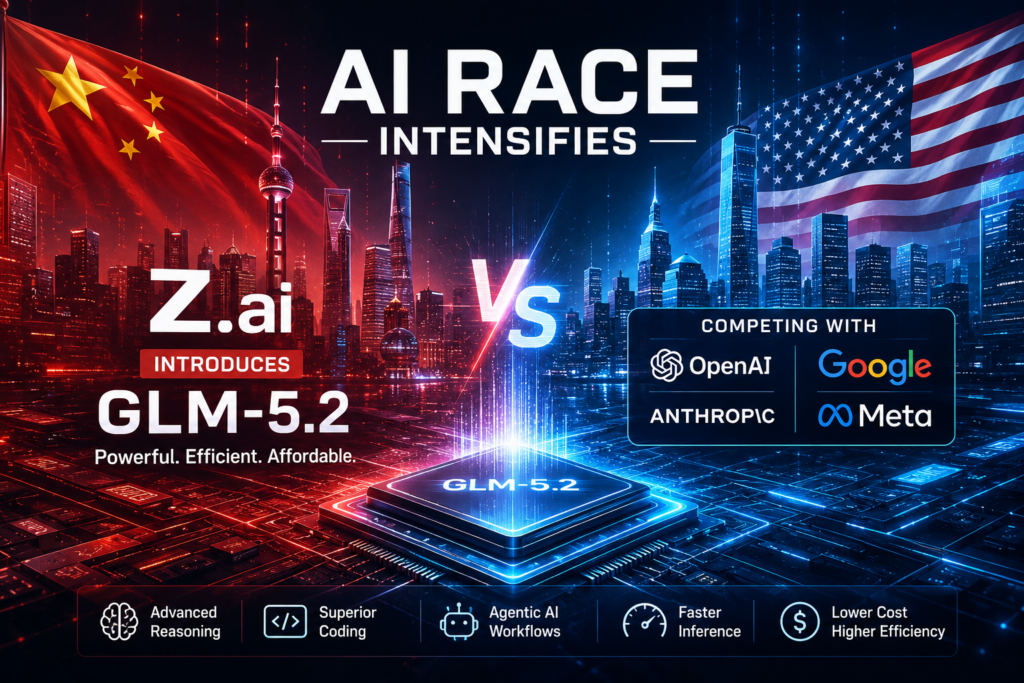
Chinese AI startup Z.ai has introduced its GLM-5.2 model, intensifying global AI competition. Explore its features, enterprise potential, cost efficiency, and how it compares with leading U.S. AI companies.


🌍 Introduction
Artificial Intelligence (AI) has rapidly become one of the most influential technologies of the 21st century. What began as a field focused on academic research has evolved into a global race involving governments, technology giants, startups, and research institutions. Today, AI is transforming industries ranging from healthcare and finance to education, manufacturing, entertainment, and cybersecurity.
For the past few years, American companies such as OpenAI, Google DeepMind, Anthropic, and Meta have largely dominated discussions surrounding frontier AI models. Their breakthroughs in generative AI, reasoning capabilities, coding assistants, and multimodal systems have shaped the modern AI landscape.
However, the competitive landscape is changing rapidly.
China has significantly accelerated its AI development efforts, supported by substantial investment in research, computing infrastructure, semiconductor innovation, and homegrown AI ecosystems. One of the latest developments attracting worldwide attention is the launch of GLM-5.2, a new flagship AI model developed by Chinese startup Z.ai.
The release has sparked discussions among researchers, investors, and enterprises about whether Chinese AI companies are beginning to close the gap with their American counterparts. Rather than competing solely on benchmark scores, Chinese firms are increasingly emphasizing affordability, efficiency, open-weight releases, and enterprise adoption.
This article explores what GLM-5.2 brings to the table, why it matters, how it compares with leading U.S. AI systems, and what this means for the future of global artificial intelligence.
🤖 Understanding the Global AI Race
Artificial Intelligence has become far more than a technological innovation—it has become a strategic national priority.
Countries now view AI as critical for:
- 🛡️ National security
- 📈 Economic growth
- 🏭 Industrial automation
- 🩺 Healthcare innovation
- 🚗 Autonomous transportation
- 🎓 Education
- 🌐 Digital infrastructure
Because AI is expected to influence nearly every industry, governments around the world are investing billions of dollars into AI research and development.
The competition is no longer limited to producing the smartest chatbot. Instead, it encompasses building complete AI ecosystems that include:
- Foundation models
- AI chips
- Cloud computing
- Developer platforms
- AI agents
- Robotics
- Edge AI
- Data infrastructure
In this environment, every major AI breakthrough has geopolitical and economic implications.
🇨🇳 China’s Growing AI Ambitions


China has invested heavily in AI over the last decade.
Its long-term vision includes becoming one of the world’s leading AI innovation hubs while reducing dependence on foreign technologies.
Chinese companies have made remarkable progress across several areas:
💡 Large Language Models
Several Chinese organizations have introduced advanced language models capable of competing internationally.
These include:
- Z.ai
- Alibaba
- Tencent
- Baidu
- Moonshot AI
- MiniMax
- DeepSeek
- ByteDance
Each organization is pursuing different strategies, including open-weight releases, enterprise AI platforms, multilingual models, and reasoning-focused systems.
🖥️ AI Infrastructure
Chinese firms continue investing in:
- GPU clusters
- AI supercomputers
- Cloud infrastructure
- Domestic semiconductor development
- AI accelerators
Although export restrictions have limited access to some advanced chips, Chinese companies have increasingly focused on optimizing software efficiency and maximizing available hardware resources.
🌐 Enterprise AI
Chinese AI developers are also targeting businesses rather than just consumers.
Enterprise applications include:
- Customer support automation
- Financial analysis
- Manufacturing optimization
- Smart cities
- Medical assistance
- Legal document review
- Software engineering
- Government services
This enterprise-first strategy is helping many AI startups establish sustainable business models.
🚀 Meet Z.ai
Among China’s growing collection of AI startups, Z.ai has quickly emerged as one of the most closely watched companies.
Although it may not yet enjoy the same global recognition as OpenAI or Google, the company has gained increasing attention among developers and AI researchers.
Its goal is ambitious:
Build powerful AI systems that are accessible, efficient, and affordable.
Instead of simply chasing larger models, Z.ai has concentrated on improving:
- ⚡ Speed
- 💰 Cost efficiency
- 🧠 Reasoning
- 💻 Coding
- 🤖 AI agent capabilities
These priorities align with growing enterprise demand, where operational costs often matter just as much as benchmark performance.
⭐ Introducing GLM-5.2


GLM-5.2 represents the newest generation of Z.ai’s language model family.
According to public reports, the model introduces major improvements in multiple areas, including:
🧠 Advanced Reasoning
Modern AI users increasingly expect models to solve complex problems rather than merely generate fluent text.
GLM-5.2 reportedly demonstrates stronger reasoning abilities across:
- Logical analysis
- Multi-step problem solving
- Mathematical reasoning
- Scientific questions
- Decision-making tasks
Reasoning performance has become one of the most important indicators of frontier AI quality.
💻 Coding Assistance
Software development is one of the fastest-growing AI applications.
GLM-5.2 reportedly performs well across coding tasks such as:
- Code generation
- Bug fixing
- Refactoring
- Documentation
- Code explanation
- Algorithm development
Strong coding capabilities make AI assistants valuable for both professional developers and students.
🤖 Agentic AI
One of the industry’s biggest trends is agentic AI.
Rather than responding to a single prompt, AI agents can:
- Plan tasks
- Execute workflows
- Use external tools
- Search documents
- Analyze files
- Generate reports
- Automate repetitive work
GLM-5.2 reportedly improves performance in these autonomous task scenarios.
This reflects a broader industry shift from simple chatbots toward intelligent digital assistants capable of handling complex workflows.
⚡ Faster Performance
Efficiency has become a major competitive advantage.
Organizations deploying AI at scale often process millions of requests every day.
Even modest improvements in efficiency can reduce infrastructure costs dramatically.
Reports suggest GLM-5.2 offers:
- Faster inference
- Lower latency
- Improved throughput
- Better hardware utilization
For enterprise customers, these improvements can translate into significant cost savings.
💰 Why Cost Matters More Than Ever
One of the most interesting aspects of China’s AI strategy is its emphasis on affordability.
While benchmark performance remains important, businesses increasingly evaluate AI based on total operating cost.
Factors include:
- GPU requirements
- Inference pricing
- Deployment costs
- Cloud expenses
- Maintenance
- Energy consumption
Lower costs make advanced AI accessible to:
- 🚀 Startups
- 🏢 Small businesses
- 🎓 Universities
- 🧑💻 Independent developers
- 🌍 Emerging markets
If AI becomes significantly cheaper to deploy, adoption could accelerate across industries worldwide.
📊 The Shift from Bigger Models to Smarter Models
During the early years of generative AI, companies focused heavily on creating larger and larger models.
Today, priorities are evolving.
Instead of simply increasing parameter counts, AI developers are optimizing for:
- Better reasoning
- Lower costs
- Faster responses
- Reduced hallucinations
- Tool use
- Long-context understanding
- Agent capabilities
This shift benefits users because it emphasizes practical performance rather than raw scale.
GLM-5.2 reflects this broader trend, aiming to deliver competitive capabilities while improving efficiency and affordability.
🚀 Chinese AI Competition Intensifies: How Z.ai’s GLM-5.2 Is Challenging the U.S. AI Giants (Part 2/3)


📊 Benchmark Performance: How Does GLM-5.2 Compare?
Whenever a new frontier AI model is released, one of the first questions researchers ask is:
How well does it perform against the best models available today?
Although benchmark scores never tell the complete story, they provide valuable insight into a model’s strengths and weaknesses.
According to public reports and early evaluations, GLM-5.2 performs strongly across several important categories, particularly:
- 🧠 Logical reasoning
- 💻 Software engineering
- 📄 Long-document understanding
- 🤖 AI agent workflows
- 🔍 Information retrieval
- 📚 Knowledge-intensive tasks
Rather than aiming only for conversational fluency, GLM-5.2 has been optimized for real-world productivity, making it attractive to businesses and developers seeking practical AI solutions.
💻 Coding Is Becoming the New AI Battleground


Coding has emerged as one of the most competitive areas in AI development.
Modern AI systems can assist with:
- Writing functions
- Explaining unfamiliar code
- Detecting bugs
- Generating unit tests
- Translating between programming languages
- Refactoring legacy applications
- Creating documentation
- Automating repetitive programming tasks
For software teams, these capabilities can significantly improve productivity.
Reports suggest that GLM-5.2 demonstrates strong performance in coding-related tasks, making it a compelling option for developers building applications, websites, and enterprise software.
🤖 The Rise of Agentic AI
One of the most exciting trends in artificial intelligence is the evolution from chatbots to AI agents.
Unlike traditional chatbots that answer one question at a time, AI agents can:
- 📅 Plan multi-step tasks
- 📂 Access documents
- 🌐 Search the web
- 📊 Analyze data
- 📝 Write reports
- 📧 Draft emails
- 🔧 Use external tools
- ⚙️ Automate workflows
This capability is transforming how businesses think about AI adoption.
GLM-5.2 has reportedly been designed with these advanced workflows in mind, enabling more autonomous and efficient task execution.
🏢 Enterprise AI Is the Biggest Opportunity
Consumer chatbots often receive the most media attention, but the largest commercial opportunity lies in enterprise AI.
Businesses are increasingly deploying AI to:
- Improve customer service
- Analyze contracts
- Automate financial reporting
- Generate marketing content
- Assist software engineers
- Enhance cybersecurity monitoring
- Optimize supply chains
- Accelerate research and development
For these use cases, reliability, scalability, and operating costs are often more important than generating creative text.
This focus on enterprise needs is one reason why models like GLM-5.2 are gaining attention.
💰 Cost Efficiency: A Competitive Advantage
One of GLM-5.2’s most discussed strengths is its potential cost efficiency.
Running advanced AI models requires substantial computing resources, including high-performance GPUs, networking infrastructure, and energy.
For organizations processing millions of AI requests each day, even small efficiency gains can translate into major savings.
Potential benefits include:
- ⚡ Faster inference
- 💵 Lower operational expenses
- 🔋 Reduced energy consumption
- 📈 Better scalability
- 🌍 Greater accessibility for startups and smaller organizations
Lower costs could make advanced AI more widely available across industries and regions.
🇺🇸 How Does GLM-5.2 Compare with Leading U.S. AI Models?
The U.S. remains home to several of the world’s leading AI developers, including OpenAI, Google, Anthropic, and Meta.
While each model has unique strengths, comparisons generally focus on areas such as reasoning, coding, multimodal capabilities, speed, and pricing.
| Feature | GLM-5.2 | Leading U.S. Frontier Models |
|---|---|---|
| 🧠 Reasoning | Strong | Very Strong |
| 💻 Coding | Strong | Excellent |
| ⚡ Speed | High | High |
| 💰 Cost Efficiency | Competitive | Varies by provider |
| 🤖 Agent Workflows | Advanced | Advanced |
| 🌍 Enterprise Focus | Strong | Strong |
It’s important to note that no single benchmark determines the “best” model. Organizations often choose models based on their specific requirements, such as latency, pricing, compliance, or integration capabilities.
🌐 Open-Weight Models and Accessibility
A growing trend in the AI industry is the release of open-weight models.
These models allow developers and organizations to run AI systems on their own infrastructure rather than relying exclusively on cloud-hosted services.
Potential advantages include:
- 🔒 Greater control over data
- 🏢 Easier enterprise customization
- 💻 Local deployment
- ⚙️ Fine-tuning for specialized tasks
- 💸 Reduced long-term costs
Chinese AI companies have increasingly embraced this strategy, helping expand adoption among developers worldwide.
🔐 Security, Privacy, and Trust
Despite rapid technical progress, AI adoption also depends on trust.
Organizations evaluating any frontier AI model—regardless of its origin—consider factors such as:
- Data privacy
- Security controls
- Regulatory compliance
- Transparency
- Governance
- Model reliability
These considerations are especially important in industries like healthcare, finance, government, and legal services, where sensitive information is routinely processed.
As a result, technical capability is only one factor influencing enterprise adoption.
🌍 Geopolitical Implications
The AI race is not solely about technology; it also reflects broader geopolitical and economic dynamics.
Governments around the world are investing heavily in:
- Domestic semiconductor production
- AI research
- Cloud infrastructure
- Workforce development
- National AI strategies
This competition is likely to shape future policies on technology exports, data governance, and international collaboration.
At the same time, many experts emphasize that global cooperation will remain important for addressing shared challenges such as AI safety, security, and responsible development.
🚀 Chinese AI Competition Intensifies: How Z.ai’s GLM-5.2 Is Challenging the U.S. AI Giants (Part 3/3)


🌍 The Future of China’s AI Ecosystem
China’s AI industry has evolved rapidly over the past decade, supported by investments in research, cloud infrastructure, semiconductor development, and a growing community of AI startups.
Companies such as Z.ai are contributing to a broader ecosystem that aims to deliver advanced AI solutions for businesses, developers, researchers, and public-sector organizations.
Rather than focusing on a single flagship chatbot, many Chinese AI firms are building comprehensive platforms that include:
- 🤖 Large language models
- 🧩 AI agent frameworks
- ☁️ Cloud AI services
- 💻 Developer tools
- 📊 Enterprise productivity solutions
- 🏭 Industry-specific AI applications
This ecosystem approach could help accelerate AI adoption across multiple sectors, particularly where cost and customization are major considerations.
🚀 Opportunities for Developers and Startups
AI is lowering barriers for innovation.
Developers now have access to increasingly capable models that can help with:
- 💡 Brainstorming ideas
- 💻 Writing code
- 🧪 Testing software
- 📝 Creating documentation
- 📈 Data analysis
- 🎨 Content generation
- 🤝 Customer support automation
If competitive pricing continues, startups may be able to experiment with sophisticated AI applications without the infrastructure budgets once required for large-scale machine learning.
This could encourage innovation in areas such as:
- Healthcare
- Education
- E-commerce
- Financial technology
- Manufacturing
- Agriculture
- Robotics
- Smart cities
🏢 How Businesses May Benefit
Businesses evaluating AI platforms typically look beyond raw benchmark scores. Key decision factors include:
- Performance: Can the model complete complex tasks accurately?
- Cost: Is it affordable to deploy at scale?
- Scalability: Can it handle growing workloads?
- Security: Does it meet organizational requirements?
- Integration: Can it connect with existing tools and workflows?
- Support: Are documentation and developer resources available?
As competition increases, providers are likely to improve their offerings across all of these dimensions, giving organizations more choices.
⚖️ Challenges Ahead
Despite the excitement surrounding GLM-5.2 and similar models, several challenges remain for the global AI industry.
🔒 Trust and Governance
Organizations need confidence that AI systems are reliable, secure, and used responsibly. This includes addressing issues such as hallucinations, bias, and transparency.
🌐 International Regulation
Governments are continuing to develop policies governing AI safety, privacy, copyright, and accountability. Regulatory requirements may differ across regions, affecting how AI models are deployed.
💻 Infrastructure Demands
Training and serving frontier AI models require significant computing power and energy. Improving efficiency will remain a major focus for AI companies worldwide.
👩💻 Talent Competition
Demand for AI researchers, engineers, and product specialists continues to grow, making talent acquisition a strategic priority for both startups and established technology firms.
📈 What This Means for the Global AI Market
The emergence of capable models from multiple regions is likely to accelerate innovation.
Increased competition can encourage:
- 🚀 Faster product development
- 💰 More competitive pricing
- 🌍 Broader AI accessibility
- 🔬 Continued research into reasoning and agentic AI
- 🤝 Expanded collaboration between developers and businesses
Rather than a single company dominating the market, the AI ecosystem may continue to diversify, with organizations selecting models based on their specific technical, operational, and regulatory needs.
🔮 Looking Ahead
The release of GLM-5.2 illustrates how quickly the AI landscape is evolving. Advances are no longer measured only by larger models or higher benchmark scores; efficiency, affordability, usability, and enterprise readiness have become equally important.
Future competition is expected to focus on:
- 🧠 More capable reasoning
- 🤖 Smarter AI agents
- 🎥 Multimodal understanding (text, images, audio, and video)
- 🌐 Better multilingual support
- ⚡ Lower operating costs
- 🔒 Improved safety and governance
- ☁️ Seamless enterprise integration
Users, developers, and businesses are likely to benefit from this rapid pace of innovation as AI tools become more powerful and more widely available.
❓ Frequently Asked Questions (FAQ)
1. What is GLM-5.2?
GLM-5.2 is a large language model developed by the Chinese AI startup Z.ai. It is designed to support advanced reasoning, coding assistance, and AI agent workflows.
2. Why is GLM-5.2 receiving attention?
The model has attracted interest because of its reported combination of strong performance and cost efficiency, contributing to discussions about China’s growing role in frontier AI.
3. Does GLM-5.2 outperform U.S. AI models?
Performance varies depending on the benchmark and task. Different models excel in different areas, and organizations often evaluate them based on their own requirements rather than a single overall ranking.
4. What industries could benefit from AI models like GLM-5.2?
Potential applications include software development, customer service, education, healthcare, finance, manufacturing, research, and business automation.
5. Why is cost efficiency important?
Lower operating costs can make advanced AI more accessible to startups, educational institutions, and businesses with limited infrastructure budgets.
🎯 Conclusion
The introduction of GLM-5.2 by Z.ai highlights the increasingly competitive nature of the global AI landscape. As Chinese and U.S. companies continue to invest in research and product development, users are seeing rapid improvements in reasoning, coding, automation, and enterprise capabilities.
While technical performance remains important, the next phase of AI competition is also being shaped by affordability, deployment efficiency, trust, governance, and real-world usability. Businesses now have a growing range of options, allowing them to select AI platforms that best fit their operational needs and regulatory environments.
Ultimately, healthy competition among AI developers can drive innovation, reduce costs, and expand access to advanced technologies. As the ecosystem continues to mature, the emphasis is likely to remain on creating AI systems that are not only more capable but also more practical, reliable, and accessible for organizations around the world.