MiniMax launches M3, an open-weight AI model featuring a 1 million token context window, multimodal capabilities, advanced coding performance, and powerful agentic AI features.

The AI race has entered a new phase with the launch of MiniMax M3, an open-weight foundation model designed to compete directly with leading proprietary systems. Released on June 1, 2026, M3 combines three capabilities rarely found together in a single open model: a 1 million token context window, native multimodal understanding, and advanced agentic reasoning for coding and autonomous task execution.
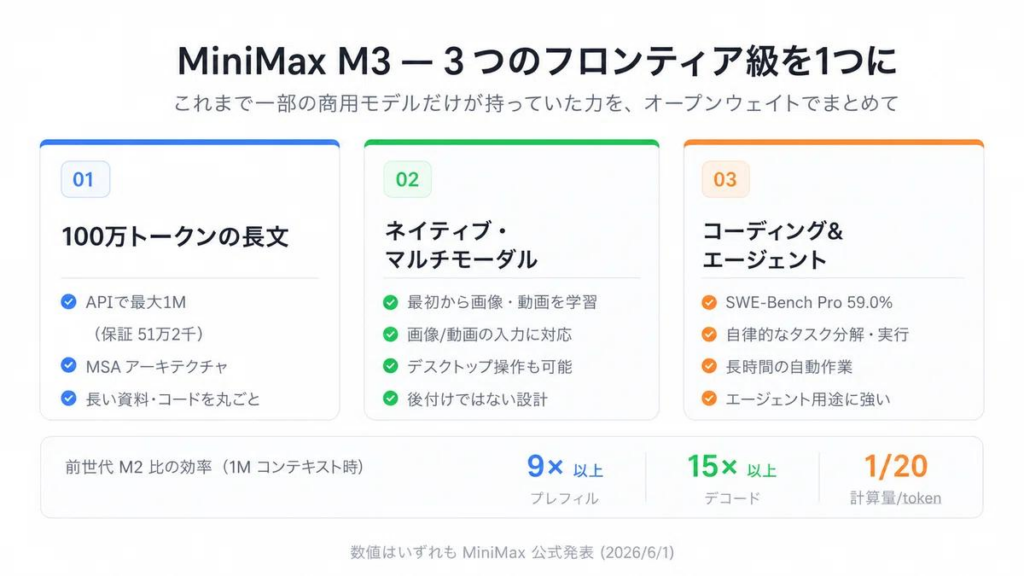
The release is significant because it narrows the gap between open-weight AI models and the most advanced closed-source systems. MiniMax positions M3 as the first open-weight model to simultaneously offer frontier-level coding performance, million-token context handling, and multimodal capabilities.
What Makes MiniMax M3 Different?

Most AI models force developers to choose between long context, strong coding performance, or multimodal functionality. MiniMax M3 attempts to deliver all three.
Key features include:
- 1 million token context window
- Text, image, and video input support
- Agentic task execution capabilities
- Desktop computer operation support
- Open-weight availability
- New MiniMax Sparse Attention (MSA) architecture
This combination makes M3 suitable for applications such as software development, enterprise document analysis, research workflows, autonomous agents, and multimodal content processing.
The Power of a 1 Million Token Context Window
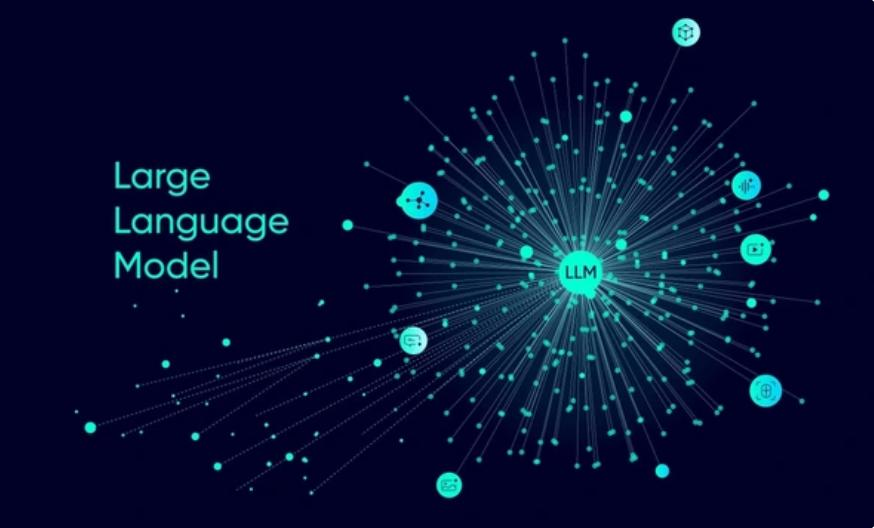
One of the headline features of M3 is its ability to process up to 1 million tokens in a single context.
For perspective:
- A typical novel contains around 100,000–150,000 words.
- Large code repositories can be analyzed in a single prompt.
- Extensive legal, financial, or research archives can be processed without aggressive chunking.
This capability allows AI systems to maintain continuity across massive datasets and complex workflows. Developers can feed entire projects, technical documentation, or large knowledge bases into the model while preserving context.
Introducing MiniMax Sparse Attention (MSA)
The technology enabling this scale is called MiniMax Sparse Attention (MSA).
Traditional transformer architectures become increasingly expensive as context length grows. MSA addresses this challenge by selecting only the most relevant portions of stored information before performing computationally intensive attention calculations.
According to MiniMax, this architecture:
- Reduces computation costs for million-token contexts
- Delivers approximately 9.7× faster input processing
- Achieves roughly 15.6× faster response generation at maximum context length
- Uses about one-twentieth of the compute required by the previous generation for long-context tasks
If these claims continue to hold under broader testing, MSA could become one of the most important architectural innovations in long-context AI systems.
Strong Agentic Capabilities
M3 is not only designed for conversation.
MiniMax emphasizes the model’s ability to act as an autonomous agent capable of:
- Executing multi-step workflows
- Navigating desktop environments
- Performing coding tasks
- Using tools and APIs
- Conducting web-based research
- Managing long-horizon objectives
This aligns with the industry’s broader shift toward AI agents that can complete tasks rather than simply generate text.
Coding Performance Targets Frontier Models
Coding has become one of the most important benchmarks for advanced AI systems.
MiniMax reports that M3 performs exceptionally well on software engineering evaluations. The company claims the model exceeds the performance of GPT-5.5 and Gemini 3.1 Pro on the SWE-Bench Pro benchmark while approaching the level of top-tier proprietary systems.
Additional benchmark highlights reported by MiniMax include:
- Competitive software engineering performance
- Strong terminal-based agent execution
- High scores in web browsing and research benchmarks
- Advanced tool-use capabilities
While independent verification remains important, the reported results indicate that open-weight models are continuing to close the performance gap with closed competitors.
Native Multimodal Understanding
Unlike many language-focused models, M3 was built with multimodal capabilities from the beginning.
The model supports:
- Text input
- Image input
- Video input
- Text output
This allows developers to build applications that combine visual understanding with long-context reasoning and agentic workflows. Examples include:
- Video analysis systems
- Document intelligence platforms
- Visual coding assistants
- Enterprise knowledge management tools
- Research automation agents
Why Open Weights Matter
The term open-weight means developers can access and run the model weights themselves, enabling:
- Greater customization
- Private deployment
- Enterprise control
- Lower long-term operating costs
- Independent experimentation
This differs from purely API-based proprietary systems where model internals remain inaccessible.
Open-weight releases have become increasingly important as organizations seek greater transparency and flexibility in deploying AI technologies. M3’s launch strengthens the growing ecosystem of high-performance open AI models.
Potential Enterprise Applications
MiniMax M3 could have significant impact across industries.
Software Development
Developers can analyze entire repositories, generate code, debug applications, and automate engineering workflows using a single model.
Legal and Compliance
Large contracts, regulations, and case documents can be processed within one context window, improving consistency and reducing fragmentation.
Research and Knowledge Management
Organizations can build systems capable of understanding vast collections of reports, papers, and internal documentation simultaneously.
Autonomous Agents
The model’s agentic abilities make it suitable for AI assistants that perform complex multi-step tasks across digital environments.
Competitive Positioning
M3 enters a crowded market that includes models from:
- OpenAI
- Anthropic
- Alibaba
- DeepSeek
Its primary differentiator is the combination of:
- Open-weight accessibility
- Million-token context support
- Multimodal processing
- Agentic performance
- Competitive coding benchmarks
Few models currently deliver all five capabilities simultaneously.
Challenges and Considerations
Despite the excitement, several questions remain:
- Some benchmark claims are company-reported and await broader independent validation.
- Open-weight release details and licensing continue to evolve.
- Long-context performance in real-world production environments will require extensive testing.
- Enterprises must evaluate governance, compliance, and infrastructure requirements before deployment.
As with any major AI release, practical adoption will depend on how well the model performs outside benchmark environments.
Conclusion
MiniMax M3 represents one of the most ambitious open-weight AI releases of 2026. By combining a 1 million token context window, native multimodal capabilities, and advanced agentic performance, the model pushes open AI systems closer to frontier proprietary offerings. Its new MiniMax Sparse Attention architecture aims to make massive-context reasoning economically viable, while strong coding and automation capabilities position it as a serious contender in the next generation of AI development tools.
Whether M3 ultimately reshapes the competitive landscape will depend on independent validation and real-world deployment results, but its launch clearly signals that open-weight AI is advancing at a remarkable pace.