Artificial Intelligence (AI) has evolved far beyond simple chatbots and recommendation systems. Today, AI agents are transforming the way businesses and individuals work by making decisions, solving problems, and completing tasks with minimal human intervention. From virtual assistants that schedule meetings to autonomous systems that manage supply chains, AI agents are becoming a cornerstone of the next digital revolution.
In this article, we’ll explore what AI agents are, how they work, their different types, real-world applications, benefits, challenges, and why they matter for the future.
🤖 What Are AI Agents?
An AI agent is a software system capable of perceiving its environment, processing information, making decisions, and taking actions to achieve specific goals.
Unlike traditional software that follows fixed instructions, AI agents can:
- Learn from experience
- Adapt to changing situations
- Make decisions independently
- Interact with users and other systems
- Plan multiple steps ahead
Think of an AI agent as a digital employee that can understand objectives and work toward completing them.
🧠 How AI Agents Work
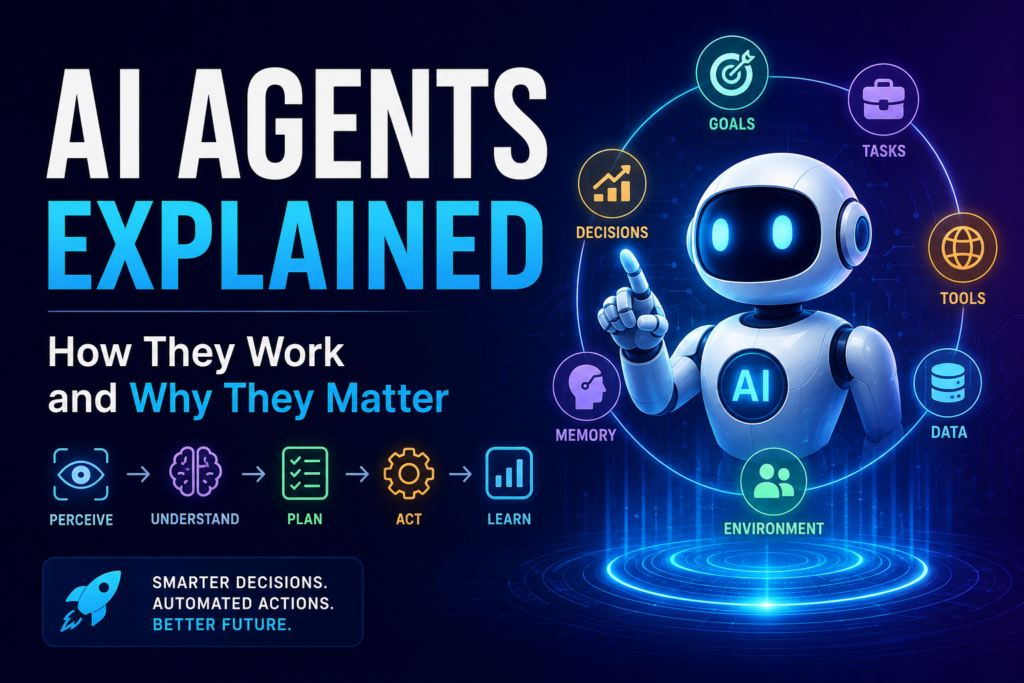
AI agents operate through a continuous cycle:
1. Perception
The agent gathers information from its environment.
Examples include:
- User prompts
- Emails
- Databases
- Sensors
- APIs
- Documents
- Images
- Audio
2. Understanding
Using AI models like Large Language Models (LLMs), the agent interprets:
- Context
- Intent
- Instructions
- Historical information
Instead of merely matching keywords, modern agents understand natural language.
3. Planning
The AI determines:
- What needs to be done
- Which tools are required
- What sequence of actions should be taken
Example:
User asks:
“Book my flight, reserve a hotel, and add everything to my calendar.”
The AI creates a multi-step plan before taking action.
4. Decision Making
The agent evaluates possible solutions based on:
- Accuracy
- Efficiency
- User preferences
- Available resources
It may compare several options before selecting the best one.
5. Action
The AI executes tasks by interacting with:
- Web browsers
- APIs
- Business software
- Databases
- Productivity tools
Examples:
- Sending emails
- Creating reports
- Booking appointments
- Updating spreadsheets
6. Learning
Advanced AI agents improve through:
- Feedback
- User interactions
- Performance evaluation
- Reinforcement learning
- Memory systems
Over time, they become more accurate and personalized.
🔄 AI Agent Workflow
Receive Goal
      ↓
Collect Information
      ↓
Understand Context
      ↓
Create Plan
      ↓
Use Tools
      ↓
Take Action
      ↓
Evaluate Results
      ↓
Improve Performance
🏗️ Components of an AI Agent
A typical AI agent includes:
🧩 Brain (AI Model)
Responsible for reasoning, language understanding, and decision-making.
Examples include advanced language models capable of planning and generating responses.
🧠 Memory
Stores:
- Previous conversations
- User preferences
- Task history
- Long-term knowledge
Memory helps agents personalize future interactions.
🔧 Tools
Agents extend their capabilities by using external tools such as:
- Search engines
- Calculators
- Email services
- Code interpreters
- Databases
- Calendars
- File systems
📊 Planning Engine
Breaks complex goals into smaller tasks.
Example:
Goal:
“Launch a marketing campaign.”
The planning engine creates subtasks such as:
- Market research
- Competitor analysis
- Content creation
- Social media scheduling
- Performance tracking
🌍 Environment
The environment is where the agent operates.
Examples include:
- Websites
- Cloud platforms
- Enterprise software
- Smart homes
- Robots
- Mobile apps
📚 Types of AI Agents
1. Simple Reflex Agents
These respond immediately to current inputs without memory.
Example:
A thermostat turns on the air conditioning when the temperature exceeds a set limit.
Best for:
- Basic automation
- Simple decision-making
2. Model-Based Agents
These maintain an internal model of the world.
They remember previous events and use that knowledge to make better decisions.
Example:
A robot vacuum remembers where it has already cleaned.
3. Goal-Based Agents
These work toward achieving a specific objective.
Example:
A navigation app finds the fastest route to your destination.
4. Utility-Based Agents
These compare multiple solutions and choose the most beneficial one.
Example:
Choosing a flight based on:
- Price
- Travel time
- Airline rating
- Layovers
5. Learning Agents
These improve over time by learning from experience.
Examples include:
- Recommendation systems
- AI tutors
- Fraud detection systems
6. Autonomous AI Agents
These perform long sequences of tasks independently.
Examples:
- AI software developers
- Autonomous customer support
- Research assistants
- Financial trading systems
🌍 Real-World Applications
💼 Business
AI agents can:
- Handle customer support
- Generate reports
- Analyze data
- Schedule meetings
- Manage workflows
🏥 Healthcare
Applications include:
- Appointment scheduling
- Medical documentation
- Patient monitoring
- Drug discovery assistance
- Clinical decision support
🎓 Education
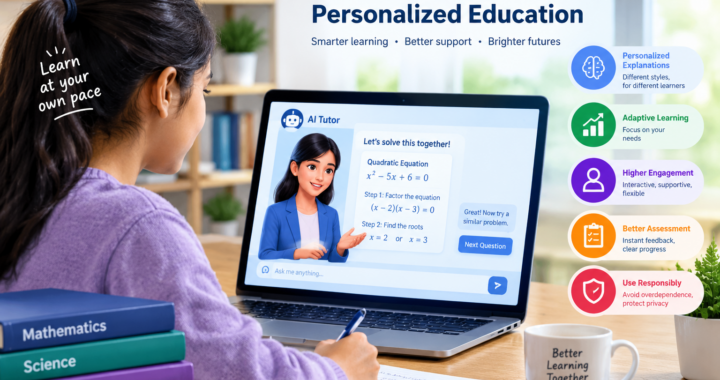
AI tutors can:
- Answer student questions
- Generate quizzes
- Explain concepts
- Create personalized study plans
🛍️ E-Commerce
AI agents help with:
- Product recommendations
- Inventory management
- Price optimization
- Customer service
- Order tracking
💰 Finance
Used for:
- Fraud detection
- Investment research
- Risk analysis
- Budget planning
- Automated customer support
🚗 Transportation
AI agents power:
- Autonomous vehicles
- Route optimization
- Fleet management
- Traffic prediction
⭐ Benefits of AI Agents
🚀 Increased Productivity
Agents automate repetitive work, allowing people to focus on higher-value tasks.
⏰ 24/7 Availability
They can operate continuously without breaks.
📈 Better Decision Making
By analyzing large datasets quickly, AI agents can support more informed decisions.
💰 Cost Savings
Automation reduces manual effort and operational expenses.
😊 Personalized Experiences
Agents learn user preferences to provide tailored recommendations and assistance.
⚡ Scalability
A single AI agent can handle thousands of requests simultaneously.
⚠️ Challenges and Risks
Despite their advantages, AI agents also present challenges:
- Hallucinations or incorrect outputs
- Privacy and data security concerns
- Bias in training data
- Over-reliance on automation
- Complex debugging
- Regulatory and ethical issues
Organizations should keep humans involved in high-stakes decisions and implement appropriate safeguards.
🔮 The Future of AI Agents
The next generation of AI agents will likely:
- Collaborate with other agents to complete complex projects
- Use multimodal inputs such as text, images, audio, and video
- Develop stronger long-term memory and personalization
- Automate increasingly sophisticated workflows across industries
- Assist in scientific research, software development, education, and healthcare
As these systems mature, they are expected to become trusted digital collaborators rather than simple tools.
📝 Final Thoughts
AI agents represent a significant step forward in artificial intelligence. By combining reasoning, planning, memory, and the ability to use external tools, they can accomplish tasks that previously required substantial human effort. Whether it’s managing business operations, assisting healthcare professionals, enhancing education, or improving customer experiences, AI agents are reshaping how work gets done.
While challenges around reliability, privacy, and ethics remain, responsible development and human oversight can help ensure these systems deliver meaningful benefits. As AI continues to evolve, understanding how AI agents work will be increasingly valuable for professionals, businesses, and anyone interested in the future of technology.