Category: Education Technology | Artificial Intelligence | Future of Learning
Introduction: How AI Is Transforming Education
Artificial intelligence (AI) is changing how students learn, practice, and understand complex subjects. Traditional classrooms generally follow a shared curriculum and teaching pace, but students differ in their knowledge, learning speed, interests, and academic challenges. An explanation that works well for one student may leave another confused.
AI tutors offer a new approach by adapting educational support to individual learners. They can explain difficult concepts in simpler language, generate practice questions, provide instant feedback, and help students revise topics according to their needs. Unlike traditional educational software that follows fixed lessons, advanced AI tutoring systems can respond conversationally to a student’s questions and adjust explanations based on the interaction.


However, the growing use of AI in education raises important questions. Can AI tutors improve genuine understanding rather than simply provide answers? Are their assessments reliable? Could students become overly dependent on automated assistance? And how can schools ensure that these technologies support teachers instead of replacing essential human relationships?
This research overview examines the potential benefits, limitations, and future of AI-powered personalized education.
1. What Are AI Tutors?
An AI tutor is a digital learning assistant that uses artificial intelligence to help students understand educational material, solve problems, and develop skills. Depending on the system, it may use large language models, adaptive learning algorithms, speech recognition, or educational data analytics.
For example, a mathematics student struggling with differential equations could ask an AI tutor to explain a concept using simpler examples. The tutor might then provide a step-by-step demonstration, generate similar problems, and offer additional practice based on the student’s responses.
AI tutors can support several educational activities, including:
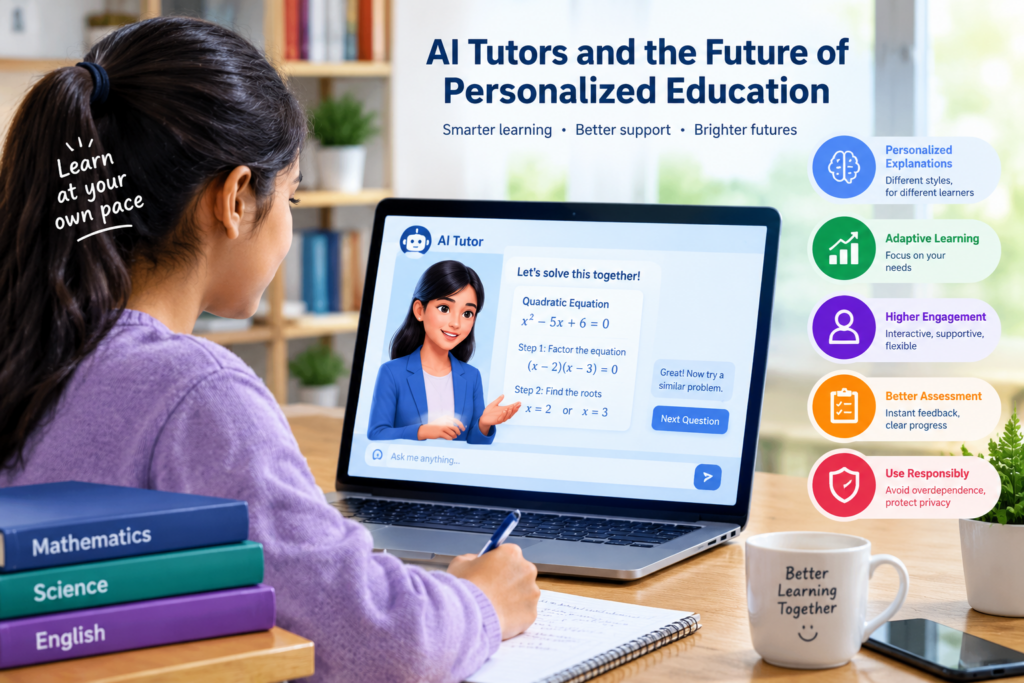
- Personalized explanations: Rephrasing difficult concepts using examples, analogies, or simpler language.
- Adaptive practice: Adjusting question difficulty according to student performance.
- Immediate feedback: Explaining mistakes and suggesting ways to correct them.
- Revision planning: Identifying topics that require additional practice.
- Multilingual learning: Helping students understand lessons in languages they know.
- Conversational learning: Allowing students to ask follow-up questions without waiting for the next classroom session.
AI tutoring can be useful for school students, university learners, competitive-exam candidates, and people pursuing lifelong learning. Its effectiveness, however, depends on the quality of its explanations, the accuracy of its feedback, and the way students use it.
2. Personalized Explanations: Learning at an Individual Pace
One of the most important advantages of AI tutors is their ability to offer different explanations for the same concept. In conventional classrooms, teachers must balance individual learning needs with limited time. AI tools can provide additional explanations whenever a learner needs them.
Consider a student who struggles with quadratic equations. An AI tutor might begin with a simple explanation, demonstrate how to factor an equation, and then offer a visual representation of the relationship between its roots and graph. If the student still experiences difficulty, the tutor can introduce easier examples before returning to more advanced problems.
This approach can reduce the embarrassment some students feel when asking basic questions in front of classmates. Learners can revisit concepts repeatedly and explore subjects at their own pace.
Personalization can also help competitive-exam candidates. A student preparing for mathematics, reasoning, English, or general knowledge can request topic-specific exercises, explanations of incorrect answers, and revision questions tailored to identified weaknesses.
However, personalization is only valuable when the explanation is accurate. AI systems can produce convincing but incorrect answers, misunderstand a student’s level, or oversimplify a difficult subject. Students should verify important information using textbooks, trusted educational resources, and teacher guidance.
3. Adaptive Learning and Intelligent Practice
Adaptive learning systems use information about student performance to determine what a learner should study next. Depending on the platform, they may consider quiz results, repeated mistakes, response times, and previous learning activities.

For example, if a student repeatedly makes mistakes when solving calculus problems involving derivatives, an adaptive system could recommend prerequisite lessons, simpler exercises, and additional practice before introducing more complex applications.
This approach may improve learning efficiency by directing attention toward areas that need improvement rather than requiring every student to complete identical exercises.
A useful adaptive learning cycle includes:
Step 1: Assess
Identify what the student already understands through diagnostic questions.
Step 2: Personalize
Select explanations, examples, and practice questions suited to the student’s needs.
Step 3: Give feedback
Explain mistakes and provide hints that help students correct their reasoning.
Step 4: Reassess
Test independent understanding and adjust the next learning activity.
Nevertheless, adaptive systems can misjudge students. A learner might answer incorrectly because of a careless mistake rather than a lack of understanding. Similarly, a student who answers correctly after guessing may appear to have mastered the concept.
For this reason, adaptive learning should combine automated performance data with student explanations, independent assessments, and teacher judgment.
4. Student Engagement, Motivation, and Confidence
Student engagement is another important consideration. Learning can become frustrating when lessons are too difficult, repetitive, or disconnected from a student’s interests. AI tutors can make practice more interactive through dialogue, quizzes, examples, and immediate responses.
Students can ask follow-up questions without waiting for a teacher’s next lesson. They may also feel more comfortable admitting confusion to a digital tutor than speaking in a classroom.
Research published in Scientific Reports in June 2025 examined a custom AI tutor in a randomized controlled trial involving 194 undergraduate physics students at Harvard University. The researchers reported that students using the AI tutoring approach learned more in less time than students participating in the comparison active-learning classes, while also reporting greater engagement and motivation.
These findings are encouraging, but they should not be interpreted as proof that every AI tutor improves every subject. The study examined a particular tutoring design and educational setting. Results may differ depending on the subject, student population, teaching method, and duration of use.
A broader systematic review published in npj Science of Learning in 2025 examined 28 studies involving 4,597 students in primary and secondary education. It found generally positive effects from intelligent tutoring systems, although the benefits were less clear when compared with other intelligent learning systems. The authors also identified a need for larger, more diverse, and longer-term studies.
The central lesson is that engagement matters, but enjoyment alone does not demonstrate learning. Students must retain information, apply concepts, and solve unfamiliar problems independently.
5. Can AI Tutors Improve Assessment Quality?
AI can assist with formative assessment, which helps students and teachers identify learning gaps before a final examination. It can generate practice tests, explain answers, create additional problems at different difficulty levels, and provide preliminary feedback on written responses.
For example, an AI tutor could evaluate a student’s explanation of a mathematical theorem and highlight missing steps. In language learning, it could suggest improvements in grammar, vocabulary, and sentence structure.
However, assessment quality depends on more than speed. AI systems may misinterpret ambiguous answers, apply inconsistent marking standards, or overlook alternative solutions that are mathematically or logically valid.
They can also give inaccurate feedback when an answer depends on a specific syllabus, examination marking scheme, or recently updated fact.
A responsible assessment system should therefore distinguish between practice feedback and official evaluation. AI-generated scores can guide revision, but consequential decisions about grades, admissions, academic progression, or qualifications should involve appropriate human oversight.
Independent tests are particularly important. If a student can answer a question only while receiving AI assistance, the system has not yet demonstrated that the student has mastered the underlying skill.
6. The Risk of Overdependence on AI
Despite its advantages, AI tutoring creates a significant educational challenge: students may begin using AI to avoid the effort required for learning.
When an AI system provides complete answers instantly, learners may skip reading, independent problem-solving, and critical thinking. A student might submit an AI-generated essay without understanding its arguments or copy a mathematical solution without learning the method.
This behavior can create the illusion of competence. Assignments may look excellent while the student’s ability to reproduce the work independently remains weak.
Overdependence can affect several important skills, including analytical reasoning, writing, memory, creativity, and decision-making. It may also reduce students’ willingness to tolerate uncertainty or persist when a difficult problem does not have an immediate solution.
The solution is not necessarily to prohibit AI. Instead, educational institutions should encourage students to use AI as a learning partner rather than an answer generator.
For example, a student can ask an AI tutor to provide one hint at a time, explain why a particular approach fails, or generate a similar problem for independent practice. The student should attempt the original problem before reviewing the complete solution.
A useful principle is simple: AI should reduce unnecessary confusion, not eliminate the thinking that produces learning.
7. Accuracy, Bias, and Student Data Privacy
AI tutors can make factual errors, invent references, misinterpret questions, or deliver explanations that sound authoritative despite being incorrect. These limitations are especially important in science, medicine, law, mathematics, and examination preparation.
Bias is another concern. If an educational system performs better in certain languages or cultural contexts than others, students may receive unequal-quality support. Automated assessments may also disadvantage learners whose answers differ in wording or approach from the patterns the system expects.
Privacy must be considered as well. Students may enter their names, grades, school information, personal challenges, or other sensitive details into tutoring platforms. Educational institutions need clear rules about what information is collected, how long it is retained, who can access it, and whether it is used to train AI systems.
UNESCO’s guidance on generative AI in education emphasizes human-centred implementation, data protection, age-appropriate use, inclusion, and institutional preparedness.
Responsible implementation should include verified educational content, transparent limitations, secure handling of student data, teacher oversight, and clear procedures for reporting errors.
8. The Digital Divide: Will Every Student Benefit?
AI tutors may expand educational access, particularly for learners who cannot afford private tutoring. Yet the benefits will not automatically reach everyone.
Some students lack reliable internet access, suitable devices, electricity, or quiet places to study. Others may encounter language barriers, inaccessible interfaces, subscription fees, or limited digital literacy.
These challenges are particularly relevant in regions where students rely on shared smartphones or low-cost mobile data. An advanced AI tutor is less useful if a learner cannot access it consistently.
Schools, governments, and educational technology providers can help by supporting low-bandwidth platforms, affordable access, regional-language content, accessible designs, and offline learning materials where feasible.
Equity also requires ensuring that students with disabilities can use the systems effectively and that teachers in under-resourced schools receive suitable training.
The objective should not be to create a future in which only well-connected students benefit from personalized education. It should be to make effective learning support more accessible across different economic, linguistic, and geographic backgrounds.
9. AI Tutors and Teachers: Competition or Collaboration?
AI tutors are most promising when they complement teachers rather than attempt to replace them.
Teachers do more than deliver information. They recognize emotional difficulties, encourage participation, manage classroom relationships, help students develop social skills, and make professional judgments about individual needs. These responsibilities require human understanding and contextual awareness that current AI systems cannot reliably reproduce.
AI can assist teachers by preparing differentiated exercises, generating lesson drafts, identifying common misconceptions, and helping students practice independently. Teachers can then devote more time to discussion, mentorship, collaborative projects, and individual support.

A balanced model might involve teachers introducing a concept, AI tutors supporting guided practice, and students completing independent assessments afterward. Teachers would review progress and intervene when learners need more substantial help.
This approach preserves the human relationship at the heart of education while using technology to extend the availability of instructional support.
10. The Future of Personalized Education
Future AI tutors may combine text, voice, images, video, and interactive simulations. Students could speak a question aloud, upload a photograph of a mathematics problem, discuss a diagram, or receive a spoken explanation in their preferred language.
AI systems may also become better at identifying misconceptions, helping students plan revision, and generating exercises aligned with specific curricula. With appropriate safeguards, these capabilities could support more flexible learning for students with different abilities and educational goals.
However, increasingly sophisticated technology will not automatically produce better educational outcomes. Effective tutoring still depends on sound teaching methods, accurate content, meaningful practice, and appropriate feedback.
Future research should investigate whether learning improvements persist over months or years, whether benefits are shared across different groups of learners, and how AI tutoring affects independent reasoning, creativity, and academic integrity.
Researchers should also compare different tutoring designs rather than treating all AI systems as equivalent. A tutor that guides a learner through a problem may produce different outcomes from one that immediately supplies the answer.
11. Best Practices for Using AI Tutors Effectively
Students, teachers, and educational institutions can maximize the benefits of AI tutoring by establishing clear learning practices.
Attempt problems independently first
Spend time thinking about a question before asking AI for assistance. This helps develop reasoning and problem-solving skills.
Ask for hints, not just answers
Request step-by-step guidance, explanations of mistakes, and questions that help you discover the solution yourself.
Verify important information
Cross-check factual claims, formulas, references, and syllabus-specific information against reliable sources.
Test your understanding without assistance
Close the AI tool and solve a new problem, summarize the lesson, or explain the concept in your own words.
Protect privacy and academic integrity
Avoid sharing unnecessary personal information and follow your institution’s rules for AI-assisted assignments.
Students can also use this sample prompt to make AI tutoring more educational:
Example AI tutor prompt
Act as my personal tutor. Teach me this topic step by step, beginning with the basics. Ask me questions to check my understanding. Give me hints before showing complete solutions, identify my mistakes, and create practice questions of increasing difficulty. At the end, test me without giving away the answers and summarize the concepts I need to revise.
Conclusion: AI Tutors Can Personalize Education, but Learning Must Remain Human-Centred
AI tutors have the potential to reshape education by providing personalized explanations, adaptive practice, immediate feedback, and flexible learning support. Emerging research offers encouraging evidence that carefully designed AI tutoring can improve learning outcomes in certain educational settings. However, the overall evidence remains mixed across systems and contexts, and long-term effects require further investigation.
The main challenge is to ensure that personalization strengthens rather than weakens independent learning. Inaccurate answers, assessment limitations, privacy risks, unequal access, and excessive dependence on automated assistance must be addressed through responsible design and educational oversight.
The future of education is unlikely to depend on choosing between teachers and AI. A more promising direction combines AI’s ability to provide scalable, responsive practice with teachers’ expertise, judgment, and human connection. When students use AI to ask better questions, examine mistakes, and develop independent skills, personalized technology can become a valuable part of a more inclusive and effective education system.