🖼️ Featured Image


🌟 Introduction
Artificial Intelligence (AI) is transforming the way people live, work, and interact with technology. From personalized recommendations on streaming platforms to intelligent virtual assistants and advanced medical diagnostics, AI has become an essential part of everyday life. Businesses of all sizes are increasingly adopting AI services to automate routine tasks, analyze large volumes of data, improve customer experiences, and drive innovation.
AIServices explores how AI-powered tools and solutions are reshaping industries while helping organizations improve efficiency, reduce costs, and make data-driven decisions. Whether you’re a business owner, technology enthusiast, student, or IT professional, understanding AI services can help you prepare for the future of digital transformation.
🧠 What Is Artificial Intelligence?
Artificial Intelligence refers to computer systems that perform tasks typically requiring human intelligence. These tasks include learning, reasoning, recognizing patterns, understanding language, solving problems, and making predictions based on data.
Modern AI systems rely on techniques such as:
🤖 Machine Learning
🧠 Deep Learning
💬 Natural Language Processing (NLP)
👁️ Computer Vision
📊 Predictive Analytics
🔊 Speech Recognition
Rather than replacing human expertise, AI often works alongside people to improve productivity and support better decision-making.
🌍 Why AI Services Matter
Organizations across many sectors use AI to streamline operations, enhance customer experiences, and uncover valuable insights.
Common benefits include:
⚡ Increased efficiency
📈 Better decision-making
💰 Reduced operational costs
😊 Improved customer satisfaction
📊 Faster data analysis
🔄 Workflow automation
💡 Greater innovation
As AI technology becomes more accessible, businesses of all sizes can adopt solutions tailored to their specific needs.
☁️ Cloud-Based AI Services
Cloud computing has made AI more affordable and scalable. Instead of investing in expensive hardware, organizations can access AI capabilities through cloud platforms.
Advantages include:
🌍 Access from anywhere
📈 Flexible scalability
💾 Secure data storage
🤝 Team collaboration
⚙️ Easy integration with existing systems
Cloud-based AI services are widely used for analytics, image recognition, language processing, and intelligent automation.
🖼️ AI in the Workplace


💬 AI Chatbots and Virtual Assistants
AI-powered chatbots and virtual assistants help organizations provide quick, consistent support around the clock. They can answer common questions, assist with bookings, guide users through processes, and escalate complex issues to human agents when necessary.
Benefits include:
💬 24/7 customer support
⏱️ Faster response times
📉 Reduced support workload
😊 Consistent user experiences
🌐 Multilingual communication
Examples of everyday AI assistants include voice-controlled smart devices, customer support chatbots, and virtual scheduling tools.
📊 AI for Business Intelligence
Business Intelligence (BI) combines data analysis with reporting tools to help organizations understand performance and identify trends. AI enhances BI by automatically detecting patterns, forecasting outcomes, and generating insights from large datasets.
Typical applications include:
📈 Sales forecasting
🛍️ Customer behavior analysis
📦 Inventory optimization
💼 Financial reporting
📊 Executive dashboards
These insights enable leaders to make more informed strategic decisions.
📈 Predictive Analytics
Predictive analytics uses historical data and AI models to estimate future outcomes. Businesses use these forecasts to improve planning and reduce uncertainty.
Examples include:
🛒 Product demand forecasting
🏦 Financial risk assessment
🚚 Supply chain planning
🏥 Hospital resource management
📣 Marketing campaign optimization
Although predictions are based on probabilities, they can significantly improve operational planning when combined with expert judgment.
🛒 AI in Marketing and Sales
Marketing teams increasingly use AI to personalize customer experiences and optimize campaigns.
AI-powered capabilities include:
📧 Personalized email campaigns
🎯 Customer segmentation
🛍️ Product recommendations
📊 Marketing performance analysis
💬 Intelligent customer engagement
By analyzing customer preferences and behavior, AI helps organizations deliver more relevant content and improve conversion rates.
🏥 AI in Healthcare
Healthcare organizations are using AI to support clinicians and improve patient care. AI tools can assist with tasks such as analyzing medical images, identifying patterns in health data, and streamlining administrative workflows.
Potential applications include:
🩺 Clinical decision support
🖼️ Medical image analysis
📅 Appointment scheduling
💊 Medication management support
📊 Population health analysis
These systems are designed to complement healthcare professionals rather than replace their expertise.
🎯 Key Skills for Working with AI
As AI adoption grows, professionals across industries benefit from developing foundational AI knowledge.
Helpful skills include:
💻 Programming fundamentals
📊 Data analysis
🧠 Critical thinking
🤝 Communication
🔒 Understanding data privacy
📚 Continuous learning
Even non-technical professionals can gain value by understanding how AI tools support productivity and decision-making.
🖼️ AI Across Industries


6
💰 AI in Finance
The financial sector has embraced AI to improve efficiency, strengthen security, and deliver better customer experiences. Financial institutions analyze enormous volumes of transaction data every day, making AI a valuable tool for identifying patterns and supporting decision-making.
Common applications include:
💳 Fraud detection
📊 Investment analysis
💹 Risk assessment
🤖 Customer service chatbots
📈 Financial forecasting
🏦 Loan application support
AI can process data much faster than manual methods, helping organizations respond quickly to changing market conditions while supporting human analysts.
🏭 AI in Manufacturing
Modern manufacturing uses AI to optimize production, improve quality control, and reduce downtime.
Popular use cases include:
⚙️ Predictive maintenance
🤖 Industrial automation
📦 Supply chain optimization
🔍 Visual quality inspection
📊 Production forecasting
🚚 Inventory management
By identifying equipment issues before failures occur, predictive maintenance can reduce costly interruptions and improve operational efficiency.
🛒 AI in E-Commerce
Online retailers use AI to create personalized shopping experiences that increase customer satisfaction.
Examples include:
🛍️ Product recommendations
🔎 Intelligent search
📦 Inventory optimization
💬 Customer support chatbots
📈 Demand forecasting
🎯 Personalized promotions
These features help customers discover relevant products while enabling businesses to better manage inventory and marketing efforts.
🖼️ AI in Education and Cybersecurity


🎓 AI in Education
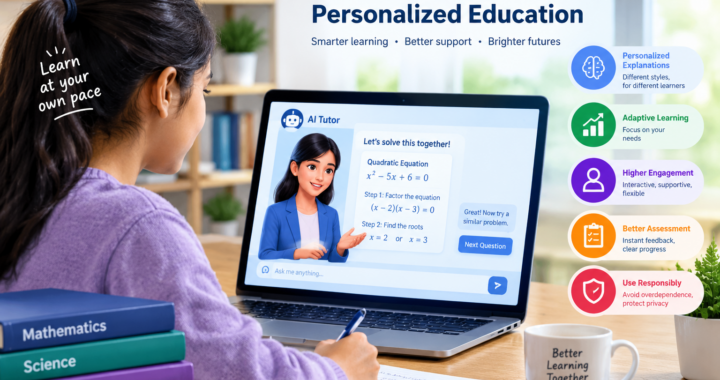
AI is helping educators personalize learning experiences and reduce administrative workloads. Adaptive learning platforms can tailor lessons to individual progress, while automated systems assist with grading and feedback.
Educational applications include:
📚 Personalized learning pathways
📝 Automated assessments
💬 AI tutoring assistants
🌐 Language learning support
📊 Student progress analytics
🎥 Interactive digital classrooms
AI complements teachers by providing additional tools for instruction and student engagement.
🔒 AI in Cybersecurity
As cyber threats become more sophisticated, AI helps organizations detect suspicious activity and respond more quickly.
AI-powered cybersecurity solutions can support:
🛡️ Threat detection
📧 Phishing identification
🔍 Network monitoring
⚠️ Anomaly detection
🔐 Identity verification
📊 Security analytics
Human expertise remains essential for investigating incidents, designing security strategies, and making critical decisions.
⚖️ Responsible AI and Ethics
Responsible AI development focuses on creating systems that are fair, transparent, secure, and accountable.
Important ethical considerations include:
🔒 Protecting privacy
⚖️ Reducing algorithmic bias
📖 Explaining AI decisions when possible
🛡️ Strengthening data security
🤝 Ensuring human oversight
Organizations should regularly evaluate AI systems to promote fairness, reliability, and compliance with applicable regulations.
🤖 Automation and Robotics
Automation powered by AI helps organizations perform repetitive tasks more efficiently.
Examples include:
🏭 Manufacturing robots
📦 Warehouse automation
🚚 Logistics optimization
🏥 Healthcare support systems
🌾 Smart agriculture
🏢 Office workflow automation
Automation can improve productivity while allowing employees to focus on higher-value work that requires creativity, judgment, and collaboration.
📊 AI for Data-Driven Decision-Making
AI helps organizations transform large datasets into meaningful insights.
Benefits include:
📈 Faster reporting
🎯 Better forecasting
💼 Improved strategic planning
😊 Enhanced customer understanding
💰 Cost optimization
🌍 Market trend analysis
When combined with human expertise, these insights support more informed business decisions.
💼 Career Opportunities in AI
The rapid growth of AI has created demand for professionals with diverse skills.
Popular career paths include:
👨💻 AI Engineer
🤖 Machine Learning Engineer
📊 Data Scientist
🧠 AI Researcher
💻 Software Developer
☁️ Cloud AI Specialist
🔐 AI Security Analyst
📈 Business Intelligence Analyst
Useful skills include:
🐍 Programming
📊 Statistics
🧠 Problem-solving
🤝 Communication
☁️ Cloud technologies
📚 Continuous learning
Because AI evolves quickly, staying current with new tools, techniques, and best practices is an important part of career development.
🖼️ The Future of Artificial Intelligence


🌍 The Future of AI Services
Artificial Intelligence is advancing rapidly and becoming an integral part of business, education, healthcare, manufacturing, transportation, and many other sectors. As computing power increases and AI models become more capable, organizations are finding new ways to improve efficiency, creativity, and decision-making.
Some emerging trends include:
🤖 Generative AI for content creation
🧠 More capable AI assistants
☁️ AI-powered cloud platforms
📊 Real-time predictive analytics
🌐 Edge AI for faster processing
🏥 Smarter healthcare technologies
🏭 Intelligent industrial automation
🌱 AI solutions for sustainability
The future of AI is likely to involve closer collaboration between humans and intelligent systems, with AI supporting—not replacing—human expertise in many professional settings.
🤝 Human–AI Collaboration
The most effective AI implementations combine machine efficiency with human creativity, judgment, and ethical decision-making.
AI is particularly well suited to:
⚡ Processing large amounts of data
🔍 Detecting patterns
📊 Forecasting trends
🔄 Automating repetitive tasks
Humans remain essential for:
💡 Creative thinking
❤️ Empathy
⚖️ Ethical judgment
🤝 Leadership
🗣️ Communication
🎯 Strategic planning
Organizations that balance automation with human oversight are often better positioned to build trustworthy and effective AI solutions.
🖼️ AI Skills and Professional Growth


📚 Learning AI Skills
You don’t need to be an expert programmer to begin learning about AI. Many professionals develop AI literacy to better understand how intelligent tools can support their work.
Helpful areas of study include:
🐍 Python programming
📊 Statistics and probability
🗄️ Databases and SQL
📈 Data visualization
🤖 Machine learning fundamentals
☁️ Cloud computing
🔒 Cybersecurity basics
📖 AI ethics
Building small projects and experimenting with publicly available tools is a practical way to strengthen your understanding.
🌱 AI for Sustainability
AI is increasingly being used to address environmental and sustainability challenges.
Examples include:
⚡ Improving energy efficiency
🌾 Supporting precision agriculture
💧 Monitoring water resources
🌍 Climate data analysis
🚚 Optimizing transportation routes
♻️ Improving waste management
These applications demonstrate how AI can contribute to responsible resource management when implemented thoughtfully.
🔐 AI Security and Responsible Use
As AI becomes more widespread, organizations must prioritize responsible development and deployment.
Key principles include:
🛡️ Protecting sensitive data
🔍 Testing AI systems regularly
⚖️ Monitoring for bias
📜 Following legal and regulatory requirements
🤝 Maintaining human oversight
📢 Communicating AI capabilities clearly
Responsible AI practices help build trust among customers, employees, and stakeholders.
🚀 AI and Business Innovation
Businesses use AI to improve productivity and create new opportunities.
Examples include:
📧 Automating customer communications
📊 Generating business insights
📦 Improving supply chain efficiency
🛍️ Personalizing customer experiences
📈 Forecasting demand
🧾 Streamlining document processing
Rather than replacing existing workflows entirely, AI often enhances them by reducing repetitive work and supporting faster decision-making.
💼 Preparing for an AI-Driven Future
As AI adoption continues to grow, professionals across many industries can benefit from developing complementary skills.
Focus on building:
🧠 Critical thinking
🤝 Collaboration
💬 Communication
📊 Data literacy
🔄 Adaptability
📚 Continuous learning
🎯 Problem-solving
The combination of technical knowledge and strong interpersonal skills will remain valuable in an AI-enabled workplace.
❓ Frequently Asked Questions (FAQ)
📌 What are AI services?
AI services are software solutions and platforms that use artificial intelligence to perform tasks such as language processing, image recognition, data analysis, prediction, automation, and decision support.
📌 Can small businesses benefit from AI?
Yes. Many AI-powered tools are available as cloud services, making them accessible and affordable for organizations of different sizes.
📌 Is AI replacing human jobs?
AI is changing how work is performed by automating certain tasks, while also creating new roles and increasing demand for skills related to technology, data, and human-centered problem-solving. The impact varies by industry and occupation.
📌 Do I need programming experience to use AI tools?
Not always. Many AI applications provide user-friendly interfaces that require little or no coding, while more advanced development work typically benefits from programming knowledge.
📌 What industries use AI?
AI is widely used in healthcare, finance, retail, manufacturing, education, transportation, agriculture, cybersecurity, marketing, logistics, and many other sectors.
🎯 Final Thoughts
Artificial Intelligence is becoming an increasingly important part of modern life and business. From improving customer service and analyzing data to supporting healthcare and enhancing education, AI services offer powerful opportunities to solve problems and improve efficiency.
Success with AI depends not only on adopting new technologies but also on using them responsibly. Organizations that prioritize transparency, privacy, fairness, and human oversight are better positioned to build trust and deliver long-term value.
AIServices encourages individuals and organizations to embrace continuous learning, experiment thoughtfully with AI tools, and focus on using technology to complement human expertise. By combining innovation with ethical practices, businesses and professionals can unlock new possibilities while creating solutions that benefit customers, communities, and society.