Artificial intelligence has moved rapidly from a specialized research field into an everyday technology used by businesses, educators, developers, researchers, creators, and individuals. One of the most important developments within this transformation is the growth of AI services.
AI services are technology solutions that use artificial intelligence to perform, improve, or automate tasks that traditionally required human effort. These services can analyze information, understand language, recognize images, generate content, identify patterns, make predictions, support decisions, and interact with users through conversational interfaces.
From customer support and marketing to healthcare administration, education, cybersecurity, software development, and business analytics, AI services are changing how organizations approach digital work. 🚀
The biggest transformation is not simply that computers can perform more tasks. It is that AI is making sophisticated capabilities accessible through relatively simple interfaces. A business does not necessarily need to build an artificial intelligence system from scratch. Instead, it can use specialized AI services through software platforms, APIs, cloud environments, or integrated applications.
This article explores the world of AI services, their major applications, benefits, limitations, implementation considerations, and future possibilities.


🤖 What Are AI Services?
AI services are software-based capabilities that use artificial intelligence to solve specific problems or support particular workflows.
Traditional software generally follows explicit instructions created by programmers. AI-powered systems can use machine learning models to identify patterns and generate outputs based on data.
For example, a traditional program might be designed to recognize a specific list of keywords. An AI service can potentially understand variations in language and determine the likely meaning of a user’s request.
AI services can include:
- Natural language processing
- Machine learning
- Speech recognition
- Computer vision
- Generative AI
- Recommendation systems
- Predictive analytics
- Fraud detection
- Intelligent search
- Document analysis
- Conversational assistants
- Automated classification
- Personalization systems
These capabilities can be delivered through cloud platforms, enterprise applications, mobile applications, websites, development APIs, and specialized software.
The result is an ecosystem in which organizations can incorporate AI into existing workflows without necessarily developing every component internally.
AI as a Service
One important model is often described as AI as a Service, or AIaaS.
Instead of purchasing and maintaining an entire AI infrastructure, organizations can access AI capabilities through external platforms. Depending on the provider and service, customers may pay based on usage, subscriptions, processing volume, or another pricing structure.
This approach can lower the technical barrier to experimentation.
A small company, for example, may want to add automatic document classification to its internal workflow. Rather than building a complete machine-learning infrastructure, it may use an existing AI service designed for document processing.
That flexibility is one reason AI services are becoming increasingly important.
☁️ AI Services and Cloud Computing
Cloud computing has played a major role in making AI technology accessible.
Building advanced AI infrastructure traditionally required expensive hardware, specialized engineers, large datasets, and significant operational resources. Cloud-based AI services can provide access to computing resources and pretrained models through online platforms.
Organizations can therefore experiment with AI without necessarily owning dedicated infrastructure.
Cloud AI services may provide capabilities such as:
Language: Understanding and generating text.
Vision: Analyzing photographs, documents, and other visual information.
Speech: Converting speech into text or generating spoken output.
Machine Learning: Training, deploying, and monitoring predictive models.
Generative AI: Producing text, images, code, or other content.
Search: Improving information discovery through semantic understanding.
This model allows companies to select the capabilities relevant to their needs.
For developers, APIs are particularly useful. An application can send information to an AI service and receive a structured response that can then be incorporated into the application’s workflow.


💼 AI Services for Businesses
Businesses are among the most active users of AI services.
Every organization generates information and performs repetitive tasks. AI can potentially assist with many of these processes.
Customer service is a common example.
Companies receive questions through websites, email, social media, phone systems, and messaging platforms. AI services can help classify incoming requests, identify frequently asked questions, summarize conversations, and provide automated responses for suitable situations.
For example, a customer might ask:
“How can I change my delivery address?”
An AI-powered support system can identify the intent of the request and provide the appropriate instructions.
If the issue is more complicated, the system can route the conversation to a human employee.
Intelligent Document Processing
Businesses also deal with large numbers of documents.
Invoices, applications, contracts, forms, receipts, reports, and correspondence may contain valuable information that employees traditionally had to extract manually.
AI services can assist with document analysis by identifying relevant fields, classifying documents, extracting information, and summarizing content.
This can reduce repetitive administrative work.
Business Intelligence
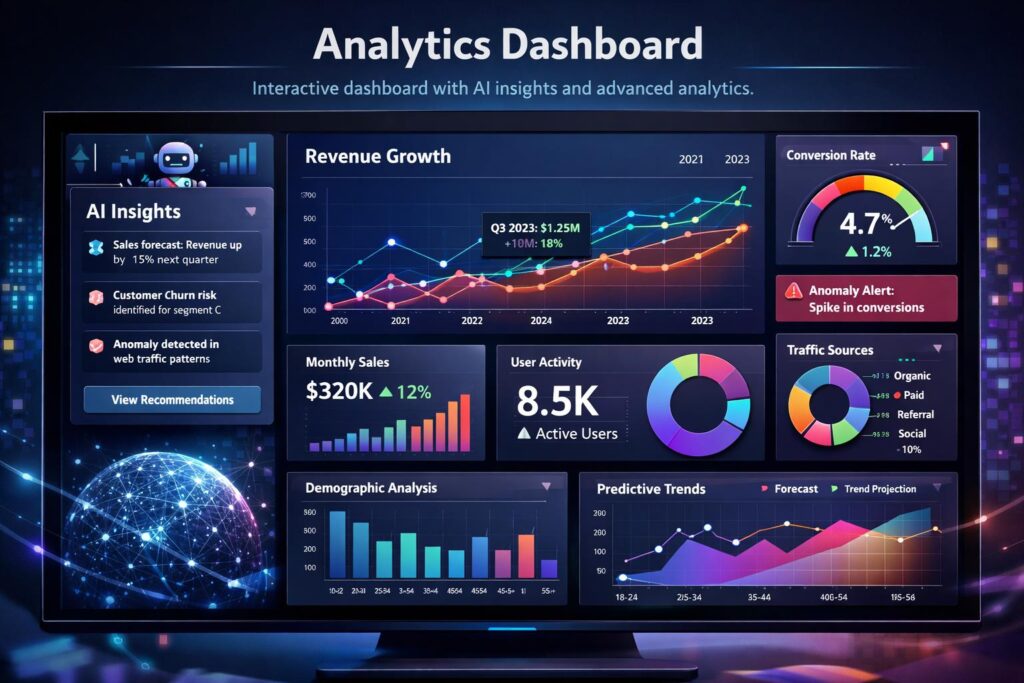
AI services can also assist organizations in understanding data.
Instead of simply displaying thousands of rows in a spreadsheet, intelligent systems can identify patterns, create summaries, or help users explore information through natural-language questions.
A manager might ask:
“Which products experienced the largest change in sales this quarter?”
An AI-enabled analytics system could help interpret the underlying data and present the relevant information.
Human review remains important, particularly when business decisions have significant consequences.
🛍️ AI Services in E-Commerce
Online shopping platforms generate enormous quantities of data. AI services can help businesses use that information to improve customer experiences.
One familiar example is product recommendation.
An online store can analyze browsing behavior, previous purchases, product relationships, and other signals to recommend potentially relevant products.
AI can also support:
- Search personalization
- Product categorization
- Review analysis
- Customer-service chatbots
- Inventory forecasting
- Fraud detection
- Marketing personalization
- Visual product search
For example, computer vision technology can potentially allow shoppers to search for products using images rather than exact text descriptions.
AI can also analyze customer reviews to identify recurring themes. Instead of reading thousands of individual comments manually, businesses can use automated analysis to discover common issues or frequently praised features.
The technology can therefore help organizations turn unstructured information into usable insights.
📚 AI Services in Education
Education is another area where AI services can provide useful support.
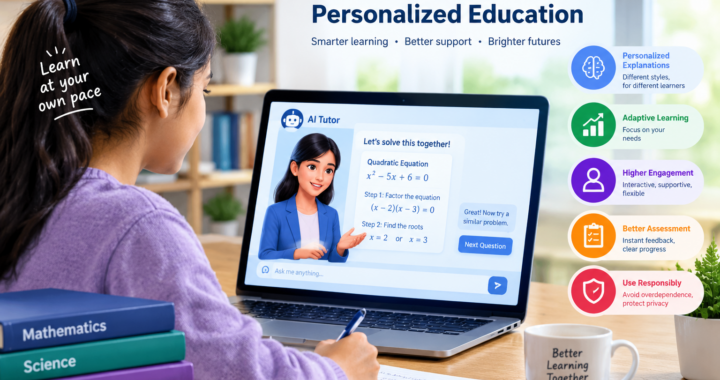
Students have different learning styles, levels of background knowledge, and educational needs. AI systems can potentially help personalize learning experiences.
A learner studying mathematics might request additional examples of a difficult concept. Another student may need a more advanced explanation.
AI services can support:
- Personalized tutoring
- Language learning
- Writing assistance
- Question generation
- Study planning
- Accessibility tools
- Educational content creation
- Feedback systems
- Administrative automation
Teachers can also use AI-powered tools to help organize materials, brainstorm classroom activities, create practice questions, or summarize information.
However, educational institutions need clear policies regarding acceptable AI use. Students should continue developing independent reasoning, research skills, writing abilities, and subject knowledge.
AI can support learning, but it should not become a substitute for learning itself. 🎓


🏥 AI Services in Healthcare
Healthcare is a particularly important area for AI services, although it requires careful implementation.
AI can support administrative processes, medical research, documentation, scheduling, information management, and other workflows.
For example, AI-powered systems can potentially help organize medical documents or summarize information for authorized professionals.
AI can also support research by processing large datasets and identifying patterns that may be difficult to detect manually.
However, healthcare applications require strong safeguards. Medical decisions can have serious consequences, and AI-generated information should not automatically be treated as professional medical advice.
Human professionals remain essential for clinical judgment, patient communication, diagnosis, treatment decisions, and accountability.
The most practical applications often focus on supporting professionals rather than replacing them.
💻 AI Services for Software Development
Software development has become one of the most visible areas of AI adoption.
Developers can use AI services for:
- Code generation
- Code explanation
- Debugging assistance
- Documentation
- Test generation
- Refactoring suggestions
- Natural-language programming support
- Technical brainstorming
A developer can describe a desired function in natural language and ask an AI system to produce an initial implementation.
Another developer may provide an error message and request possible explanations.
This can accelerate experimentation and reduce the amount of time spent on repetitive tasks.
However, AI-generated code requires review.
A generated solution may contain incorrect assumptions, security vulnerabilities, inefficient algorithms, or compatibility problems. Developers need to test the output and understand how it works.
AI can increase development speed, but software quality still depends on engineering practices.
The Rise of AI-Powered Development Environments
AI capabilities are increasingly integrated directly into development environments.
Instead of switching between a code editor and a separate chatbot, developers can receive suggestions inside their existing workflow.
This creates a more continuous development experience.
The broader trend suggests that programming interfaces may increasingly combine traditional coding with natural-language interaction.
📊 AI Services for Data Analysis
Modern organizations produce vast quantities of data.
Sales records, website activity, customer interactions, operational metrics, financial information, and research datasets can all contain useful patterns.
AI services can help analyze these datasets.
Common applications include:
Classification: Assigning information to categories.
Prediction: Estimating future outcomes from historical patterns.
Anomaly Detection: Identifying unusual behavior.
Clustering: Finding groups with similar characteristics.
Summarization: Turning large datasets into understandable descriptions.
Forecasting: Estimating future trends based on available data.
For example, an organization could use machine-learning techniques to identify unusual transactions that deserve additional review.
Another organization could analyze historical demand to support inventory planning.
AI does not eliminate the need for good data. Poor-quality, incomplete, biased, or incorrectly labeled data can produce unreliable results.
This means data governance is a critical part of successful AI implementation.


🔐 AI Services and Cybersecurity
Cybersecurity is another area where AI services are increasingly relevant.
Digital systems generate enormous numbers of events every day. Security teams need to identify which events deserve attention.
AI can help analyze patterns and detect potentially unusual activity.
Applications may include:
- Anomaly detection
- Email threat analysis
- Malware classification
- Identity monitoring
- Network behavior analysis
- Fraud detection
- Security alert prioritization
Suppose a system observes activity that differs significantly from established patterns. An AI model may flag it for additional investigation.
However, cybersecurity is an adversarial environment. Attackers can attempt to manipulate systems, evade detection, or exploit weaknesses in AI-powered infrastructure.
Organizations therefore need multiple layers of security rather than relying on a single AI system.
Human security professionals, established security controls, monitoring systems, and regular testing remain important.
🎨 AI Services for Creative Industries
Creative professionals are also exploring AI services.
Writers, designers, marketers, filmmakers, musicians, and content creators can use AI tools for brainstorming, drafting, editing, organization, and experimentation.
For example, a marketing team could ask an AI service to generate several campaign concepts and then have human creators refine the strongest ideas.
A writer could use AI to explore alternative outlines.
A designer could experiment with visual concepts.
The creative process remains fundamentally human because creators determine goals, meaning, audience, and final quality.
AI can expand the range of possibilities available during the creative process.
Responsible Creative Use
Creators should also consider originality, intellectual-property questions, disclosure practices, and platform rules when using AI-generated material.
The exact legal and contractual environment can vary by jurisdiction and use case, so professional advice may be appropriate for high-stakes situations.
📱 AI Services for Everyday Productivity
AI services are not limited to large corporations.
Individuals can use AI-powered tools for everyday activities.
For example:
📝 Writing: Improve grammar and structure.
📅 Planning: Organize schedules and tasks.
📖 Learning: Explain unfamiliar concepts.
💡 Brainstorming: Generate ideas.
🌍 Translation: Assist with multilingual communication.
📊 Organization: Convert notes into structured information.
💻 Technology: Explain software and programming problems.
The important factor is how the technology is used.
Instead of asking AI to make every decision, users can treat it as an assistant that helps them explore possibilities and organize information.


⚙️ How Organizations Can Introduce AI Services
Implementing AI successfully requires more than purchasing a tool.
Organizations should begin by identifying a genuine problem.
For example:
- Is customer support overwhelmed by repetitive questions?
- Are employees spending excessive time searching documents?
- Is data analysis taking too long?
- Are administrative processes highly repetitive?
- Could users benefit from personalized assistance?
Once the problem is identified, the organization can evaluate suitable AI services.
Start Small
A limited pilot project can be useful.
Instead of introducing AI across an entire company immediately, an organization might test it within one workflow.
The results can then be evaluated based on measurable criteria such as time savings, accuracy, user satisfaction, operational costs, and error rates.
Establish Human Oversight
AI systems should have clear boundaries.
Organizations need to determine:
- What decisions can AI support?
- What decisions require human approval?
- What information can be submitted?
- Who is responsible for reviewing outputs?
- What happens when the system is uncertain?
Clear answers reduce operational and security risks.
⚠️ Challenges and Limitations of AI Services
Despite their potential, AI services are not perfect.
One major challenge is accuracy.
AI models can generate convincing responses that contain errors. This is especially important when users rely on AI for technical, financial, legal, scientific, or medical information.
Another issue is bias.
AI models learn from data, and data can contain historical biases or incomplete representation. Developers and organizations need processes for testing and monitoring system behavior.
Privacy is another important concern.
Organizations should understand how information is processed, stored, protected, and potentially used by an AI provider.
There is also the challenge of explainability.
Some AI models can produce useful results without providing simple explanations of every internal calculation. In high-impact situations, organizations may require additional transparency and human review.
Finally, employees need training.
An organization can purchase advanced AI technology and still receive limited value if employees do not understand how to use it effectively.
🌱 The Future of AI Services
The AI-services ecosystem is likely to continue evolving rapidly.
Future systems may become more capable of combining different forms of information.
A user might provide:
📄 a document
🎤 a voice request
🖼️ an image
📊 a dataset
💻 source code
and ask the AI system to analyze them together.
This multimodal approach can make AI more useful across professional workflows.
AI services may also become increasingly connected to business software.
Instead of merely answering questions, an assistant could potentially retrieve authorized information, prepare reports, organize tasks, and help users navigate complex workflows.
With greater capability comes greater responsibility.
Organizations will need strong authentication, authorization, monitoring, privacy controls, testing, and governance.
The future therefore involves both technological innovation and responsible implementation.
🌍 AI Services and the Changing Digital Economy
AI services are contributing to a broader transformation in how digital work is organized.
Historically, software automation focused primarily on structured, repetitive tasks.
Modern AI expands automation into areas involving language, images, documents, predictions, and other forms of unstructured information.
This does not mean every job will be replaced by AI. The effects will vary significantly across industries, occupations, organizations, and individual workflows.
Many roles may instead change as workers use AI to handle certain tasks while focusing more heavily on communication, decision-making, creativity, relationship-building, and specialized expertise.
The long-term impact will depend on how businesses, workers, educators, governments, and technology developers adapt.
🤝 Humans and AI Working Together
The most meaningful future for AI services may be collaborative.
Human beings bring context, values, experience, creativity, empathy, and accountability.
AI systems bring computational scale, pattern recognition, rapid information processing, and automation.
Combining these strengths can create new ways of working.
Consider a researcher. AI might help organize thousands of pieces of information, while the researcher determines which questions matter.
Consider a teacher. AI might generate practice material, while the teacher understands the individual needs of students.
Consider a software developer. AI might suggest an implementation, while the developer evaluates architecture and security.
Consider a business leader. AI might summarize operational data, while humans make decisions based on organizational goals and broader context.
The technology becomes most useful when human judgment remains part of the process.
🚀 Conclusion: The Expanding World of AI Services
AI services are becoming an important component of modern digital infrastructure.
They can help organizations analyze information, automate repetitive tasks, improve customer experiences, support employees, assist developers, personalize education, strengthen certain cybersecurity workflows, and accelerate creative experimentation.
The technology is powerful, but successful adoption requires realistic expectations.
AI systems can make mistakes. Data quality matters. Privacy must be protected. Security controls are necessary. Human oversight remains essential for many important decisions.
The organizations that benefit from AI are likely to be those that focus not only on adopting advanced technology but also on identifying meaningful problems, measuring results, training people, and establishing responsible governance.
For individuals, AI services can become useful companions for learning, writing, planning, research, creativity, and productivity. For businesses, they can become components of increasingly intelligent digital workflows.