How AI Could Learn Your Preferences, Understand Your Habits, and Act as a Personalized Digital Companion
Artificial intelligence is moving toward a fascinating new idea: AI personal twins—digital systems designed to understand an individual’s preferences, routines, communication style, goals, and decision-making patterns.
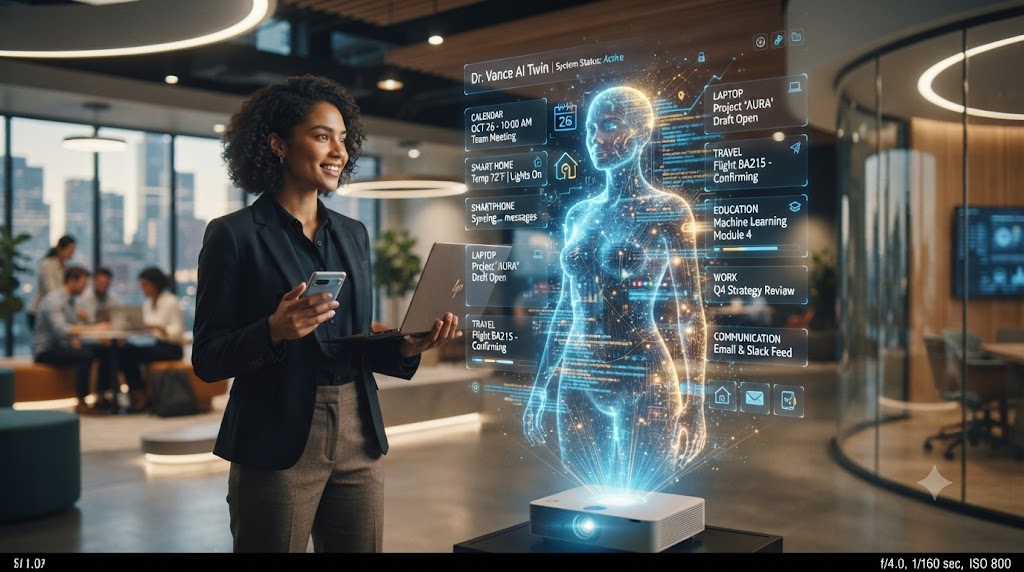
A personal AI twin would be more than a chatbot with your name. It could potentially become a persistent digital representation that learns from information you intentionally provide, remembers preferences, interacts with applications, and helps you make decisions.
Imagine waking up in the morning and asking your digital twin to organize your day. It already knows your preferred working hours, recurring commitments, communication preferences, and long-term goals. It checks your calendar, summarizes important information, identifies potential conflicts, and suggests a schedule.
Later, it could help draft an email in your preferred style, prepare notes for a meeting, organize a trip, compare products, or remind you about an unfinished project. 🤖✨
The concept raises exciting possibilities—but also serious questions about privacy, identity, security, consent, and control.


🌐 What Is an AI Personal Twin?
An AI personal twin can be understood as a personalized AI system designed to represent aspects of an individual digitally.
It could learn from information such as:
- Preferences
- Communication patterns
- Work routines
- Frequently used applications
- Personal goals
- Writing style
- Scheduling preferences
- Interests
- User-provided memories
- Repeated instructions
The goal would not necessarily be to create a perfect copy of a person.
Instead, the AI could become a personalized digital layer that helps the individual interact with information and digital services.
For example, two people might ask an AI:
“Plan my weekend.”
A generic assistant might provide the same type of suggestions to both.
A personal twin could potentially produce very different plans because it understands that one person prefers quiet activities, another enjoys social events, one has a strict budget, and another prioritizes convenience.
Personalization becomes the central feature.
🤖 AI Personal Twin vs. Traditional AI Assistant
The difference between a traditional AI assistant and an AI personal twin is primarily continuity and personalization.
A basic AI assistant responds to individual requests.
A personal AI twin could maintain a longer-term understanding of the user.
For example:
Traditional AI:
“What kind of restaurants do you like?”
Personal AI twin:
“I know you usually prefer vegetarian options, quieter restaurants, and places within your normal travel range.”
The second system does not necessarily need the user to repeat the same preferences every time.
That could make interactions feel more natural.
The AI becomes less like a search box and more like a persistent digital assistant that understands context.
🧠 How Would a Personal Twin Learn?
A personal twin could learn through several different sources, depending on what the user chooses to connect.
💬 Conversations
Repeated interactions can reveal preferences and recurring instructions.
📅 Calendars
Schedules can help the AI understand availability and recurring commitments.
📄 Documents
Personal notes and work documents can provide context for projects.
📱 Applications
Connected apps could provide information about tasks and workflows.
📝 Explicit Preferences
Users could directly tell the AI things such as:
“Keep my emails concise.”
“Remind me about important deadlines.”
“Prefer morning meetings.”
The most important principle is user control.
A personal AI should not automatically have unlimited access to everything a person does.
People should be able to decide what information is available and how it can be used.
👤 Your Digital Personality
One of the most interesting possibilities is personalization of communication style.
Suppose someone normally writes emails that are:
- Short
- Professional
- Friendly
- Direct
Their AI twin could learn these patterns and generate drafts that resemble their preferred style.
Another person might prefer:
- Detailed explanations
- Formal language
- Longer messages
- More context
The AI could adapt accordingly.
Over time, this could make AI-generated communication feel much more personalized.
However, there is an important distinction between imitating a person’s preferred communication style and pretending to literally be that person.
That distinction becomes particularly important when AI systems communicate with other people.
📧 Could Your AI Twin Communicate for You?
Potentially, yes.
Imagine receiving a message:
“Can we schedule a meeting next week?”
Your AI twin could check your availability and respond according to rules you have established.
For example:
“Tuesday afternoon or Thursday morning would work.”
The human may not need to participate in the scheduling conversation at all.
This could save considerable time.
But communication becomes more complicated when messages involve emotions, negotiations, relationships, or sensitive decisions.
Should an AI respond to a close friend?
Should it negotiate a business contract?
Should it decline an invitation?
Should it make a commitment on your behalf?
These situations require carefully defined boundaries.


🏠 AI Personal Twins at Home
Personal AI could become part of everyday household life.
Imagine telling your AI twin:
“What should I do tomorrow?”
It could combine information from your schedule, tasks, preferences, and plans to create a personalized overview.
It could remind you about:
📅 Appointments
📝 Important tasks
🎓 Study schedules
💼 Work deadlines
🎂 Birthdays
🛒 Shopping lists
✈️ Travel plans
Instead of simply reminding you about individual events, it could help organize them into a broader picture.
This could make digital organization feel less fragmented.
🧑💼 AI Twins at Work
The workplace could be one of the biggest environments for personal AI twins.
Imagine an employee having a personal AI that understands:
- Current projects
- Meeting history
- Work preferences
- Frequently used documents
- Writing style
- Regular responsibilities
- Important deadlines
Before a meeting, the AI could prepare a concise briefing.
After the meeting, it could organize notes and identify action items.
When an employee receives a complicated email, the AI could summarize it and suggest possible responses.
For repetitive administrative work, it could potentially complete approved tasks.
The employee becomes less focused on manually organizing information and more focused on making decisions.
🚀 AI Twins as Digital Representatives
The idea becomes even more interesting when the AI acts as a representative.
Suppose you are attending a conference but cannot participate in every discussion.
Your AI twin could potentially:
- Monitor approved information
- Answer basic questions
- Provide your public professional information
- Schedule meetings
- Collect questions
- Prepare follow-up notes
This creates a new concept:
Digital Representation
Instead of a person being digitally represented only through social-media profiles or websites, their AI could become an interactive representative.
This could have major implications for professionals, creators, businesses, and organizations.
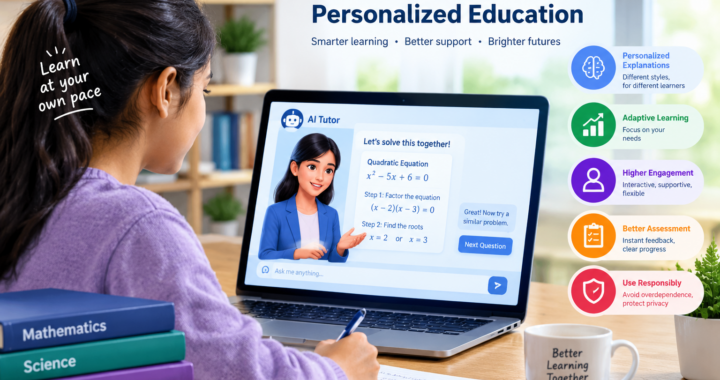
🎓 AI Personal Twins for Students
Students could also benefit from highly personalized AI systems.
A student’s digital assistant could understand:
📚 Subjects being studied
📝 Current assignments
⏰ Available study hours
🎯 Academic goals
🧠 Preferred learning methods
📖 Areas requiring additional practice
Instead of providing generic explanations, the AI could adjust its teaching approach.
For example, if a student understands algebra but struggles with geometry, the system could spend more time explaining spatial concepts.
It could also create personalized revision schedules.
This could make educational AI more adaptive.
✈️ AI Twins for Travel
Travel planning often involves dozens of decisions.
Where should you stay?
Which transportation should you use?
What activities fit your schedule?
What is within your budget?
What food options are suitable?
A personal AI twin could potentially remember your travel preferences.
If you prefer quiet hotels, short transportation connections, museums, vegetarian food, and moderate budgets, the system could incorporate those preferences into future planning.
Over time, travel planning could become less about searching through hundreds of options and more about receiving a curated set of choices based on your established preferences.
🛍️ AI Personal Twins and Shopping
Shopping could also become highly personalized.
Instead of browsing thousands of products, you could ask:
“Find me a laptop suitable for my work.”
Your AI could consider criteria you have explicitly provided, such as:
- Budget
- Operating system
- Performance requirements
- Portability
- Battery expectations
- Preferred brands
- Existing devices
It could then narrow the options.
This could change the relationship between consumers and online stores.
Instead of businesses competing primarily to attract users to websites, they may increasingly compete for visibility inside AI-mediated purchasing decisions.
💡 Your AI Twin Could Become a Decision Assistant
Perhaps the most useful role of a personal twin would be helping people think.
Consider a complicated decision.
You might ask:
“What are the advantages and disadvantages of these two options?”
A personalized AI could organize the information around criteria that matter to you.
It could say:
“Based on the priorities you have previously told me, these are the factors that deserve attention.”
Importantly, the AI should present information rather than secretly making decisions on your behalf.
The user remains responsible for deciding what matters.
This makes personal AI more like a decision-support system than an automated replacement for human judgment.
🔐 The Biggest Challenge: Privacy
Personalization requires information.
The more an AI knows about you, the more useful it may become.
But the same information can also become highly sensitive.
Imagine an AI knowing:
Your schedule
Your work projects
Your contacts
Your writing style
Your preferences
Your travel plans
Your personal notes
Your purchasing patterns
This creates a valuable digital profile.
Protecting that profile would be extremely important.
Users need transparency about:
What information is stored?
Where is it stored?
Who can access it?
How long is it retained?
Can it be deleted or corrected?
Can it be exported?
Which applications can use it?
A personal AI without strong privacy controls could create serious risks.
🛡️ Security Becomes Personal
Cybersecurity becomes even more important when AI systems act as digital representatives.
Imagine an attacker gaining access to a person’s AI twin.
They might obtain information about the user’s schedule, projects, contacts, or preferences.
If the AI also has permission to send messages or perform actions, the consequences could become more serious.
This creates a new security model:
Protect the AI because the AI represents you.
Personal AI systems may eventually need strong authentication, permission controls, activity monitoring, encryption, and clear emergency shutdown mechanisms.
Users should also be able to see what actions their AI has taken.
🎭 Can an AI Really Be Your Digital Twin?
There is an important philosophical question here.
A human being is much more than a collection of preferences and communication patterns.
People change.
People contradict themselves.
People make emotional decisions.
People learn from experiences.
People have relationships and personal histories.
An AI model can reproduce patterns from information, but that does not make it literally identical to the person.
Therefore, “digital twin” is best understood as a useful metaphor for a highly personalized digital representation.
It does not mean the AI has become the human.
🧠 Memory Will Be Central to Personal AI
One of the biggest technical developments behind personal AI is persistent memory.
Without memory, an AI has to rediscover context repeatedly.
With memory, it can potentially understand longer-term preferences.
For example:
A user repeatedly asks for concise business writing.
The AI recognizes the pattern.
The user prefers morning scheduling.
The AI incorporates it into planning.
The user frequently works on a particular project.
The AI remembers relevant context.
This creates continuity.
But memory also needs controls.
People should be able to understand what their AI remembers and correct inaccurate information.
A digital twin should not become more personalized by accumulating incorrect assumptions.
🔄 Your Digital Twin Could Evolve With You
People change over time.
A university student may eventually become a professional.
A person may change careers.
Their interests may change.
Their communication style may evolve.
Their priorities may shift.
A useful personal AI must therefore be capable of updating its understanding.
The goal should not be to freeze a person into an old profile.
Instead, the AI should allow preferences and information to evolve.
This creates an interesting idea:
Your AI twin could become a digital reflection of your changing life.
👨👩👧 AI Twins and Family Life
Personal AI could eventually coordinate information across households.
For example, family members could maintain separate AI systems while selectively sharing information.
A household planning system could know:
🏫 School schedules
🛒 Shopping requirements
📅 Shared appointments
✈️ Travel plans
🏠 Household tasks
But each person could maintain private information that remains inaccessible to others.
This would require sophisticated permission systems.
Privacy within families can be just as important as privacy from companies.
🧑🤝🧑 AI Twins and Social Relationships
Personal AI could also change how people communicate.
Imagine your AI helping prepare a birthday message based on your established writing style.
Or helping organize a group event.
Or reminding you to respond to an important message.
These uses could reduce communication friction.
But there is a potential downside.
If people outsource too much communication, relationships could become less personal.
A message written entirely by AI may be efficient but could lack the emotional authenticity of a message written personally.
The best use may therefore be AI assistance rather than total replacement.
🏢 AI Twins for Entrepreneurs
Entrepreneurs often have to make dozens of decisions every day.
A personal AI could potentially act as a digital business assistant.
It might help organize:
📊 Business data
📧 Emails
📅 Meetings
📑 Documents
💡 Ideas
📣 Marketing tasks
🔎 Research
📈 Performance reports
An entrepreneur could essentially have a persistent digital operations layer available throughout the day.
This could be particularly useful for small businesses where one person performs many different roles.
💻 Developers and AI Personalization
Software developers are likely to play a major role in building personal AI ecosystems.
Future applications may allow users to connect personal AI systems to:
Cloud storage
Calendars
Email
Messaging
Productivity tools
Smart-home systems
Financial tools
Business applications
Developers will need to build strong permission systems so users can control what each application can access.
Interoperability could also become important.
People may not want their entire digital identity trapped inside one AI platform.
The future could involve portable personal AI profiles that work across multiple services.
🌍 The Idea of a Portable Digital Identity
One fascinating possibility is that people could eventually own a portable AI identity.
Instead of one company owning the complete representation of a user, the individual could control their personal AI profile.
The user might choose:
Which AI model processes information.
Which applications can access the profile.
Which memories are stored.
Which preferences are shared.
Which tasks the AI can perform.
This could shift some power from platforms toward individuals.
However, implementing such a system would require technical standards, strong security, and clear legal frameworks.
⚠️ The Risk of AI Impersonation
The same technology that allows an AI to represent you can also be misused.
If AI can imitate someone’s writing style, voice, image, or communication patterns, malicious actors could attempt to create fake digital versions of people.
This could lead to:
🚨 Fraud
🚨 Social engineering
🚨 Fake messages
🚨 Identity theft
🚨 Reputation damage
As personal AI develops, authentication will become increasingly important.
People may need ways to verify whether they are communicating with a person’s genuine AI representative or an imitation.
📜 Who Owns Your AI Twin?
Another major question is ownership.
If an AI learns from years of your information, who owns the resulting digital representation?
Is it:
The individual?
The AI company?
The employer?
The application provider?
The answer may depend on contracts, technology, data policies, and future regulation.
This could become an important area of digital rights.
People may increasingly want explicit control over their digital identities and the data used to construct personalized AI systems.
🔮 What Could AI Personal Twins Look Like in the Future?
Imagine waking up in 2030 and opening your personal AI dashboard.
Your AI twin tells you:
☀️ “You have three important appointments today.”
📚 “Your study plan needs 45 additional minutes.”
💼 “I’ve summarized the documents for your afternoon meeting.”
📧 “There are four emails requiring your decision.”
✈️ “Your upcoming trip has two schedule conflicts.”
🛒 “Your household shopping list is ready.”
You review everything.
The AI does not control your life.
It helps you understand and organize it.
That distinction could be fundamental.
The most valuable personal AI may not be the one that makes the most decisions.
It may be the one that gives people better information and more control over their own decisions.
🚀 The Future of Personal AI
AI personal twins could eventually become one of the most important forms of consumer AI.
The evolution could look something like:
AI chatbot → personalized assistant → persistent AI → AI agent → digital representative → personal AI ecosystem
At each stage, the system becomes more integrated into everyday life.
But greater capability requires greater responsibility.
Personal AI systems will need:
🔐 Strong security
🧠 Reliable memory
👤 User control
📋 Transparent permissions
🔎 Explainable actions
🚨 Emergency controls
🔄 Data portability
🛡️ Privacy protection
Without these foundations, personalization could become intrusive rather than useful.
🌟 Conclusion: Your Digital Twin Could Become Your Digital Companion
AI personal twins represent a fascinating direction for artificial intelligence.
Rather than interacting with a generic AI every time you open an application, you could eventually have a persistent digital system that understands your preferences, remembers relevant context, helps organize your information, and acts on your behalf within clearly defined boundaries.
It could help manage schedules, prepare communications, organize work, support learning, plan travel, compare products, and coordinate digital services. 🤖📱
But a personal AI twin should not become a replacement for human identity or human judgment.
The most important principle may be control.
People should determine what their AI knows, what it can access, what it is allowed to do, and when humans must make the final decision.
If those principles are built into the technology, personal AI could become one of the most useful digital developments of the coming decade.
The future may not simply give everyone an AI assistant.
It may give everyone a personal digital layer that understands how they prefer to live and work.
And that could fundamentally change the way humans interact with technology. 🌐🧠✨