Artificial Intelligence (AI) has rapidly become one of the most transformative technologies of the 21st century. From personalized recommendations to self-driving cars, AI is reshaping industries and daily life. However, behind its remarkable capabilities lies a darker side that raises serious ethical, social, and economic concerns. While AI promises efficiency and innovation, it also introduces risks that society must carefully navigate.
1. Job Displacement and Economic Inequality
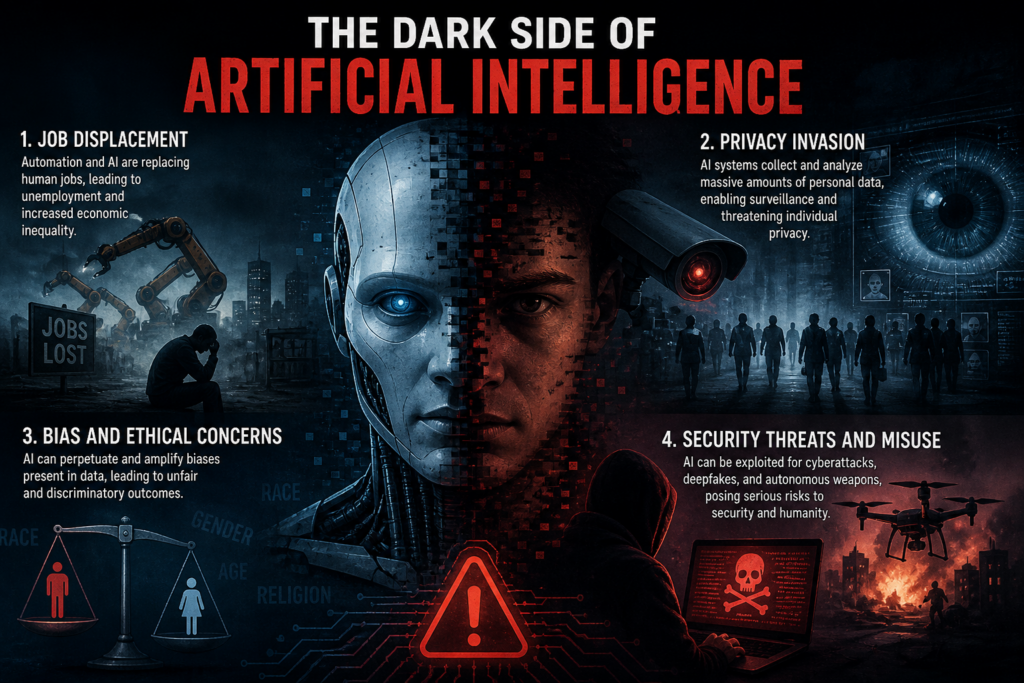
One of the most significant concerns surrounding AI is its impact on employment. Automation powered by AI is replacing repetitive and routine tasks across industries such as manufacturing, customer service, and even white-collar professions like accounting and legal research. While new jobs may emerge, the transition is often uneven and leaves many workers struggling to adapt.
This shift can widen the gap between skilled and unskilled workers. Those with expertise in AI and technology benefit greatly, while others may face unemployment or reduced wages. Developing countries, where labor-intensive jobs dominate, are particularly vulnerable. Without proper policies, AI could deepen economic inequality rather than reduce it.
2. Privacy Invasion and Surveillance
AI thrives on data, and the more data it has, the more powerful it becomes. However, this reliance on vast amounts of personal information raises serious privacy concerns. Governments and corporations can use AI to monitor individuals through facial recognition, online activity tracking, and predictive analytics.
In some cases, surveillance technologies are used to maintain public safety, but they can also be misused to control populations or suppress dissent. Individuals often have little knowledge or control over how their data is collected and used. This lack of transparency can lead to a world where privacy becomes a luxury rather than a basic right.
3. Bias and Ethical Concerns
AI systems are only as unbiased as the data they are trained on. If the data contains biases, the AI will likely replicate or even amplify them. This has been observed in areas such as hiring algorithms, loan approvals, and criminal justice systems.
For example, biased AI can lead to discrimination against certain groups based on race, gender, or socioeconomic status. These decisions can have long-lasting consequences, affecting people’s lives in profound ways. Moreover, ethical dilemmas arise when AI systems make decisions without clear accountability. Who is responsible when an AI system makes a harmful mistake—the developer, the company, or the machine itself?
4. Security Threats and Misuse
AI also introduces new security risks. Cybercriminals can use AI to create more sophisticated attacks, such as deepfakes, automated hacking, and phishing schemes that are harder to detect. Deepfake technology, in particular, poses a significant threat by enabling the creation of realistic but fake audio and video content.
Additionally, AI can be weaponized in warfare through autonomous drones and advanced surveillance systems. These technologies raise concerns about the lack of human control in critical decision-making processes, potentially leading to unintended consequences. The misuse of AI by malicious actors can destabilize societies and increase global tensions.
Conclusion
While Artificial Intelligence offers immense potential to improve lives and drive progress, its darker aspects cannot be ignored. Issues such as job displacement, privacy invasion, bias, and security threats highlight the need for responsible development and regulation. Governments, organizations, and individuals must work together to ensure that AI is used ethically and transparently. By addressing these challenges proactively, society can harness the benefits of AI while minimizing its risks, creating a future where technology serves humanity rather than harms it.