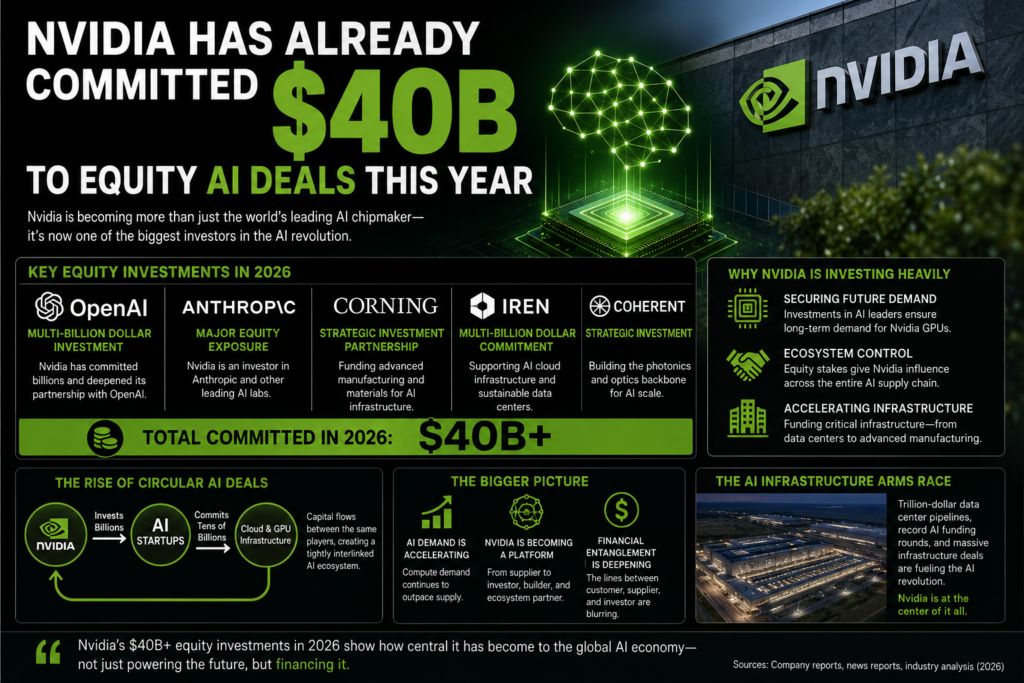
Nvidia is rapidly evolving from being just the world’s dominant AI chipmaker into one of the most aggressive investors in the AI ecosystem. In early 2026, the company has already committed more than $40 billion in equity-linked investments across AI startups and infrastructure players, marking one of the largest corporate venture pushes in tech history.
This strategy reflects a deeper shift in how the AI industry is being financed: not only through cloud contracts and chip sales, but also through cross-investments that tie together suppliers, customers, and platform builders.
A $40 Billion Bet on the AI Stack

According to industry reports, Nvidia’s equity commitments this year span a wide range of AI companies, including model developers, cloud infrastructure firms, and hardware ecosystem partners. Some of the largest known allocations include:
- A major stake and funding package linked to OpenAI
- Significant investment exposure in Anthropic and related AI labs
- Multi-billion-dollar commitments to infrastructure and manufacturing partners such as Corning, IREN, and Coherent
Altogether, these deals push Nvidia’s 2026 equity AI exposure past the $40 billion mark, making it one of the most concentrated corporate investment strategies in the AI boom so far.
Why Nvidia Is Investing So Heavily
Nvidia’s strategy is not traditional venture capital—it is tightly aligned with its core business.
1. Securing Future Demand for GPUs
By investing in AI companies that consume massive compute resources, Nvidia effectively strengthens long-term demand for its GPUs and data center chips.
2. Locking in Ecosystem Control
Equity stakes give Nvidia influence across the AI supply chain—from model training labs to cloud infrastructure providers.
3. Accelerating Infrastructure Buildout
Many investments are tied to physical expansion: data centers, fiber optics, and advanced manufacturing capacity needed for AI scaling.
Circular AI Economy Concerns
A growing theme in the industry is the rise of “circular AI deals,” where companies invest in each other while also committing to purchase each other’s services.
For example, in recent AI financing rounds:
- Nvidia has committed billions to AI startups
- Those startups, in turn, commit to spending tens of billions on cloud and GPU infrastructure
This creates a tightly interlinked ecosystem where capital flows in multiple directions between the same players, raising both optimism and caution among analysts.
The Bigger Picture: AI Infrastructure Arms Race
Nvidia’s $40B equity push is part of a much larger trend: the AI infrastructure arms race.
Across the industry:
- Cloud providers are expanding trillion-dollar data center pipelines
- AI startups are raising record-breaking private funding rounds
- Hardware firms are locking in long-term supply chains for chips, optics, and networking
Recent deals even show consortiums involving Nvidia, Microsoft, BlackRock, and others acquiring data center assets worth tens of billions to secure compute capacity for the AI future.
What This Means Going Forward
Nvidia’s aggressive investment strategy signals three key realities:
1. AI demand is still accelerating
The company is betting that compute demand will continue to outstrip supply for years.
2. Nvidia is becoming a platform, not just a supplier
Its role is expanding into capital allocator, ecosystem builder, and infrastructure partner.
3. Financial entanglement is deepening
The line between customer, supplier, and investor in AI is increasingly blurred.
Conclusion
Nvidia’s commitment of over $40 billion in equity AI deals this year shows how central the company has become to the global AI economy. It is no longer just selling the picks and shovels of the AI gold rush—it is actively financing the miners, owning stakes in the mining companies, and helping build the roads they travel on.
Whether this strategy becomes a long-term advantage or a source of systemic risk will depend on how the AI boom evolves—but for now, Nvidia is placing one of the largest bets in modern tech history.